Guttate psoriasis
Peer reviewed by Dr Hayley Willacy, FRCGP Last updated by Dr Laurence KnottLast updated 14 Dec 2021
Meets Patient’s editorial guidelines
- DownloadDownload
- Share
- Language
- Discussion
- Ask Patient
- Audio Version
- Add to preferred sources on Google
Medical Professionals
Professional Reference articles are designed for health professionals to use. They are written by UK doctors and based on research evidence, UK and European Guidelines. You may find the Guttate psoriasis article more useful, or one of our other health articles.
What is guttate psoriasis?
Guttate psoriasis is a distinctive acute skin condition characterised by small drop-like, salmon-pink papules which usually have a fine scale. This variant primarily occurs on the trunk and the proximal extremities but it may have a more generalised distribution. A history of an upper respiratory infection secondary to group A beta haemolytic streptococci often precedes the eruption by 2-3 weeks. Guttate psoriasis may be chronic and unrelated to streptococcal infection.
How common is guttate psoriasis? (Epidemiology)
It is more common in individuals younger than 30 years1 .
Genetic predisposition: guttate psoriasis has been linked with HLA-BW17, HLA-B13, HLA-CW62 3 .
It is most often associated with streptococcal infection - two thirds have evidence of a recent strep throat infection - but may also be associated with stress, trauma (Köbner's phenomenon) or drugs - eg, antimalarials, lithium, non-steroidal anti-inflammatory drugs, beta-blockers4 .
Guttate psoriasis symptoms
In most cases there is a history of an antecedent streptococcal infection, usually of the upper respiratory tract, such as pharyngitis or tonsillitis, 2-3 weeks prior to the eruption.
There may be a positive family history of psoriasis.
The onset of the skin lesions is often acute, with multiple papules erupting on the trunk and the proximal extremities.
Lesions may sometimes spread to involve the face, the ears and the scalp.
The palms and the soles are rarely affected.
The rash is often associated with mild itching.
Like other forms of psoriasis, guttate psoriasis tends to improve during the summer and worsen during the winter.
Examination of the skin reveals characteristic lesions consisting of multiple, discrete drop-like salmon-pink papules. A fine scale may be seen on established lesions.
Guttate psoriasis hands
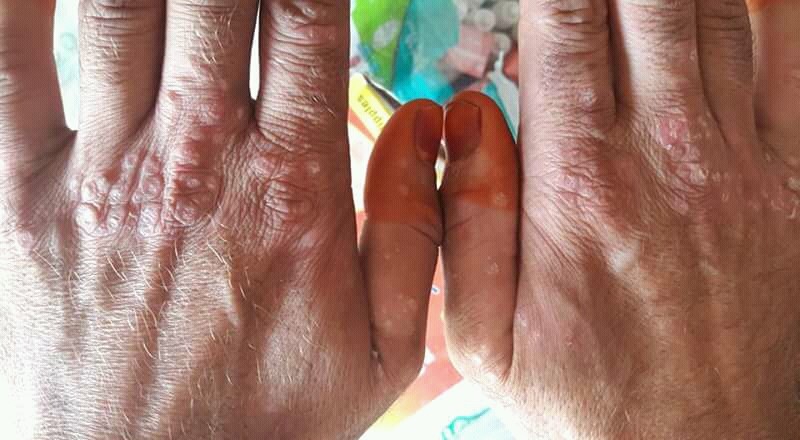
Nail changes characteristic of chronic psoriasis (eg, pits, ridges and the oil-drop sign) are usually absent.
Differential diagnosis
Viral exanthem.
Investigations
Diagnosis is clinical and biopsy is usually not required.
Dermoscopy may be useful in differentiating guttate psoriasis from chronic pityriasis lichenoides5 .
Serology: levels of antibodies to streptolysin O (ASO) may be elevated.
Cultures: bacterial culture of the throat or perianal area.
Treatment for guttate psoriasis6
Treatment of acute guttate psoriasis is not based on trial evidence; rather, it is guided by expert opinion.
Usually, the rash resolves within a few weeks to months without treatment for guttate psoriasis, so simple reassurance and emollients may therefore be sufficient.
Clearance of guttate lesions can be accelerated by judicious exposure to sunlight or by a short course of narrow-band ultraviolet B (UVB) phototherapy, so consider early referral in those who do not respond to topical treatment7 .
Topical treatment with a vitamin D preparation, topical corticosteroid, or coal tar preparation can be considered but may be difficult due to the extent, size and wide distribution of lesions.
Antibiotic treatment has often been given because of the association between guttate psoriasis and streptococcal infection. However a Cochrane review did not find convincing evidence of benefit and recommended further trials8 .
A prospective study reported that the use of tonsillectomy for patients with chronic guttate psoriasis may be beneficial9 .
Targeted therapy may result from research exploiting the role of the cytokine interleukin (IL)-17 in the pathogenesis of guttate and several other forms of psoriasis10 .
Guttate psoriasis complications
Complications are largely iatrogenic:
Steroid-induced cutaneous atrophy, telangiectasia, hypopigmentation.
PUVA side-effects - eg, nausea and vomiting, photosensitivity.
Prognosis
Guttate psoriasis often runs a self-limited course over several weeks to a few months with complete remission in about 60%. Other patients go on to develop chronic plaque-type psoriasis. Good prognosis is associated with younger age and high ASO titres, whilst poorer prognosis is associated with a family history of psoriasis11 .
Scarring is not a problem.
Previously affected areas may show post-inflammatory hypopigmentation or hyperpigmentation.
Recurrent episodes may occur, especially with pharyngeal carriage of streptococci.
Patient picks for Dermatology

Professional
Chronic plaque psoriasis
Synonyms: psoriasis vulgaris (chronic stationary type) Background Plaque psoriasis is a common, chronic, relapsing, inflammatory skin disorder with a strong genetic basis. Epidemiology Psoriasis: The assessment and management of psoriasis; NICE Clinical Guideline (October 2012 - last updated September 2017) 28767 : NICE CG153 Psoriasis: The.
by Dr Toni Hazell, FRCGP
Professional
Psoriasis of hands and feet
Synonyms: psoriasis palmoplantaris, psoriasis palmaris et plantaris Psoriasis predominantly affecting the palms and soles takes two forms: Erythematous scaly plaques typical of psoriasis elsewhere in the body. Palmoplantar pustulosis (PPP) is a chronic, recurrent skin disease belonging to the spectrum of psoriasis. ... Emerging TreatmentsAm J.
by Dr Colin Tidy, MRCGP

Professional
Erythroderma
Synonyms: psoriatic erythroderma, erythroderma psoriatica Background Shao S, Wang G, Maverakis E, et al; Targeted Treatment for Erythrodermic Psoriasis: Rationale and Recent Advances. Drugs. 2020 Apr;80(6):525-534. doi: 10.1007/s40265-020-01283-2. 65657 : Targeted Treatment for Erythrodermic Psoriasis: Rationale and Recent Advances. Erythroderma.
by Dr Colin Tidy, MRCGP
Professional
Generalised pustular psoriasis
Synonyms: acute generalised pustular psoriasis of von Zumbusch, pustular psoriasis von Zumbusch variant What is generalised pustular psoriasis. Pustular psoriasis defines a heterogeneous group of skin inflammatory diseases, which have in common the presence of aseptic pustules. Genetically distinct from psoriasis vulgaris, they have been shown to.
by Dr Colin Tidy, MRCGP

Medicine
Tazarotene for psoriasis
Apply a thin layer of tazarotene gel each evening before going to bed. Remember to wash your hands well after using the gel. This will help prevent accidentally getting it on other areas of your skin, which could cause irritation.
by Michael Stewart, MRPharmS

Medicine
Dithranol for psoriasis
Apply dithranol once a day only. Wash it off after it has been in contact with your skin for the required time. Remember to wash your hands well after using it. This will help to prevent accidentally getting it on other areas of your skin. Dithranol commonly produces a feeling of warmth on your skin. If burning or soreness occurs, this can mean that the strength is too high for you or that it has been left on for too long. Dithranol can stain your skin, hair and clothing.
by Michael Stewart, MRPharmS
Exclusive updates for healthcare professionals
Stay informed with the latest clinical updates, professional insights, and evidence-based guidance. The Patient Pro newsletter curates essential content for healthcare professionals—delivered straight to your inbox.
By subscribing you accept our Privacy Policy. You can unsubscribe at any time. We never sell your data.
Further reading and references
- The Psoriasis Association
- Guttate Psoriasis; DermIS (Dermatology Information System)
- Hwang YJ, Jung HJ, Kim MJ, et al; Serum levels of LL-37 and inflammatory cytokines in plaque and guttate psoriasis. Mediators Inflamm. 2014;2014:268257. doi: 10.1155/2014/268257. Epub 2014 Aug 14.
- Weigle N, McBane S; Psoriasis. Am Fam Physician. 2013 May 1;87(9):626-33.
- Umapathy S, Pawar A, Mitra R, et al; Hla-a and hla-B alleles associated in psoriasis patients from mumbai, Western India. Indian J Dermatol. 2011 Sep-Oct;56(5):497-500. doi: 10.4103/0019-5154.87128.
- Cafardi J; Guttate HLA-B13, The Manual of Dermatology, 2012.
- Nahary L, Tamarkin A, Kayam N, et al; An investigation of antistreptococcal antibody responses in guttate psoriasis. Arch Dermatol Res. 2008 Sep;300(8):441-9. Epub 2008 Jul 22.
- Errichetti E, Lacarrubba F, Micali G, et al; Differentiation of pityriasis lichenoides chronica from guttate psoriasis by dermoscopy. Clin Exp Dermatol. 2015 Oct;40(7):804-6. doi: 10.1111/ced.12580. Epub 2015 Feb 16.
- Cunliffe D; Guttate Psoriasis, Primary Care Dermatology Society
- Diagnosis and management of psoriasis and psoriatic arthritis in adults; Scottish Intercollegiate Guidelines Network - SIGN (October 2010)
- Dupire G, Droitcourt C, Hughes C, et al; Antistreptococcal interventions for guttate and chronic plaque psoriasis. Cochrane Database Syst Rev. 2019 Mar 5;3:CD011571. doi: 10.1002/14651858.CD011571.pub2.
- Harabuchi Y, Takahara M; Recent advances in the immunological understanding of association between tonsil and immunoglobulin A nephropathy as a tonsil-induced autoimmune/inflammatory syndrome. Immun Inflamm Dis. 2019 Jun;7(2):86-93. doi: 10.1002/iid3.248. Epub 2019 Apr 7.
- Lee E, Zarei M, LaSenna C, et al; Psoriasis Targeted Therapy: Characterization of Interleukin 17A Expression in Subtypes of Psoriasis. J Drugs Dermatol. 2015 Oct 1;14(10):1133-6.
- Ko HC, Jwa SW, Song M, et al; Clinical course of guttate psoriasis: long-term follow-up study. J Dermatol. 2010 Oct;37(10):894-9. doi: 10.1111/j.1346-8138.2010.00871.x.
About the authorView full bio
Updated by

Dr Laurence Knott
General Practitioner, Medical Author
BSc (Hons) Biochemistry, MBBS
Dr Laurence Knott qualified in 1973 and has had extensive experience as a General Practitioner.
About the reviewerView full bio

Dr Hayley Willacy, FRCGP
General Practitioner, Medical Author
MBChB (1992), DRCOG, DFFP, MRCOG (Part 1) MRCGP (2007), DFSRH (2013), MSc - medical education (2020)
Dr Hayley Willacy was an NHS GP working in northwest England, who retired from clinical practice in 2022 after 30 years.
Simple access to trusted treatments and health services online.
Common conditions
Get help with common conditions through the NHS, without a GP appointment.





More in dermatology
- Common childhood rashes
- Genital herpes in pregnancy
- Gout
- Herpes viruses
- Immune thrombocytopenia
- Juvenile plantar dermatosis
- Keratoacanthoma
- Klippel-Trénaunay syndrome
- Leg ulcers
- Lipodystrophy syndrome
- Lumps
- Lymphatic filariasis
- Pubic and body lice
- Spider naevus
- Systemic sclerosis
- Toe and finger clubbing
- Vasculitis
- Vitiligo
- Xanthelasma