
What is astigmatism
Peer reviewed by Dr Krishna Vakharia, MRCGPAuthored by Simon Berry, MCOptom Originally published 23 Feb 2024
Meets Patient’s editorial guidelines
- DownloadDownload
- Share
- Language
- Discussion
- Ask Patient
- Audio Version
- Add to preferred sources on Google
Astigmatism is a common condition which is usually easily corrected with glasses, contacts lenses or, sometimes, surgery. Here we look at what it means if you have the condition, and what you can do about it.
Video picks for Eye health Video library
What is astigmatism?
Astigmatism isn't as straightforward as being short-sighted or long-sighted, and as an eye specialist I regularly get patients worriedly asking me: “Have I got a stigma?” No - you do not have a stigma - but here I'll explain what astigmatism is?
Human eye schematic
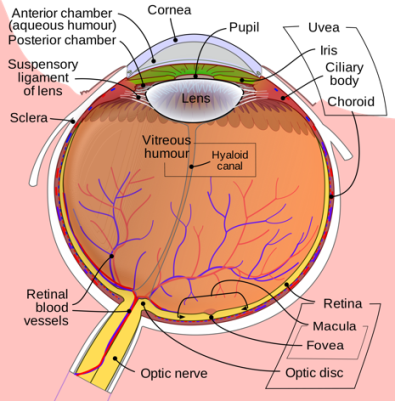
Our eyes have two optical lenses - the lens, which is inside the eye, and the clear front cover, the cornea - which gives us around two thirds of our optical power.
For most people, astigmatism only affects the cornea. It's rare to have astigmatism affecting the lens of your eye, and even rarer for it to affect the retina.
Astigmatism
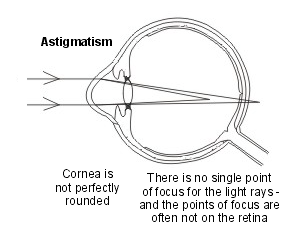
Astigmatism is when the surface of the cornea has two different shaped slopes, creating two different points of focus. Think of the curve of your eye as sports balls.
If you have a round, football or basketball shaped cornea - so all the rays of light entering the eye meet to a single point of focus - there is no astigmatism.
If the curve is different in two different directions, like a rugby ball or an American football, these two different slopes means light entering the eye has a different focus point for each curve - this is astigmatism.
These two different slopes mean that optically, light entering the eye has a different focus point for each curve. This creates a distortion in vision which is different to experience than being just short or long sighted.
How common is astigmatism?
You need to wear glasses when you have a refractive error - a type of vision problem that makes it hard to see clearly due to an issue in how your eyes focus light.
Astigmatism is the most common refractive error affecting around 4 in 10 people around the world.
If you have astigmatism you'll often be long- or short- sighted also, and many optical prescriptions have an astigmatic component to them.
As with other refractive errors, if the numbers are small and it is not causing any symptoms then your astigmatism does not need to be corrected. Your optometrist may not even mention you have an astigmatism if it is not causing any problems.
What are the symptoms of astigmatism?
The key symptoms of astigmatism include:
Blurred or distorted vision.
Glares or halos around lights.
Some people with astigmatism say they have difficulty driving at night but there are many more common things that can cause this symptom
Unlike being short- or near- sighted, how far or near the objects you are looking at does not make a difference - the symptoms are the same.
For example, if you are short sighted and looking at the London Eye, it will appear as a circular structure which is uniformly blurred.
If you have astigmatism, and you are looking at the London Eye, it will look slightly oval shaped and some parts will be more blurred than others.
How does my prescription let me know if I have astigmatism?
On your optical prescription there are generally three numbers. The second and the third number - the cyl and the axis - describe your astigmatism. If there is no second and third number then you do not have astigmatism. The cyl number stands for cylinder - this describes the shape of the optical lens that is needed to correct astigmatism. The higher this number, the more pronounced the astigmatism is, and the worse your vision will be.
The axis number describes the direction of the cylinder. If you think back to the rugby ball analogy - If you wanted to recreate the way it looks, you would need to describe both how sloped each curve is, and the direction of each slope. This is why you have two numbers.
How can I check if I have astigmatism?
Whilst you need to see an optometrist to get an accurate answer about whether and to what extent you have astigmatism - you could try this quick self-test:
Place your left hand over your left eye and from around 30cm (1ft) away look at a target above you.
Do any of the lines appear blacker or more in focus than the others?
If they do, you may have astigmatism in your left eye.
Repeat the process with your right hand over your right eye.
This test is not totally accurate but can give you an idea wether you have any astigmatism.
Does astigmatism get worse?
We are all born with astigmatism as our eyes, in particular our optics, are not fully developed. This corrects itself fairly quickly in the first few months of life using nature’s auto-correct program - emmetropisation.
Usually, all of your early astigmatism will have corrected itself by 6 months old. If a child over 1 year has significant astigmatism then it needs to be corrected to make sure the visual system develops normally.
Once we've finished growing, the cornea settles and astigmatism does not usually change much. There are some eye diseases that change the shape of the cornea and so will also change the astigmatism. The most common of these is keratoconus.
The cornea, and the astigmatism, can also change due to trauma or surgery. All of these conditions can be picked up in a detailed eye examination.
How is astigmatism corrected?
Astigmatism can generally be easily corrected with glasses, contact lenses or surgery.
Glasses will have a magnification effect that can be a little difficult to get used to. For the first few days it is quite common to feel a little sea sick when moving your head around - but this fades quickly.
Contact lenses can be more complicated. With soft contact lenses a toric lens, which is shaped to correct the astigmatism, is needed. It’s important this lens doesn't rotate too much on the eye, otherwise vision would not be stable.
If you feel your vision is getting worse, if you see halos around lights or your sight is blurred, see an optometrist at your opticians to have your eyes checked.
Patient picks for Eye health

Eye health
Astigmatism
Astigmatism is a common eye condition that affects the shape of the cornea or the lens of the eye. The cornea and lens are typically smooth and round in shape, but in people with astigmatism, they are irregularly shaped. The main symptom of astigmatism is blurred vision. It occurs because the cornea at the front of the eye is unevenly curved. Vision problems, such as astigmatism, are also known as refractive errors. Astigmatism is a common condition that can be corrected by glasses or contact lenses, or cured with laser eye surgery.
by Dr Doug McKechnie, MRCGP

General health and lifestyle
Ideas, Concerns and Expectations - a guide to filling in your GP’s online form
Booking a GP appointment has changed. Instead of waiting on the phone line at 8am, many people now complete an online consultation form through their practice website. At first glance, it may feel like another bureaucratic hurdle. But in fact, these forms are designed to help you, and your GP team, get to the heart of your problem more quickly. The way you fill them in makes a real difference. When you provide clear, thoughtful information, it not only helps the practice decide whether something is urgent, but also ensures you are directed to the right person in the wider primary care team. That might be your GP - but it could just as easily be a nurse, a pharmacist, a physiotherapist, or another professional who can meet your needs sooner. One of the simplest tools to guide you is known as Ideas, Concerns and Expectations, or ICE.
by Thomas Andrew Porteus, MBCS

Health research
What is a clinical trial?
We need clinical trials to understand how new treatments work on people. If successful, they may eventually be used in the real world by those who need them for a better quality of life. Find out all about how clinical trials work, along with personal insights from Alice - who has participated in around 50 trials over his life.
by Amberley Davis

Bones, joints and muscles
What is hypermobility syndrome?
Having supple joints with a wide range of motion allows the body to move freely, and for some people - gymnasts, athletes and dancers, for example - this can be an advantage. But being super flexible can have its drawbacks, too. When you're hypermobile, your joints move easily beyond the normal range. Over time, this can cause pain and in the very worst cases, dislocation or long-term damage to the joint. It can also be linked to a range of issues in other parts of the body.
by Allie Anderson

General health and lifestyle
What is weather change sickness?
If you've ever felt under the weather when the seasons change - or when temperatures have significantly soared or plummeted - then you're not alone. Weather change sickness describes the effects of dramatic changes in weather on our physical health. While these changes alone can't directly make us ill, they are linked to several factors that can make us feel run-down at different points of the year.
by Lynn Stephen

Podcasts
The Big O... Oh No!
Clare and Janet discuss orgasms - and what can help if it isn’t happening for you or your partner. Also the myths surrounding female orgasm. Do you really know what the clitoris looks like?!
by Thomas Andrew Porteus, MBCS
About the authorView full bio
Authored by

Simon Berry, MCOptom
Optometrist
BSc (hons) MCOptom
Simon Berry is an Optometrist from Durham.
About the reviewerView full bio

Dr Krishna Vakharia, MRCGP
Chief Medical Officer for Health, Optum UK
MBChB, MRCGP(2013), BMedSci (hons), DFSRH, DRCOG, PGDipDerm (Distn)
Dr Krishna Vakharia is an NHS GP. She is also a regular examiner for the postgraduate Diploma in Practical Dermatology at Cardiff University as well as being the Chief Medical Officer for health at Optum UK.
Article history
Article also available in English, German, Spanish, French, Italian, Portuguese, Hindi, Hebrew, Arabic, and Swedish.
23 Feb 2024 | Originally published
Authored by:
Simon Berry, MCOptomPeer reviewed by
Dr Krishna Vakharia, MRCGP
Share your thoughts or experiences with others in our patient communities.
Sign up to the Patient newsletter
Your weekly dose of clear, trustworthy health advice - written to help you feel informed, confident and in control.
By subscribing you accept our Privacy Policy. You can unsubscribe at any time. We never sell your data.