COL4A1-related brain small-vessel disease
Last updated 18 Aug 2020
Meets Patient’s editorial guidelines
- DownloadDownload
- Share
- Language
- Discussion
- Ask Patient
- Audio Version
- Add to preferred sources on Google
COL4A1-related brain small-vessel disease is part of a group of conditions called the COL4A1-related disorders. The conditions in this group have a range of signs and symptoms that involve fragile blood vessels. COL4A1-related brain small-vessel disease is characterised by weakening of the blood vessels in the brain. Stroke is often the first symptom of this condition, typically occurring in mid-adulthood. In affected individuals, stroke is usually caused by bleeding in the brain (hemorrhagic stroke) rather than a lack of blood flow in the brain (ischemic stroke), although either type can occur. Individuals with this condition are at increased risk of having more than one stroke in their lifetime. People with COL4A1-related brain small vessel disease also have leukoencephalopathy, which is a change in a type of brain tissue called white matter that can be seen with magnetic resonance imaging (MRI). Affected individuals may also experience seizures and migraine headaches accompanied by visual sensations known as auras.
Video picks for Genetic conditionsVideo library
Description
COL4A1-related brain small-vessel disease is part of a group of conditions called the COL4A1-related disorders. The conditions in this group have a range of signs and symptoms that involve fragile blood vessels. COL4A1-related brain small-vessel disease is characterised by weakening of the blood vessels in the brain. Stroke is often the first symptom of this condition, typically occurring in mid-adulthood. In affected individuals, stroke is usually caused by bleeding in the brain (hemorrhagic stroke) rather than a lack of blood flow in the brain (ischemic stroke), although either type can occur. Individuals with this condition are at increased risk of having more than one stroke in their lifetime. People with COL4A1-related brain small vessel disease also have leukoencephalopathy, which is a change in a type of brain tissue called white matter that can be seen with magnetic resonance imaging (MRI). Affected individuals may also experience seizures and migraine headaches accompanied by visual sensations known as auras.
Some people with COL4A1-related brain small-vessel disease have an eye abnormality called Axenfeld-Rieger anomaly. Axenfeld-Rieger anomaly involves underdevelopment and eventual tearing of the colored part of the eye (iris) and a pupil that is not in the center of the eye. Other eye problems experienced by people with COL4A1-related brain small-vessel disease include clouding of the lens of the eye (cataract) and the presence of arteries that twist and turn abnormally within the light-sensitive tissue at the back of the eye (arterial retinal tortuosity). Axenfeld-Rieger anomaly and cataract can cause impaired vision. Arterial retinal tortuosity can cause episodes of bleeding within the eye following any minor trauma to the eye, leading to temporary vision loss.
The severity of the condition varies greatly among affected individuals. Some individuals with COL4A1-related brain small-vessel disease do not have any signs or symptoms of the condition.
Inheritance patterns
The source lists the following possible inheritance patterns: Autosomal dominant. More than one pattern can apply in different cases.
Related genes
Other names
Brain small-vessel disease with hemorrhage
Patient picks for Genetic conditions
Heart health and blood vessels
Coarctation of the aorta
Coarctation of the aorta is a type of congenital heart disease where there is a narrowing in part of the aorta, the main artery that leaves the left side of the heart.
by Dr Toni Hazell, FRCGP

Heart health and blood vessels
Anatomy of the heart and blood vessels
The heart is a muscular pump that pushes blood through blood vessels around the body. The heart beats continuously, pumping the equivalent of more than 14,000 litres of blood every day through five main types of blood vessels: arteries, arterioles, capillaries, venules and veins.
by Dr Oliver Starr, MRCGP

Diet and nutrition
How gut bacteria affect mood, focus and brain health
There is emerging scientific evidence that the gut microbiome can influence brain health - from mood and focus to neurological diseases such as multiple sclerosis and Parkinson's. We ask the experts about this link and how best to look after the gut bacteria to support brain health.
by Sally Turner
Heart health and blood vessels
Raynaud's phenomenon
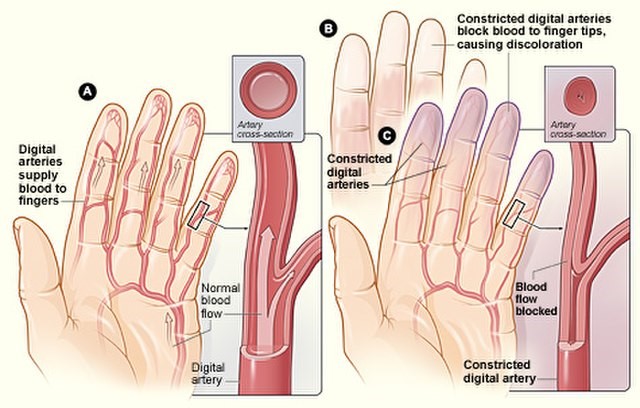
Raynaud's phenomenon (often just called Raynaud's), is a condition where the small blood vessels of the fingers become narrow (constrict). This happens most often when they are in a cool environment. Blood vessels to other extremities such as the toes, ears and nose may also be affected. It is named after Dr Maurice Raynaud, the man who first described it in 1862.
by Dr Hayley Willacy, FRCGP
Heart health and blood vessels
Buerger's disease
Buerger's disease causes inflammation of blood vessels in the legs and arms, particularly in the hands and feet. It leads to narrowing and blockage of the blood vessels so that blood flow to the hands and feet is reduced. This causes pain and other symptoms. It may eventually lead to damage and death of the tissues in the hands and/or feet. The exact cause is not known. It mainly affects smokers but occasionally occurs in non-smokers. The single most important thing that you can do if you are diagnosed with Buerger's disease is to stop smoking. This can help to stop the disease from becoming worse and reduces your chance of needing surgical removal (amputation) of a finger, a toe, or worse.
by Dr Laurence Knott

Cancer
Brain tumours
This leaflet aims to give a brief overview of the various types of brain tumours. The treatment and survival rates vary greatly, depending on factors such as the type of tumour and the location in the brain.
by Dr Toni Hazell, FRCGP
Related patient information and medicines

Patient information leaflet
Coeliac disease
Coeliac disease (also spelled celiac disease) mainly affects the part of the gut called the small intestine. Coeliac disease is caused by a reaction of the gut to gluten. Gluten-related neurological conditions Some rare conditions of the brain and nervous system are slightly more common in people with coeliac disease, such as the following: Gluten.
Patient information leaflet
Coarctation of the aorta
Coarctation of the aorta is a type of congenital heart disease where there is a narrowing in part of the aorta, the main artery that leaves the left side of the heart. Normal heart detail Cross-section diagram of a normal heart PatientPicksPlaceholder Heart - lung circulation heart - lung circulation What is coarctation of the ... Infective.
Patient information leaflet
Sickle cell disease
Sickle cell disease (SCD) is a serious, inherited condition affecting the blood and various organs in the body. It affects the red blood cells, causing episodes of 'sickling', which produce episodes of pain and other symptoms. In between episodes of sickling, people with SCD are normally well. Long-term complications can occur. Good treatment,.

Patient information leaflet
Polycystic kidney disease
Polycystic kidney disease (PKD) causes many fluid-filled sacs (cysts) to develop in the kidneys. The most common type of PKD is an inherited condition called autosomal dominant polycystic kidney disease (ADPKD). With ADPKD, problems commonly do not develop until the age of 30-50, with some people never developing any problems. The two common.
Patient information leaflet
Raynaud's phenomenon
Raynaud's phenomenon (often just called Raynaud's), is a condition where the small blood vessels of the fingers become narrow (constrict). This happens most often when they are in a cool environment. Blood vessels to other extremities such as the toes, ears and nose may also be affected. It is named after Dr Maurice Raynaud, the man who first.
Patient information leaflet
Buerger's disease
Buerger's disease causes inflammation of blood vessels in the legs and arms, particularly in the hands and feet. It leads to narrowing and blockage of the blood vessels so that blood flow to the hands and feet is reduced. What is Buerger's disease. Buerger's disease is a condition that causes inflammation of the small- and medium-sized blood.
Further reading and references
- COL4A1-related brain small-vessel disease; MedlinePlus, National Library of Medicine.
- Lanfranconi S, Markus HS. COL4A1 mutations as a monogenic cause of cerebral small vessel disease: a systematic review. Stroke. 2010 Aug;41(8):e513-8. doi: 10.1161/STROKEAHA.110.581918. Epub 2010 Jun 17.
- Sibon I, Coupry I, Menegon P, Bouchet JP, Gorry P, Burgelin I, Calvas P, Orignac I, Dousset V, Lacombe D, Orgogozo JM, Arveiler B, Goizet C. COL4A1 mutation in Axenfeld-Rieger anomaly with leukoencephalopathy and stroke. Ann Neurol. 2007 Aug;62(2):177-84. doi: 10.1002/ana.21191.
- Vahedi K, Alamowitch S. Clinical spectrum of type IV collagen (COL4A1) mutations: a novel genetic multisystem disease. Curr Opin Neurol. 2011 Feb;24(1):63-8. doi: 10.1097/WCO.0b013e32834232c6.
- Volonghi I, Pezzini A, Del Zotto E, Giossi A, Costa P, Ferrari D, Padovani A. Role of COL4A1 in basement-membrane integrity and cerebral small-vessel disease. The COL4A1 stroke syndrome. Curr Med Chem. 2010;17(13):1317-24. doi: 10.2174/092986710790936293.
Share your thoughts or experiences with others in our patient communities.
Simple access to trusted treatments and health services online.
Common conditions
Get help with common conditions through the NHS, without a GP appointment.





Sign up to the Patient newsletter
Your weekly dose of clear, trustworthy health advice - written to help you feel informed, confident and in control.
By subscribing you accept our Privacy Policy. You can unsubscribe at any time. We never sell your data.