Supravalvular aortic stenosis
Last updated 24 Feb 2022
Meets Patient’s editorial guidelines
- DownloadDownload
- Share
- Language
- Discussion
- Ask Patient
- Audio Version
- Add to preferred sources on Google
Supravalvular aortic stenosis (SVAS) is a heart defect that develops before birth. This defect is a narrowing (stenosis) of the large blood vessel that carries blood from the heart to the rest of the body (the aorta). The condition is described as supravalvular because the section of the aorta that is narrowed is located just above the valve that connects the aorta with the heart (the aortic valve). Some people with SVAS also have defects in other blood vessels, most commonly stenosis of the artery from the heart to the lungs (the pulmonary artery). An abnormal heart sound during a heartbeat (heart murmur) can often be heard during a chest exam. If SVAS is not treated, the aortic narrowing can lead to shortness of breath, chest pain, and ultimately heart failure.
Video picks for Genetic conditionsVideo library
Description
Supravalvular aortic stenosis (SVAS) is a heart defect that develops before birth. This defect is a narrowing (stenosis) of the large blood vessel that carries blood from the heart to the rest of the body (the aorta). The condition is described as supravalvular because the section of the aorta that is narrowed is located just above the valve that connects the aorta with the heart (the aortic valve). Some people with SVAS also have defects in other blood vessels, most commonly stenosis of the artery from the heart to the lungs (the pulmonary artery). An abnormal heart sound during a heartbeat (heart murmur) can often be heard during a chest exam. If SVAS is not treated, the aortic narrowing can lead to shortness of breath, chest pain, and ultimately heart failure.
The severity of SVAS varies considerably, even among family members. Some affected individuals die in infancy, while others never experience symptoms of the disorder.
Inheritance patterns
The source lists the following possible inheritance patterns: Autosomal dominant. More than one pattern can apply in different cases.
Related genes
Other names
Aortic stenosis, supravalvular
Stenosis, aortic supravalvular
Stenosis, supravalvular aortic
Supravalvar aortic stenosis
Supravalvular stenosis, aortic
SVAS
Patient picks for Genetic conditions
Heart health and blood vessels
Aortic stenosis
The aortic valve is a heart valve that lies between the left ventricle and the aorta. In aortic stenosis, when the aortic valve opens to let blood pump through, it does not open as widely as it would normally. The opening between the left ventricle and the aorta is therefore narrowed (stenosed). The amount of blood that can pass from the left ventricle to the aorta is therefore reduced. The more narrowed the valve, the smaller the amount of blood that can get through, and the more significant the symptoms. In some cases, aortic stenosis occurs at the same time as aortic regurgitation.
by Dr Philippa Vincent, MRCGP
Heart health and blood vessels
Aortic regurgitation
Aortic regurgitation is sometimes called aortic incompetence or a leaky aortic valve. In aortic regurgitation the valve does not close properly. The aortic valve is a heart valve that lies between the left ventricle and the aorta. Therefore, blood leaks back (regurgitates) into the left ventricle from the aorta. In some cases, aortic regurgitation occurs at the same time as aortic stenosis. Read more about aortic stenosis.
by Dr Colin Tidy, MRCGP
Heart health and blood vessels
Aortic dissection
An aortic dissection is a rare, serious condition. The inner layer of the aorta (the biggest blood vessel in the body, coming directly from the heart) tears. Blood then surges through the tear. This causes the inner and middle layers of the aorta to separate (dissect). Aortic dissection is a medical emergency and needs urgent treatment. The treatment for aortic dissection includes an operation to repair the wall of the aorta. Medicines to reduce blood pressure are also used. Aortic dissection is often fatal but early diagnosis and treatment of aortic dissection can greatly improve survival.
by Dr Colin Tidy, MRCGP
Heart health and blood vessels
Mitral stenosis
Mitral stenosis means that when the mitral valve opens, it does not open fully. The opening is therefore narrower than normal (stenosed).
by Dr Colin Tidy, MRCGP
Heart health and blood vessels
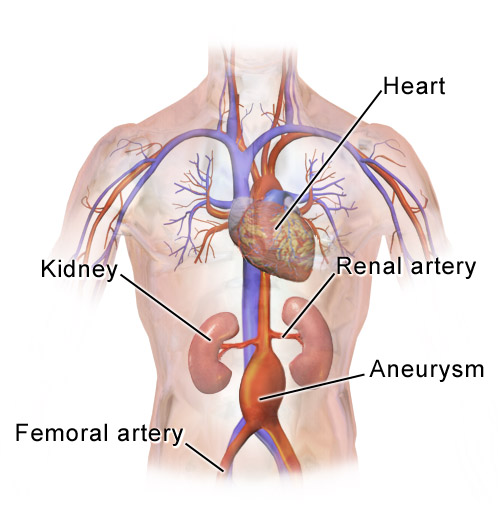
Abdominal aortic aneurysm
The aorta is the main blood vessel in the abdomen, running down from your heart. It is normally about the diameter of a garden hose. In older people, particularly those who smoke, part of it can enlarge and balloon up. This is called an abdominal aortic aneurysm (often abbreviated to AAA, pronounced 'triple-A'). This doesn't cause any symptoms and the person is usually unaware they have it, until it leaks or bursts. The medical term for this is rupture. If the aneurysm ruptures, it can be fatal. In the UK there is a screening programme for men over the age of 65, to see if they have a triple-A. An operation to repair the aneurysm may be advised if it is larger than 5.5 cm, as above this size the risk of rupture increases significantly.
by Dr Doug McKechnie, MRCGP
Bones, joints and muscles
Spinal stenosis
Spinal stenosis is a term used to describe a narrowing of your spinal canal. The narrowing may not cause any symptoms. However, the narrowing may progress to cause squeezing (compression) of your spinal nerves or compression of your spine. Spinal stenosis causes back pain and leg pain. Most often it occurs when you walk. Weakness of the legs may make you feel unsteady. This may affect both legs or just one leg. Spinal stenosis affecting the cervical spine in your neck may also cause pain and weakness in the shoulders and arms. Spinal stenosis can often be treated by simple measures such as medicines for pain relief, keeping as active as you can and losing weight if you are overweight. Sometimes steroid injections or surgery are suggested if simple measures are not successful.
by Dr Rosalyn Adleman, MRCGP
Related patient information and medicines
Patient information leaflet
Aortic stenosis
The aortic valve is a heart valve that lies between the left ventricle and the aorta. In aortic stenosis, when the aortic valve opens to let blood pump through, it does not open as widely as it would normally. The opening between the... What is aortic stenosis. Aortic stenosis is a narrowing of the aortic valve which is the valve between the left.
Patient information leaflet
Aortic regurgitation
Aortic regurgitation is sometimes called aortic incompetence or a leaky aortic valve. In aortic regurgitation the valve does not close properly. The aortic valve is a heart valve that lies between the left ventricle and the aorta. Therefore, blood leaks back (regurgitates) into the left ventricle from the aorta. In some cases, aortic regurgitation.

Patient information leaflet
Congenital heart disease
Congenital heart disease is a condition where an abnormality (defect) develops in the heart before birth. There are a number of types of congenital heart defect. Some are mild and cause few problems; others are life-threatening for the baby. Abnormalities or defects of the heart which develop before birth are together (collectively) called.
Patient information leaflet
Heart valve disease
Heart valves sit in between the chambers of the heart and control the blood flow through the heart. There are four common types of heart valve problem - mitral stenosis, mitral regurgitation , aortic stenosis and aortic regurgitation. The leaflet called Anatomy of the heart includes details about the function of the heart and how the heart beats. .
Patient information leaflet
Aortic dissection
An aortic dissection is a rare, serious condition. The inner layer of the aorta (the biggest blood vessel in the body, coming directly from the heart) tears. A severe injury to the chest may also cause aortic dissection. Aortic stenosis Aortic stenosis , previous cardiac surgery, having a history of aortic diseases in your family and smoking can.
Patient information leaflet
Can I take Amlodipine and Quetiapine together?
Severe liver disease Amlodipine is broken down very slowly by the liver; if you have liver problems, the dose must be adjusted carefully to avoid toxic build-up... Severe heart disease (Aortic Stenosis) Amlodipine should be used with extreme caution if you have narrowing of the aortic heart valve (aortic stenosis), as it can cause a dangerous drop.
Further reading and references
- Supravalvular aortic stenosis; MedlinePlus, National Library of Medicine.
- Metcalfe K, Rucka AK, Smoot L, Hofstadler G, Tuzler G, McKeown P, Siu V, Rauch A, Dean J, Dennis N, Ellis I, Reardon W, Cytrynbaum C, Osborne L, Yates JR, Read AP, Donnai D, Tassabehji M. Elastin: mutational spectrum in supravalvular aortic stenosis. Eur J Hum Genet. 2000 Dec;8(12):955-63. doi: 10.1038/sj.ejhg.5200564.
- Micale L, Turturo MG, Fusco C, Augello B, Jurado LA, Izzi C, Digilio MC, Milani D, Lapi E, Zelante L, Merla G. Identification and characterization of seven novel mutations of elastin gene in a cohort of patients affected by supravalvular aortic stenosis. Eur J Hum Genet. 2010 Mar;18(3):317-23. doi: 10.1038/ejhg.2009.181. Epub 2009 Oct 21.
- Rodriguez-Revenga L, Badenas C, Carrio A, Mila M. Elastin mutation screening in a group of patients affected by vascular abnormalities. Pediatr Cardiol. 2005 Nov-Dec;26(6):827-31. doi: 10.1007/s00246-005-0885-8.
- Tassabehji M, Urban Z. Congenital heart disease: Molecular diagnostics of supravalvular aortic stenosis. Methods Mol Med. 2006;126:129-56. doi: 10.1385/1-59745-088-X:129.
- Urban Z, Riazi S, Seidl TL, Katahira J, Smoot LB, Chitayat D, Boyd CD, Hinek A. Connection between elastin haploinsufficiency and increased cell proliferation in patients with supravalvular aortic stenosis and Williams-Beuren syndrome. Am J Hum Genet. 2002 Jul;71(1):30-44. doi: 10.1086/341035. Epub 2002 May 6.
Share your thoughts or experiences with others in our patient communities.
Simple access to trusted treatments and health services online.
Common conditions
Get help with common conditions through the NHS, without a GP appointment.





Sign up to the Patient newsletter
Your weekly dose of clear, trustworthy health advice - written to help you feel informed, confident and in control.
By subscribing you accept our Privacy Policy. You can unsubscribe at any time. We never sell your data.