VACTERL association
Last updated 29 May 2025
Meets Patient’s editorial guidelines
- DownloadDownload
- Share
- Language
- Discussion
- Ask Patient
- Audio Version
- Add to preferred sources on Google
VACTERL association is a disorder that affects many body systems. VACTERL stands for vertebral defects, anal atresia, cardiac defects, tracheo-esophageal fistula, renal anomalies, and limb abnormalities. People diagnosed with VACTERL association typically have at least three of these characteristic features. Affected individuals may have additional abnormalities that are not among the characteristic features of VACTERL association.
Video picks for Genetic conditionsVideo library
Description
VACTERL association is a disorder that affects many body systems. VACTERL stands for vertebral defects, anal atresia, cardiac defects, tracheo-esophageal fistula, renal anomalies, and limb abnormalities. People diagnosed with VACTERL association typically have at least three of these characteristic features. Affected individuals may have additional abnormalities that are not among the characteristic features of VACTERL association.
Defects in the bones of the spine (vertebrae) are present in 60 to 80 percent of people with VACTERL association. These defects may include misshapen vertebrae, fused vertebrae, and missing or extra vertebrae. In some people, spinal problems require surgery or cause health problems, such as back pain of varying severity, throughout life. Sixty to 90 percent of individuals with VACTERL association have narrowing or blockage of the anus (anal atresia). Anal atresia may be accompanied by abnormalities of the genitalia and urinary tract (genitourinary anomalies). Heart (cardiac) defects occur in 40 to 80 percent of individuals with VACTERL association. Cardiac defects can range in severity from a life-threatening problem to a subtle defect that does not cause health problems. Fifty to 80 percent of people with VACTERL association have a tracheo-esophageal fistula, which is an abnormal connection (fistula) between the esophagus and the windpipe (trachea). Tracheo-esophageal fistula can cause problems with breathing and feeding early in life and typically requires surgical correction in infancy. Kidney (renal) anomalies occur in 50 to 80 percent of individuals with VACTERL association. Affected individuals may be missing one or both kidneys or have abnormally developed or misshapen kidneys, which can affect kidney function. Limb abnormalities are seen in 40 to 50 percent of people with VACTERL association. These abnormalities most commonly include poorly developed or missing thumbs or underdeveloped forearms and hands.
Some of the features of VACTERL association can be subtle and are not identified until late in childhood or adulthood, making diagnosis of this condition difficult.
Inheritance patterns
The source lists the following possible inheritance patterns: Pattern unknown. More than one pattern can apply in different cases.
Other names
VATER association
Related patient information and medicines
Patient information leaflet
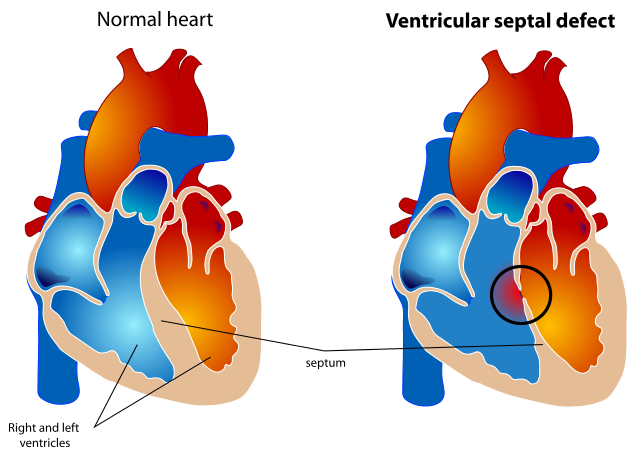
Ventricular septal defect
Ventricular septal defect (VSD) is a gap or defect in the septum between the heart's two lower chambers (ventricles). The septum is a wall that separates the heart's right and left side of the heart. Septal defects are sometimes called a 'hole' in the heart. It is the most common heart problem that babies are born with. Many defects in the.

Patient information leaflet
Down's syndrome
Down's syndrome (also known as Down syndrome) is a genetic chromosome problem. A number of advice and support groups are available for people with Down's syndrome and their families and carers, such as the Down's Syndrome Association (see Further Reading below for link to website). However, you should never feel that you ... Great support and.

Patient information leaflet
Bowel cancer screening
Bowel (colorectal) cancer is common. The outlook (prognosis) and chance of cu... A screening programme operates in the UK for certain age groups. The tests may include regular colonoscopy or some specialised scans. If you have a disease or family history that causes an increased risk of developing bowel cancer, your doctor will advise on the type.
Patient information leaflet
Miscarriage and bleeding in early pregnancy
Grie... Loss. Anger. These feelings are common. It is best not to bottle up feelings but to discuss them as fully as possible with partner, friends, a healthcare professional or anyone else who can listen and understand. As time goes on, the sense of loss usually becomes less. However, the time this takes varies greatly. Pangs of grief sometimes.

Patient information leaflet
Getting help for domestic violence
Being a victim of domestic violence can have a huge effect on your confidence and self esteem. There are many organisations that help people experiencing domestic violence Domestic violence and abuse. MARAC stands for Multi-Agency Risk Assessment Conference. It is a group of people who represent all the organisations who help those who experience.

Patient information leaflet
Varicocele
Find out more: [https://patient.info/health/scrotal-lumps-pain-and-swelling/varicocele](https://patient.info/health/scrotal-lumps-pain-and-swelling/varicocele) Follow Patient: Website: [https://patient.info/](https://patient.info/) Facebook: [. The European Association of Urology recommends that varicocele treatment should be offered if: The.
Further reading and references
- VACTERL association; MedlinePlus, National Library of Medicine.
- Garcia-Barcelo MM, Wong KK, Lui VC, Yuan ZW, So MT, Ngan ES, Miao XP, Chung PH, Khong PL, Tam PK. Identification of a HOXD13 mutation in a VACTERL patient. Am J Med Genet A. 2008 Dec 15;146A(24):3181-5. doi: 10.1002/ajmg.a.32426.
- Raam MS, Pineda-Alvarez DE, Hadley DW, Solomon BD. Long-term outcomes of adults with features of VACTERL association. Eur J Med Genet. 2011 Jan-Feb;54(1):34-41. doi: 10.1016/j.ejmg.2010.09.007. Epub 2010 Oct 1.
- Solomon BD, Pineda-Alvarez DE, Raam MS, Bous SM, Keaton AA, Velez JI, Cummings DA. Analysis of component findings in 79 patients diagnosed with VACTERL association. Am J Med Genet A. 2010 Sep;152A(9):2236-44. doi: 10.1002/ajmg.a.33572.
- Solomon BD, Pineda-Alvarez DE, Raam MS, Cummings DA. Evidence for inheritance in patients with VACTERL association. Hum Genet. 2010 Jun;127(6):731-3. doi: 10.1007/s00439-010-0814-7. Epub 2010 Apr 6.
- Solomon BD. VACTERL/VATER Association. Orphanet J Rare Dis. 2011 Aug 16;6:56. doi: 10.1186/1750-1172-6-56.
Share your thoughts or experiences with others in our patient communities.
Simple access to trusted treatments and health services online.
Common conditions
Get help with common conditions through the NHS, without a GP appointment.





Sign up to the Patient newsletter
Your weekly dose of clear, trustworthy health advice - written to help you feel informed, confident and in control.
By subscribing you accept our Privacy Policy. You can unsubscribe at any time. We never sell your data.