Vibratory urticaria
Last updated 18 Aug 2020
Meets Patient’s editorial guidelines
- DownloadDownload
- Share
- Language
- Discussion
- Ask Patient
- Audio Version
- Add to preferred sources on Google
Vibratory urticaria is a condition in which exposing the skin to vibration, repetitive stretching, or friction results in allergy symptoms such as hives (urticaria), swelling (angioedema), redness (erythema), and itching (pruritus) in the affected area. The reaction can be brought on by towel drying, hand clapping, running, a bumpy ride in a vehicle, or other repetitive stimulation. Headaches, fatigue, faintness, blurry vision, a metallic taste in the mouth, facial flushing, and more widespread swelling (especially of the face) can also occur during these episodes, especially if the stimulation is extreme or prolonged. The reaction occurs within a few minutes of the stimulation and generally lasts up to an hour. Affected individuals can have several episodes per day.
Video picks for Genetic conditionsVideo library
Description
Vibratory urticaria is a condition in which exposing the skin to vibration, repetitive stretching, or friction results in allergy symptoms such as hives (urticaria), swelling (angioedema), redness (erythema), and itching (pruritus) in the affected area. The reaction can be brought on by towel drying, hand clapping, running, a bumpy ride in a vehicle, or other repetitive stimulation. Headaches, fatigue, faintness, blurry vision, a metallic taste in the mouth, facial flushing, and more widespread swelling (especially of the face) can also occur during these episodes, especially if the stimulation is extreme or prolonged. The reaction occurs within a few minutes of the stimulation and generally lasts up to an hour. Affected individuals can have several episodes per day.
Inheritance patterns
The source lists the following possible inheritance patterns: Autosomal dominant. More than one pattern can apply in different cases.
Related genes
Other names
DDU
Dermodistortive urticaria
VBU
Vibratory angioedema
Patient picks for Genetic conditions
Skin, nail and hair health
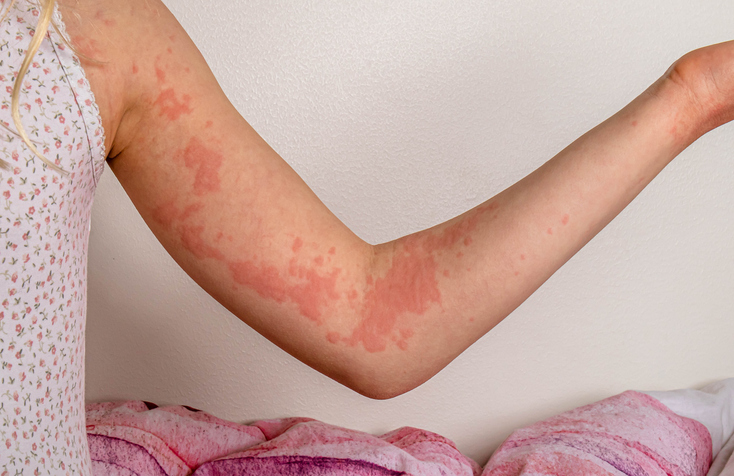
Hives
Hives (also called urticaria) are itchy red or white bumps on the skin that look like a nettle rash. Hives are common and are often caused by an allergic reaction, stress, infections, or certain medications. Most hives get better on their own within a few days. This leaflet discusses the causes, types, and treatment for hives.
by Dr Philippa Vincent, MRCGP
Allergies, blood and immune system
Aquagenic urticaria: living with an allergy to water
Imagine that getting caught in a rain shower feels like falling into a stinging nettle bush, or not being able to cry without burning your cheeks. For people with water allergy, this is reality. So how is it possible to live with such an unusual condition?
by Amberley Davis

Patient explainers
What are hives? | Patient Explainers
Hives are itchy red or white bumps on the skin. This itchy rash is also known as urticaria, or as nettle rash. In some cases this itchy rash is triggered by a physical stimulus. If this is the case, the condition is called inducible urticaria or physical urticaria. Examples of physical factors which can trigger hives include pressure, friction, sweating, cold, heat, sunlight and water. Treatments include avoiding the trigger (where possible), and antihistamines. Urticaria can be called acute (short-lived episode) or chronic (persisting). Find out more: [https://patient.info/health/hives-inducible-urticaria](https://patient.info/health/hives-inducible-urticaria) Follow Patient: Website: [https://patient.info/](https://patient.info/) Facebook: [https://www.facebook.com/patient](https://www.facebook.com/patient) Twitter: [https://twitter.com/patient](https://twitter.com/patient) Pinterest: [https://uk.pinterest.com/patient/](https://uk.pinterest.com/patient/) Instagram: [https://www.instagram.com/patient.info/](https://www.instagram.com/patient.info/)
by Dr Sarah Jarvis
Related patient information and medicines
Patient information leaflet
Hives
Hives (also called urticaria) are itchy red or white bumps on the skin that look like a nettle rash. This leaflet discusses the causes, types, and treatment for hives. ... Solar hives or solar urticaria This is a rare condition in which an urticarial rash develops on skin exposed to sunlight. Water contact (aquagenic) hives In this rare condition,.

Patient information leaflet
Antihistamines
Either H1 or H2 histamine receptors can be blocked by medicines, but the group commonly known as antihistamines blocks the H1 receptor. Antihistamines are medicines used to treat hay fever. They can also be used for va... For example: Hives (urticaria) Hives. Itching (pruritus) Itching. To reduce the severity of the rash and itching associated.

Patient information leaflet
Mastocytosis and mast cell disorders
The most common type - urticaria pigmentosa (see section on symptoms, below) - is seen in 1 person in every 1,000 who attends a skin (dermatology) clinic. Cutaneous mastocytosis When larger than normal numbers of mast cells are present in the skin they commonly cause a condition called urticaria pigmentosa. Urticaria pigmentosa Urticaria.
Patient information leaflet
Mosquito bites
More sev... The symptoms of more severe reactions to mosquito bites may include: A large area of swelling and redness. A slightly raised temperature (fever) Fever. Hives (also called urticaria or nettle rash Hives ), with itchy red or white bumps on the skin. Swollen glands (lymph nodes) Swollen lymph glands. Why do mosquito bites itch. When a.
Patient information leaflet
Drug allergy
Medicines can cause allergic reactions. In this leaflet these reactions are called 'drug allergies'. In this instance the drugs referred to are medicines people take for their health. Photosensitivity - some medicines make the skin more sensitive to sunburn. Urticaria - this takes the form of itchy raised weals (also known as ' hives Hives ') on.

Patient information leaflet
Allergies
Allergies are the body's response to a substance called an allergen. These may be harmless substances for the majority of people, but for some, the person's immune system reacts to the allergen, causing an allergic reaction. ... Inflammation of the eyes (conjunctivitis) - leads to watering, itching and a hot feeling in the eyes Allergic.
Further reading and references
- Vibratory urticaria; MedlinePlus, National Library of Medicine.
- Abajian M, Mlynek A, Maurer M. Physical urticaria. Curr Allergy Asthma Rep. 2012 Aug;12(4):281-7. doi: 10.1007/s11882-012-0269-0.
- Abajian M, Schoepke N, Altrichter S, Zuberbier T, Maurer M. Physical urticarias and cholinergic urticaria. Immunol Allergy Clin North Am. 2014 Feb;34(1):73-88. doi: 10.1016/j.iac.2013.09.010. Epub 2013 Oct 28.
- Aloyouny A, Stoopler ET. Vibrational angioedema: considerations for oral health care providers. Spec Care Dentist. 2016 Nov;36(6):335-338. doi: 10.1111/scd.12185. Epub 2016 Apr 26.
- Boyden SE, Desai A, Cruse G, Young ML, Bolan HC, Scott LM, Eisch AR, Long RD, Lee CC, Satorius CL, Pakstis AJ, Olivera A, Mullikin JC, Chouery E, Megarbane A, Medlej-Hashim M, Kidd KK, Kastner DL, Metcalfe DD, Komarow HD. Vibratory Urticaria Associated with a Missense Variant in ADGRE2. N Engl J Med. 2016 Feb 18;374(7):656-63. doi: 10.1056/NEJMoa1500611. Epub 2016 Feb 3.
- Dice JP. Physical urticaria. Immunol Allergy Clin North Am. 2004 May;24(2):225-46, vi. doi: 10.1016/j.iac.2004.01.005.
- Kalathoor I. Snoring-Induced Vibratory Angioedema. Am J Case Rep. 2015 Oct 1;16:700-2. doi: 10.12659/AJCR.894636.
- Lang DM, Hsieh FH, Bernstein JA. Contemporary approaches to the diagnosis and management of physical urticaria. Ann Allergy Asthma Immunol. 2013 Oct;111(4):235-41. doi: 10.1016/j.anai.2013.07.031. Epub 2013 Aug 20. No abstract available.
Share your thoughts or experiences with others in our patient communities.
Simple access to trusted treatments and health services online.
Common conditions
Get help with common conditions through the NHS, without a GP appointment.





Sign up to the Patient newsletter
Your weekly dose of clear, trustworthy health advice - written to help you feel informed, confident and in control.
By subscribing you accept our Privacy Policy. You can unsubscribe at any time. We never sell your data.