ankyrin repeat domain 11
Last updated 1 Dec 2025
Meets Patient’s editorial guidelines
- DownloadDownload
- Share
- Language
- Discussion
- Ask Patient
- Audio Version
- Add to preferred sources on Google
The ANKRD11 gene provides instructions for making a protein called ankyrin repeat domain 11 (ANKRD11). As its name suggests, this protein contains multiple regions called ankyrin domains; proteins with these domains help other proteins interact with each other. The ANKRD11 protein interacts with certain proteins called histone deacetylases, which are important for controlling gene activity. Through these interactions, ANKRD11 affects when genes are turned on and off. For example, ANKRD11 brings together histone deacetylases and other proteins called p160 coactivators. This association regulates the ability of p160 coactivators to turn on gene activity. ANKRD11 may also enhance the activity of a protein called p53, which controls the growth and division (proliferation) and the self-destruction (apoptosis) of cells.
Video picks for GenesVideo library
Normal function
The ANKRD11 gene provides instructions for making a protein called ankyrin repeat domain 11 (ANKRD11). As its name suggests, this protein contains multiple regions called ankyrin domains; proteins with these domains help other proteins interact with each other. The ANKRD11 protein interacts with certain proteins called histone deacetylases, which are important for controlling gene activity. Through these interactions, ANKRD11 affects when genes are turned on and off. For example, ANKRD11 brings together histone deacetylases and other proteins called p160 coactivators. This association regulates the ability of p160 coactivators to turn on gene activity. ANKRD11 may also enhance the activity of a protein called p53, which controls the growth and division (proliferation) and the self-destruction (apoptosis) of cells.
The ANKRD11 protein is found in nerve cells (neurons) in the brain. During embryonic development, ANKRD11 helps regulate the proliferation of these cells and development of the brain. Researchers speculate that the protein may also be involved in the ability of neurons to change and adapt over time (plasticity), which is important for learning and memory. ANKRD11 may function in other cells in the body and appears to be involved in normal bone development.
Conditions referring to this gene or chromosome
Other names
ANCO-1
ANCO1
ankyrin repeat domain-containing protein 11
ankyrin repeat-containing cofactor 1
LZ16
nasopharyngeal carcinoma susceptibility protein
T13
Patient picks for Genes

Healthy living
Walk, jog, repeat: what is Jeffing?
No, it’s not about perfecting your best Jeff Goldblum impression, and it’s not a quirky new social media challenge either. Jeffing is actually a fitness method created in the 1970s by Olympian Jeff Galloway. Also known as the run-walk-run method, Jeffing combines running with short walking breaks to make exercise easier and more manageable. We spoke with an expert to break down what it’s all about and if it’s actually good for your health and fitness.
by Victoria Raw

Pregnancy
How to cope with repeated pregnancy loss
Having a miscarriage can be a devastating experience which brings a range of difficult feelings, from shock and grief to loss and anxiety. For some women, the next pregnancy will be successful. But for others, miscarriage happens time and time again. Around one in 100 women experience repeated pregnancy loss, defined as the loss of three or more pregnancies in a row.
by Lydia Smith

Preventative health
Drawing Bow & Arrow Fly
Settle into horse stance, feet wide and knees softly bent. Bring the hands into gentle fists in front of the chest, elbows relaxed. Extend the left arm and open the hand into an “L” shape with the thumb and index finger while the other three fingers curl inward. The left arm reaches out as though holding the bow. Keeping the knees bent, let the right fist remain in front of the chest, then draw the right elbow straight back along a clean line, as if pulling a bowstring. Turn the head and gaze through the space between the left thumb and index finger. With a steady exhale, “release” the arrow. Repeat to the other side, maintaining the rootedness of the legs and the spaciousness of the chest. Traditionally, this form is said to regulate the Wood, Metal, and Fire elements, supporting the Liver, Lungs, and Heart meridians. It helps open the chest, strengthen the back and legs, and cultivate clear focus—beneficial for vision, direction, and the sense of moving toward one’s aims.

Preventative health
Settling Breath
Bring the feet hip distance wide. The arms are by your side, palms facing out. As you inhale your arms float up to your side and overhead. As you exhale, palms face down towards the earth and you draw your arms and hands down in front of the body. You repeat this three times and each time your intention changes. The first time you are clearing out what no longer serves you from the form of your body, the sedond time you are filling with energy and intention and the third time you are sealing what you filled into your body.

Mental health
Work, rest, repeat: How to break the burnout cycle
Feeling tired after a long day isn’t usually a cause for concern - especially if you take time to recover. But what happens when long hours and little rest start to add up? We spoke to a GP to explain the health hazards of overworking and share tips to prevent burnout and illness.
by Victoria Raw
Condition & symptom support
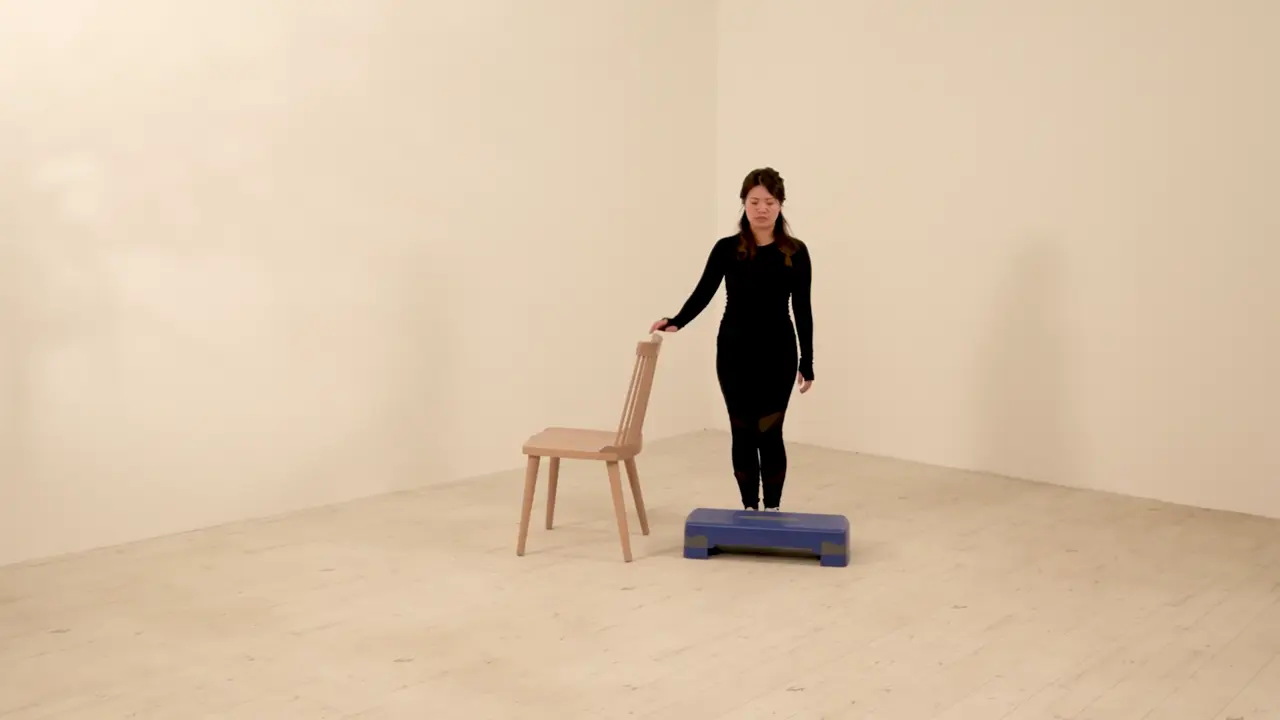
Supported Standing Step Ups Slow
The Supported Standing Step Up Slow is a lower-body strength and balance exercise that targets the legs and glutes. Stand in front of a low step or platform and hold a support for balance. Step up slowly with one foot, then bring the other to meet it before stepping down. Repeat with control. This exercise enhances strength, coordination, and stability.
Related patient information and medicines
Patient information leaflet
Tremors
A tremor is a shaking or trembling in your body which you are unable to control. Anxiety Anxiety Anxiety , like excitement, stimulates release of a hormone called adrenaline (epinephrine), the so-called 'fight or flight' hormone. Some people who are dependent on... Parkinson's disease Tremor is one of the three 'key features' of Parkinson's.

Patient information leaflet
Kidney stones
Kidney stones are hard stones that can cause severe pain in your side along with blood in your urine, and nausea and vomiting. You are more likely to develop kidney stones if you eat a Western diet, don't drink enough fluids or are overweight. Once you have had one episode they are likely to recur but there are several kidney stone treatment.

Patient information leaflet
Cardiac enzymes
Cardiac enzymes are substances released by the heart muscle when it is injured - for example, during a heart attack or a severe case of angina. A heart attack (myocardial infarction) can present in many ways, the most common of which is chest pain. Taking blood tests for heart enzymes can help medical professionals to diagnose a heart attack. What.

Patient information leaflet
Ectopic pregnancy
An ectopic pregnancy is a pregnancy which is not in the womb - the normal place. Ectopic means 'misplaced'. It occurs in about 11 in 1,000 pregnancies. Although many ectopic pregnancies are now treated without the need for an operation, you should always see a doctor urgently if you think you have an ectopic pregnancy symptoms. Symptoms include.

Patient information leaflet
Genital warts
Genital warts are a common sexually transmitted infection. They are small lumps that develop around the genital area. They may not cause any symptoms but sometimes they can be uncomfortable or itch or bleed. They are usually passed on by sexual contact. What are genital warts. Anogenital warts are small lumps that develop on the genitals and/or.
Patient information leaflet
Olecranon bursitis
Olecranon bursitis is a condition where there is. The olecranon is the bony tip of your elbow. A bursa is a soft bag of fluid lying over a joint in the body. '-itis' means inflammation. Elbow with olecranon bursitis Olecranon Bursitis Elbow What is olecranon bursitis. Olecranon bursitis, also called elbow bursitis, is when the fluid-filled sac.
Further reading and references
- ankyrin repeat domain 11; MedlinePlus, National Library of Medicine.
- Gallagher D, Voronova A, Zander MA, Cancino GI, Bramall A, Krause MP, Abad C, Tekin M, Neilsen PM, Callen DF, Scherer SW, Keller GM, Kaplan DR, Walz K, Miller FD. Ankrd11 is a chromatin regulator involved in autism that is essential for neural development. Dev Cell. 2015 Jan 12;32(1):31-42. doi: 10.1016/j.devcel.2014.11.031. Epub 2014 Dec 31.
- Kim HJ, Cho E, Park JB, Im WY, Kim HJ. A Korean family with KBG syndrome identified by ANKRD11 mutation, and phenotypic comparison of ANKRD11 mutation and 16q24.3 microdeletion. Eur J Med Genet. 2015 Feb;58(2):86-94. doi: 10.1016/j.ejmg.2014.11.003. Epub 2014 Nov 20.
- Neilsen PM, Cheney KM, Li CW, Chen JD, Cawrse JE, Schulz RB, Powell JA, Kumar R, Callen DF. Identification of ANKRD11 as a p53 coactivator. J Cell Sci. 2008 Nov 1;121(Pt 21):3541-52. doi: 10.1242/jcs.026351. Epub 2008 Oct 7.
- Sacharow S, Li D, Fan YS, Tekin M. Familial 16q24.3 microdeletion involving ANKRD11 causes a KBG-like syndrome. Am J Med Genet A. 2012 Mar;158A(3):547-52. doi: 10.1002/ajmg.a.34436. Epub 2012 Feb 3.
- Sirmaci A, Spiliopoulos M, Brancati F, Powell E, Duman D, Abrams A, Bademci G, Agolini E, Guo S, Konuk B, Kavaz A, Blanton S, Digilio MC, Dallapiccola B, Young J, Zuchner S, Tekin M. Mutations in ANKRD11 cause KBG syndrome, characterized by intellectual disability, skeletal malformations, and macrodontia. Am J Hum Genet. 2011 Aug 12;89(2):289-94. doi: 10.1016/j.ajhg.2011.06.007. Epub 2011 Jul 21.
- Walz K, Cohen D, Neilsen PM, Foster J 2nd, Brancati F, Demir K, Fisher R, Moffat M, Verbeek NE, Bjorgo K, Lo Castro A, Curatolo P, Novelli G, Abad C, Lei C, Zhang L, Diaz-Horta O, Young JI, Callen DF, Tekin M. Characterization of ANKRD11 mutations in humans and mice related to KBG syndrome. Hum Genet. 2015 Feb;134(2):181-90. doi: 10.1007/s00439-014-1509-2. Epub 2014 Nov 21.
- Willemsen MH, Fernandez BA, Bacino CA, Gerkes E, de Brouwer AP, Pfundt R, Sikkema-Raddatz B, Scherer SW, Marshall CR, Potocki L, van Bokhoven H, Kleefstra T. Identification of ANKRD11 and ZNF778 as candidate genes for autism and variable cognitive impairment in the novel 16q24.3 microdeletion syndrome. Eur J Hum Genet. 2010 Apr;18(4):429-35. doi: 10.1038/ejhg.2009.192. Epub 2009 Nov 18.
- Zhang A, Yeung PL, Li CW, Tsai SC, Dinh GK, Wu X, Li H, Chen JD. Identification of a novel family of ankyrin repeats containing cofactors for p160 nuclear receptor coactivators. J Biol Chem. 2004 Aug 6;279(32):33799-805. doi: 10.1074/jbc.M403997200. Epub 2004 Jun 7.
Share your thoughts or experiences with others in our patient communities.
Simple access to trusted treatments and health services online.
Common conditions
Get help with common conditions through the NHS, without a GP appointment.





Sign up to the Patient newsletter
Your weekly dose of clear, trustworthy health advice - written to help you feel informed, confident and in control.
By subscribing you accept our Privacy Policy. You can unsubscribe at any time. We never sell your data.