calcium voltage-gated channel subunit alpha1 S
Last updated 18 Aug 2020
Meets Patient’s editorial guidelines
- DownloadDownload
- Share
- Language
- Discussion
- Ask Patient
- Audio Version
- Add to preferred sources on Google
The CACNA1S gene provides instructions for making the main piece (subunit) of a structure called a calcium channel. Channels containing the CACNA1S protein are found in muscles used for movement (skeletal muscles). These skeletal muscle calcium channels play a key role in a process called excitation-contraction coupling, by which electrical signals (excitation) trigger muscle tensing (contraction).
Video picks for GenesVideo library
Normal function
The CACNA1S gene provides instructions for making the main piece (subunit) of a structure called a calcium channel. Channels containing the CACNA1S protein are found in muscles used for movement (skeletal muscles). These skeletal muscle calcium channels play a key role in a process called excitation-contraction coupling, by which electrical signals (excitation) trigger muscle tensing (contraction).
Calcium channels made with the CACNA1S subunit are located in the outer membrane of muscle cells, so they can transmit electrical signals from the cell surface to inside the cell. The channels interact with another type of calcium channel called ryanodine receptor 1 (RYR1) channels (produced from the RYR1 gene). RYR1 channels are located in the membrane of a structure inside the cell that stores calcium ions. Signals transmitted by CACNA1S-containing channels turn on (activate) RYR1 channels, which then release calcium ions inside the cells. The resulting increase in calcium ion concentration within muscle cells stimulates muscles to contract, allowing the body to move.
Conditions referring to this gene or chromosome
Other names
CAC1S_HUMAN
CACH1
CACN1
CACNL1A3
calcium channel, voltage-dependent, L type, alpha 1S subunit
Cav1.1
CCHL1A3
DHPR
dihydropyridine receptor
dihydropyridine-sensitive L-type calcium channel alpha-1 subunit
HOKPP
HypoKPP
hypoPP
MHS5
Voltage-dependent L-type calcium channel subunit alpha-1S
voltage-gated calcium channel subunit alpha Cav1.1
Patient picks for Genes

Treatment and medication
Calcium channel blockers
Calcium channel blockers (sometimes called calcium antagonists) are a group of medicines that affect the way calcium passes into certain muscle cells. They are commonly prescribed to manage high blood pressure, angina, Raynaud's phenomenon and some abnormal heart rhythms (arrhythmias). They are also used to try to stop premature labour in pregnancy. A calcium-channel blocker can be used alone. However, one is often combined with another medicine to treat high blood pressure or angina, when one medicine alone has not worked so well.
by Dr Toni Hazell, FRCGP

Drug interactions checker
Can I take Levothyroxine and Calcium together?
Taking calcium at the same time as levothyroxine can stop your thyroid medication from working properly. This can lead to symptoms of an underactive thyroid, such as feeling very tired, feeling cold, or gaining weight.
Drug interactions checker
Can I take Calcium and Doxycycline together?
Taking calcium at the same time as doxycycline can stop the antibiotic from working properly. The calcium attaches to the medicine in your stomach, which prevents your body from absorbing it into your bloodstream. This means the infection you are treating might not clear up as it should.
Mental health
Mind and body control - how to channel your ‘internal telekinesis’
The dark nights have arrived, and right on cue, Mike Flanagan has turned his attention to one of Stephen King’s most iconic tales of teenage torment and supernatural terror... Carrie. The story of a schoolgirl with telekinetic powers - the fictional ability to move objects using the mind alone - has gripped our morbid imaginations for decades. Little wonder, then, that this horror classic is getting a new lease of life in a television adaptation. But while we ourselves may not be able to bend spoons or move furniture, we do possess our own real-world form of ‘internal-telekinesis’. Through mental focus and controlled breathing, we can influence our heart rate and help calm an overworked nervous system.
by Hannah Boynton-Forshaw

Drug interactions checker
Can I take Calcium and Ciprofloxacin together?
Taking calcium at the same time as ciprofloxacin can significantly reduce the amount of the antibiotic that gets into your bloodstream. This means the medicine may not work properly to clear your infection.

Medicine
Verapamil - a calcium-channel blocker
You can take verapamil either before or after meals. Do not drink grapefruit juice whilst you are on verapamil. The most common side-effect of treatment is constipation.
by Michael Stewart, MRPharmS
Related patient information and medicines
Patient information leaflet
Heart valve disease
A heart valve that is diseased or damaged can affect the flow of blood through the heart. If rheumatic fever is the cause then symptoms often start between the ages of 20 and 50 years, ... Other causes of heart valve disease Other causes of heart valve disease include: Deposits of calcium (calcification) in parts of the valve. This is the most.

Patient information leaflet
Swollen legs
Legs may swell for numerous reasons. Some of the possible diagnoses are listed in this leaflet. Types of swollen legs There are many different kinds of swelling of the legs. Conditions causing low protein levels include malnutrition, nephrotic syndrome, liver failure, Liver failure and a gut condition called protein-losing enteropathy..

Patient information leaflet
Anal fissure
ServiceUpsellPlaceholder How common are anal fissures. Anal fissures are common and probably ... Other medicines Some studies have shown that other medicines may also help relax the anal sphincter muscle and increase the blood supply to the area, to encourage the anal fissure to heal. For example, medicines called calcium-channel blockers Calcium.

Patient information leaflet
Can I take Levothyroxine and Felodipine together?
Taking levothy... If your thyroid levels are not well-controlled, it can change how your body processes the blood pressure medication. Why this happens Levothyroxine is a thyroid hormone, and felodipine is a calcium channel blocker used for high blood pressure. Thyroid hormones affect your metabolism. If you are hyperthyroid (too much hormone) or.

Patient information leaflet
Kidney cancer
As the tumour grows: The affected kidney tends to become larger. In time the tumour may grow through the wall of the kidney and invade nearby tissues and organs, such as the muscles around the spine, the liver, the nearby large blood vessels, etc. Some cells may break off into the lymph channels or bloodstream. The cancer may then spread to nearby.
Patient information leaflet
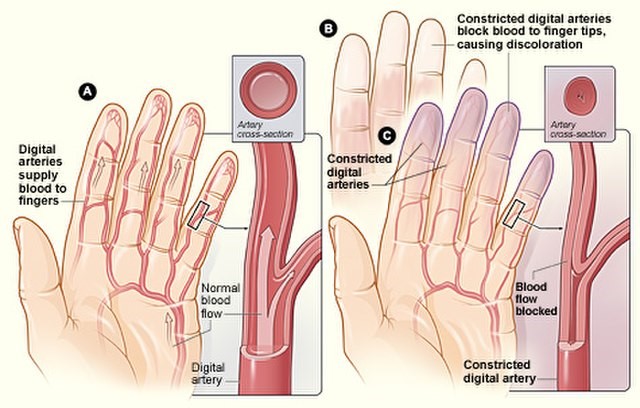
Raynaud's phenomenon
If you have severe symptoms, or symptoms that are easily triggered then portable heat packs and batter... The charity Scleroderma & Raynaud's UK has a list of suppliers - see below for their details. Your pharmacist or local medical supplier may also be able to advise. Other treatments are needed only in some cases. Medication A calcium-channel.
Further reading and references
- calcium voltage-gated channel subunit alpha1 S; MedlinePlus, National Library of Medicine.
- Fouad G, Dalakas M, Servidei S, Mendell JR, Van den Bergh P, Angelini C, Alderson K, Griggs RC, Tawil R, Gregg R, Hogan K, Powers PA, Weinberg N, Malonee W, Ptacek LJ. Genotype-phenotype correlations of DHP receptor alpha 1-subunit gene mutations causing hypokalemic periodic paralysis. Neuromuscul Disord. 1997 Jan;7(1):33-8. doi: 10.1016/s0960-8966(96)00401-4.
- Lehmann-Horn F, Jurkat-Rott K, Rudel R. Periodic paralysis: understanding channelopathies. Curr Neurol Neurosci Rep. 2002 Jan;2(1):61-9. doi: 10.1007/s11910-002-0055-9.
- Miller TM, Dias da Silva MR, Miller HA, Kwiecinski H, Mendell JR, Tawil R, McManis P, Griggs RC, Angelini C, Servidei S, Petajan J, Dalakas MC, Ranum LP, Fu YH, Ptacek LJ. Correlating phenotype and genotype in the periodic paralyses. Neurology. 2004 Nov 9;63(9):1647-55. doi: 10.1212/01.wnl.0000143383.91137.00.
- Monnier N, Procaccio V, Stieglitz P, Lunardi J. Malignant-hyperthermia susceptibility is associated with a mutation of the alpha 1-subunit of the human dihydropyridine-sensitive L-type voltage-dependent calcium-channel receptor in skeletal muscle. Am J Hum Genet. 1997 Jun;60(6):1316-25. doi: 10.1086/515454.
- Riazi S, Biesecker LG, Rosenberg H, Dirksen RT. Nonsyndromic Malignant Hyperthermia Susceptibility. 2003 Dec 19 [updated 2025 Aug 7]. In: Adam MP, Bick S, Mirzaa GM, Wallace SE, Amemiya A, editors. GeneReviews(R) [Internet]. Seattle (WA): University of Washington, Seattle; 1993-2026. Available from http://www.ncbi.nlm.nih.gov/books/NBK1146/
- Stewart SL, Hogan K, Rosenberg H, Fletcher JE. Identification of the Arg1086His mutation in the alpha subunit of the voltage-dependent calcium channel (CACNA1S) in a North American family with malignant hyperthermia. Clin Genet. 2001 Mar;59(3):178-84. doi: 10.1034/j.1399-0004.2001.590306.x.
- Venance SL, Cannon SC, Fialho D, Fontaine B, Hanna MG, Ptacek LJ, Tristani-Firouzi M, Tawil R, Griggs RC; CINCH investigators. The primary periodic paralyses: diagnosis, pathogenesis and treatment. Brain. 2006 Jan;129(Pt 1):8-17. doi: 10.1093/brain/awh639. Epub 2005 Sep 29.
- Wang Q, Liu M, Xu C, Tang Z, Liao Y, Du R, Li W, Wu X, Wang X, Liu P, Zhang X, Zhu J, Ren X, Ke T, Wang Q, Yang J. Novel CACNA1S mutation causes autosomal dominant hypokalemic periodic paralysis in a Chinese family. J Mol Med (Berl). 2005 Mar;83(3):203-8. doi: 10.1007/s00109-005-0638-4. Epub 2005 Feb 22.
- Weber F, Lehmann-Horn F. Hypokalemic Periodic Paralysis. 2002 Apr 30 [updated 2018 Jul 26]. In: Adam MP, Bick S, Mirzaa GM, Pagon RA, Wallace SE, Amemiya A, editors. GeneReviews(R) [Internet]. Seattle (WA): University of Washington, Seattle; 1993-2026. Available from http://www.ncbi.nlm.nih.gov/books/NBK1338/
- Yamakage M, Namiki A. Calcium channels--basic aspects of their structure, function and gene encoding; anesthetic action on the channels--a review. Can J Anaesth. 2002 Feb;49(2):151-64. doi: 10.1007/BF03020488.
Share your thoughts or experiences with others in our patient communities.
Simple access to trusted treatments and health services online.
Common conditions
Get help with common conditions through the NHS, without a GP appointment.





Sign up to the Patient newsletter
Your weekly dose of clear, trustworthy health advice - written to help you feel informed, confident and in control.
By subscribing you accept our Privacy Policy. You can unsubscribe at any time. We never sell your data.