collagen type XVIII alpha 1 chain
Last updated 18 Aug 2020
Meets Patient’s editorial guidelines
- DownloadDownload
- Share
- Language
- Discussion
- Ask Patient
- Audio Version
- Add to preferred sources on Google
The COL18A1 gene provides instructions for making a protein that forms collagen XVIII. Three COL18A1 proteins, called alpha 1 subunits, attach to each other to form collagen XVIII. Collagen XVIII is found in the basement membranes of tissues throughout the body. Basement membranes are thin, sheet-like structures that separate and support cells in these tissues.
Video picks for GenesVideo library
Normal function
The COL18A1 gene provides instructions for making a protein that forms collagen XVIII. Three COL18A1 proteins, called alpha 1 subunits, attach to each other to form collagen XVIII. Collagen XVIII is found in the basement membranes of tissues throughout the body. Basement membranes are thin, sheet-like structures that separate and support cells in these tissues.
There are three versions (isoforms) of the alpha 1 subunit of collagen XVIII, which form three different lengths of the collagen XVIII protein. The short version of collagen XVIII is found in basement membranes throughout the body, including several parts of the eye. The two longer versions are found primarily in the liver. In addition, a piece of collagen XVIII can be cut off to form the protein endostatin. Endostatin is able to block the formation of blood vessels (angiogenesis) and is known as an anti-angiogenic factor.
Little is known about the function of collagen XVIII, but it appears that all of the isoforms are involved in normal development of the eye.
Conditions referring to this gene or chromosome
Other names
antiangiogenic agent
collagen alpha-1(XVIII) chain
collagen type XVIII alpha 1
collagen, type XVIII, alpha 1
endostatin
FLJ27325
FLJ34914
KNO
KNO1
KS
MGC74745
multi-functional protein MFP
Patient picks for Genes
Diet and nutrition
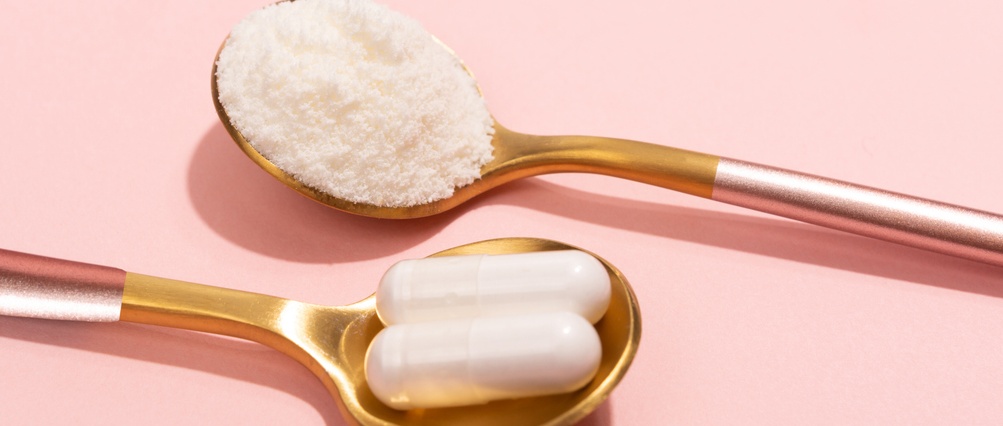
Can collagen supplements boost your health?
As we age, our body's natural collagen production decreases. This fact has prompted many people to consider taking collagen supplements - not only for their cosmetic benefits but for potential health improvements too.
by Victoria Raw

Drug interactions checker
Can I take Candesartan and Collagen together?
There are no known significant interactions between candesartan and collagen supplements. It is generally considered safe to take these together.

Drug interactions checker
Can I take Biotin and Collagen together?
There are no known harmful interactions between biotin and collagen. In fact, they are frequently taken together in 'hair, skin, and nails' supplements because they work in different ways to support the body's connective tissues.
Drug interactions checker
Can I take Adcal-D3 and Collagen together?
There is no known harmful interaction between Adcal-D3 and collagen supplements. In fact, they are often used together to support bone and joint health.

Drug interactions checker
Can I take Carbocisteine and Collagen together?
There are no known interactions between carbocisteine and collagen supplements. It is generally considered safe to take these two substances together.

Drug interactions checker
Can I take Collagen and Tamoxifen together?
There is no known direct interaction between collagen supplements and tamoxifen. Collagen is a protein found naturally in the body, and taking it as a supplement is generally considered safe alongside this medication.
Related patient information and medicines
Patient information leaflet
Can I take Candesartan and Collagen together?
There are no known sign... It is generally considered safe to take these together. Why this happens Candesartan is a blood pressure medication (an angiotensin II receptor blocker) that works on the hormonal system controlling blood vessels. Collagen is a protein supplement used for skin, joint, and bone health. These two substances are processed.
Patient information leaflet
Localised scleroderma
Systemic sclerosis affects the skin but may also involve the body's internal organs. See separate leaflet called Systemic sclerosis for more details Systemic sclerosis. The rest of this leaflet is only about localised scleroderma. Cause... What is known is that cells called fibroblasts make too much of a protein called collagen. The collagen gets.
Patient information leaflet
Can I take Biotin and Collagen together?
There are no known harmful interactions between biotin and collagen. Why this happens Biotin is a B-vitamin (B7) that helps the body convert nutrients into energy and supports the productio... Collagen is a structural protein that provides the 'building blocks' for skin and joints. They do not interfere with each other's absorption, metabolism, or.
Patient information leaflet
Can I take Adcal-D3 and Collagen together?
There is no known harmful interaction between Adcal-D3 and collagen supplements. In fact, they are often used together to ... Why this happens Adcal-D3 provides calcium and vitamin D3, while collagen provides amino acids. These substances are processed by the body through different pathways and do not interfere with each other's absorption or.
Patient information leaflet
Can I take Carbocisteine and Collagen together?
Why this happens Carbocisteine works by breaking down the chemical bonds in mucus to make it thinner and easier to cough up. Collagen is a protein used by the body for skin, joint, and bone health. These two substances are processed by the body through different pathways and do not interfere with how the other is absorbed, broken down, or used by.
Patient information leaflet
Can I take Collagen and Tamoxifen together?
There is no known direct interaction between collagen supplements and tamoxifen. Collagen is a protein found naturally in the body, and taking it as a supplement is generally considered safe alongside this medication. Why this happens Collagen is broken down into amino acids in the digestive tract, similar to eating protein-rich food. Disclaimer.
Further reading and references
- collagen type XVIII alpha 1 chain; MedlinePlus, National Library of Medicine.
- Edwards Y. Structure and expression of mammalian carbonic anhydrases. Biochem Soc Trans. 1990 Apr;18(2):171-5. doi: 10.1042/bst0180171. No abstract available.
- Fukai N, Eklund L, Marneros AG, Oh SP, Keene DR, Tamarkin L, Niemela M, Ilves M, Li E, Pihlajaniemi T, Olsen BR. Lack of collagen XVIII/endostatin results in eye abnormalities. EMBO J. 2002 Apr 2;21(7):1535-44. doi: 10.1093/emboj/21.7.1535.
- Passos-Bueno MR, Suzuki OT, Armelin-Correa LM, Sertie AL, Errera FI, Bagatini K, Kok F, Leite KR. Mutations in collagen 18A1 and their relevance to the human phenotype. An Acad Bras Cienc. 2006 Mar;78(1):123-31. doi: 10.1590/s0001-37652006000100012. Epub 2006 Mar 8.
- Sertie AL, Sossi V, Camargo AA, Zatz M, Brahe C, Passos-Bueno MR. Collagen XVIII, containing an endogenous inhibitor of angiogenesis and tumor growth, plays a critical role in the maintenance of retinal structure and in neural tube closure (Knobloch syndrome). Hum Mol Genet. 2000 Aug 12;9(13):2051-8. doi: 10.1093/hmg/9.13.2051.
- Suzuki O, Kague E, Bagatini K, Tu H, Heljasvaara R, Carvalhaes L, Gava E, de Oliveira G, Godoi P, Oliva G, Kitten G, Pihlajaniemi T, Passos-Bueno MR. Novel pathogenic mutations and skin biopsy analysis in Knobloch syndrome. Mol Vis. 2009;15:801-9. Epub 2009 Apr 23.
- Suzuki OT, Sertie AL, Der Kaloustian VM, Kok F, Carpenter M, Murray J, Czeizel AE, Kliemann SE, Rosemberg S, Monteiro M, Olsen BR, Passos-Bueno MR. Molecular analysis of collagen XVIII reveals novel mutations, presence of a third isoform, and possible genetic heterogeneity in Knobloch syndrome. Am J Hum Genet. 2002 Dec;71(6):1320-9. doi: 10.1086/344695. Epub 2002 Nov 1.
Share your thoughts or experiences with others in our patient communities.
Simple access to trusted treatments and health services online.
Common conditions
Get help with common conditions through the NHS, without a GP appointment.





Sign up to the Patient newsletter
Your weekly dose of clear, trustworthy health advice - written to help you feel informed, confident and in control.
By subscribing you accept our Privacy Policy. You can unsubscribe at any time. We never sell your data.