SNF2 related chromatin remodeling annealing helicase 1
Last updated 1 Oct 2024
Meets Patient’s editorial guidelines
- DownloadDownload
- Share
- Language
- Discussion
- Ask Patient
- Audio Version
- Add to preferred sources on Google
The SMARCAL1 gene provides instructions for producing a protein that interacts with DNA. The SMARCAL1 protein helps when the process of making new copies of DNA, called DNA replication, is blocked by DNA damage. When DNA replication stalls, the SMARCAL1 proteins repair DNA damage by reattaching the two strands of DNA's double helix and allowing replication to proceed.
Video picks for GenesVideo library
Normal function
The SMARCAL1 gene provides instructions for producing a protein that interacts with DNA. The SMARCAL1 protein helps when the process of making new copies of DNA, called DNA replication, is blocked by DNA damage. When DNA replication stalls, the SMARCAL1 proteins repair DNA damage by reattaching the two strands of DNA's double helix and allowing replication to proceed.
The SMARCAL1 protein is also thought to influence the activity (expression) of other genes through a couple of different mechanisms. One mechanism is by attaching (binding) to certain regions of DNA and turning specific genes on or turning off. The other mechanism is by binding to chromatin, which is the complex of DNA and protein that packages DNA into chromosomes. Research on the function of similar proteins suggests that the SMARCAL1 protein may be involved in a process known as chromatin remodeling. This occurs by changing (remodeling) the structure of chromatin to alter how tightly DNA is packaged. Chromatin remodeling is one way gene expression is regulated during development. When DNA is tightly packed, gene expression is lower than when DNA is loosely packed.
Conditions referring to this gene or chromosome
Other names
HARP
HepA-related protein
HHARP
SMAL1_HUMAN
Patient picks for Genes

Chest and lungs
Tuberculosis
Tuberculosis (TB) is an infection with a germ (bacterium) called Mycobacterium tuberculosis. If you have symptoms, or a doctor can find signs of the infection when examining you, this is known as active tuberculosis. If you have TB infection without any signs or symptoms, this is known as latent TB.
by Dr Colin Tidy, MRCGP

Travel and vaccinations
Roundworms
Roundworms (also called nematodes) are worms with a long round body. They vary in length from several millimetres to up to two metres. Roundworms are common in warm tropical countries and most infections seen in the UK will have been acquired abroad. Children are more often affected than adults. Treatment is usually very effective but wiping out (eradication of) roundworm infections has proved to be very difficult.
by Dr Toni Hazell, FRCGP

Travel and vaccinations
Ebola
Ebola is a viral infection, which mainly occurs in West and Equatorial Africa. There is as yet no vaccine or cure for Ebola, and about 4 out of 10 of those infected die of the disease. The risk of becoming infected with Ebola in the UK is very small. Ebola is spread by close contact with an infected person. People with Ebola become infectious when they have symptoms.
by Dr Mary Elisabeth Lowth, FRCGP

Travel and vaccinations
Schistosomiasis
Schistosomiasis is a tropical disease caused by an infection with parasitic worms. In the past it was more commonly known as Bilharzia. Many people do not develop symptoms of acute schistosomiasis, or their symptoms may be mild and go unrecognised. Diagnosis is usually made by testing the urine or poo (faeces) or through a blood test. Treatment is with a medicine called praziquantel. Many people recover completely following treatment.
by Dr Surangi Mendis, MRCGP
Infections
Leptospirosis and Weil's disease
Leptospirosis is caused by infection with Leptospira germs (bacteria). The infection passes from animals (commonly rats, cattle, pigs and dogs) to humans. In most cases, leptospirosis causes a mild illness. But, in some people, a more severe illness occurs. This more severe form is commonly referred to as Weil's disease. The main treatment for leptospirosis is antibiotics and most people make a full recovery.
by Dr Caroline Wiggins, MRCGP

Heart health and blood vessels
Deep vein thrombosis
A deep vein thrombosis (DVT) is a blood clot in a vein. Blood clots in veins most often occur in the legs but can occur elsewhere in the body, including the arms. This leaflet is about blood clots in leg veins. The most common cause of a blood clot developing in a vein is immobility. A complication can occur in some cases where part of the blood clot breaks off and travels to the lung (pulmonary embolus). This is usually prevented if you are given anticoagulation treatment.
by Dr Toni Hazell, FRCGP
Related patient information and medicines

Patient information leaflet
Antiphospholipid syndrome
Antiphospholipid syndrome (APS) - also called Hughes' syndrome - makes blood more likely than normal to clot (a thrombophilia Thrombophilia ). This increases the risk of developing blood clots (called thromboses) within blood. If you are pregnant and have APS, you will need to have some of your antenatal care under the supervision of a doctor who.
Patient information leaflet
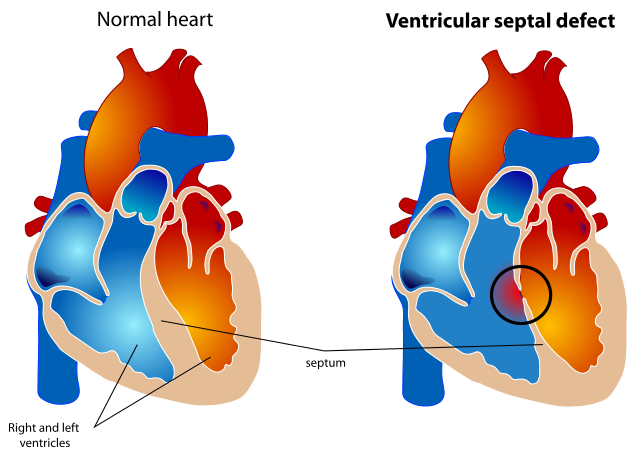
Ventricular septal defect
Ventricular septal defect (VSD) is a gap or defect in the septum between the heart's two lower chambers (ventricles). The septum is a wall that separates the heart's right and left side of the heart. Septal defects are sometimes called a 'hole' in the heart. It is the most common heart problem that babies are born with. Many defects in the.
Patient information leaflet
Tuberculosis
Tuberculosis (TB) is common in developing countries. The death rate from TB is falling but it still causes about two million deaths per year worldwide. The main risk factors for TB in the developing world are: Poor nutrition. These include: An increase in poverty. The ageing population. Immigration from areas where TB is common. More people.
Patient information leaflet
Macular degeneration
What is macular degeneration. Macular degeneration (also known as age-related macular degeneration) occurs when cells in the macula - the central area of the retina - degenerate. The r etina is a light sensitive layer that lines the interior of the eye. See Anatomy of the Eye Anatomy of the eye for further information. Damage to the macula affects.

Patient information leaflet
Can I take Oestrogel pump-pack and Vitamin C together?
This can lead to higher levels of the medicine in your bloodstream, p... Using other medicines Taking multiple medicines. Our Medicines Interaction Checker helps you check whether your prescriptions, over-the-counter medicines, and supplements are safe to take together. Simply search for your medicines to see potential interactions and what to do.

Patient information leaflet
Alpha-1 antitrypsin deficiency
Alpha-1 antitrypsin deficiency is an inherited genetic condition. A genetic condition is one that can be passed on from parents through genes. In alpha-1 antitrypsin deficiency the result of a genetic abnormality leads to lung and, in some people, liver damage. Lung symptoms are the most common and include shortness of breath, cough and wheezing..
Further reading and references
- SNF2 related chromatin remodeling annealing helicase 1; MedlinePlus, National Library of Medicine.
- Bansal R, Hussain S, Chanana UB, Bisht D, Goel I, Muthuswami R. SMARCAL1, the annealing helicase and the transcriptional co-regulator. IUBMB Life. 2020 Oct;72(10):2080-2096. doi: 10.1002/iub.2354. Epub 2020 Aug 5.
- Boerkoel CF, Takashima H, John J, Yan J, Stankiewicz P, Rosenbarker L, Andre JL, Bogdanovic R, Burguet A, Cockfield S, Cordeiro I, Frund S, Illies F, Joseph M, Kaitila I, Lama G, Loirat C, McLeod DR, Milford DV, Petty EM, Rodrigo F, Saraiva JM, Schmidt B, Smith GC, Spranger J, Stein A, Thiele H, Tizard J, Weksberg R, Lupski JR, Stockton DW. Mutant chromatin remodeling protein SMARCAL1 causes Schimke immuno-osseous dysplasia. Nat Genet. 2002 Feb;30(2):215-20. doi: 10.1038/ng821. Epub 2002 Jan 22.
- Deguchi K, Clewing JM, Elizondo LI, Hirano R, Huang C, Choi K, Sloan EA, Lucke T, Marwedel KM, Powell RD Jr, Santa Cruz K, Willaime-Morawek S, Inoue K, Lou S, Northrop JL, Kanemura Y, van der Kooy D, Okano H, Armstrong DL, Boerkoel CF. Neurologic phenotype of Schimke immuno-osseous dysplasia and neurodevelopmental expression of SMARCAL1. J Neuropathol Exp Neurol. 2008 Jun;67(6):565-77. doi: 10.1097/NEN.0b013e3181772777.
- Elizondo LI, Cho KS, Zhang W, Yan J, Huang C, Huang Y, Choi K, Sloan EA, Deguchi K, Lou S, Baradaran-Heravi A, Takashima H, Lucke T, Quiocho FA, Boerkoel CF. Schimke immuno-osseous dysplasia: SMARCAL1 loss-of-function and phenotypic correlation. J Med Genet. 2009 Jan;46(1):49-59. doi: 10.1136/jmg.2008.060095. Epub 2008 Sep 19.
Share your thoughts or experiences with others in our patient communities.
Simple access to trusted treatments and health services online.
Common conditions
Get help with common conditions through the NHS, without a GP appointment.





Sign up to the Patient newsletter
Your weekly dose of clear, trustworthy health advice - written to help you feel informed, confident and in control.
By subscribing you accept our Privacy Policy. You can unsubscribe at any time. We never sell your data.