
Is the food traffic light labelling system useful?
Peer reviewed by Dr Sarah JarvisAuthored by Rose Constantine Smith, ANutrOriginally published 4 Sept 2018
Meets Patient’s editorial guidelines
- DownloadDownload
- Share
- Language
- Discussion
- Ask Patient
- Audio Version
- Add to preferred sources on Google
These days supermarkets are bursting with an overwhelming variety of packaged food and drinks to suit all dietary wants and needs. But it's not just choice that has increased - there's now more nutritional information on food packaging than ever. The question is, is this info actually helping us make healthier choices?
Video picks for Healthy eatingVideo library
Information overload?
In the past, we didn't always have recommended daily intakes for nutrients like calories, fat and sugar. Instead, people were cooking the majority of their meals from scratch. This meant that there was not much demand for processed foods, let alone ingredients lists and nutritional information.
Between the 1900s and now, more and more processed foods have come to market in response to our need for more convenient meals. In 1987, Dietary Reference Values were published to give the public a guide to how much they should be getting of key nutrients.
Since then, food labelling has evolved and with it, rules and regulations about what must and must not be said. By law, there's some nutritional information which should always be available on food packing in the UK. This includes:
The food or drink's energy value given in both kilojoules (kJ) and kilocalories (kcal).
The amounts in grams (g) of fat, saturates, carbohydrate, sugars, protein and salt.
Traffic light labels
The traffic light label was introduced in 2014, as part of an initiative by the government to improve public health. It was designed to give consumers an immediate idea as to whether something is: healthy (green or low) or not (red or high) in terms of fat, sugar or salt.
Traffic light system
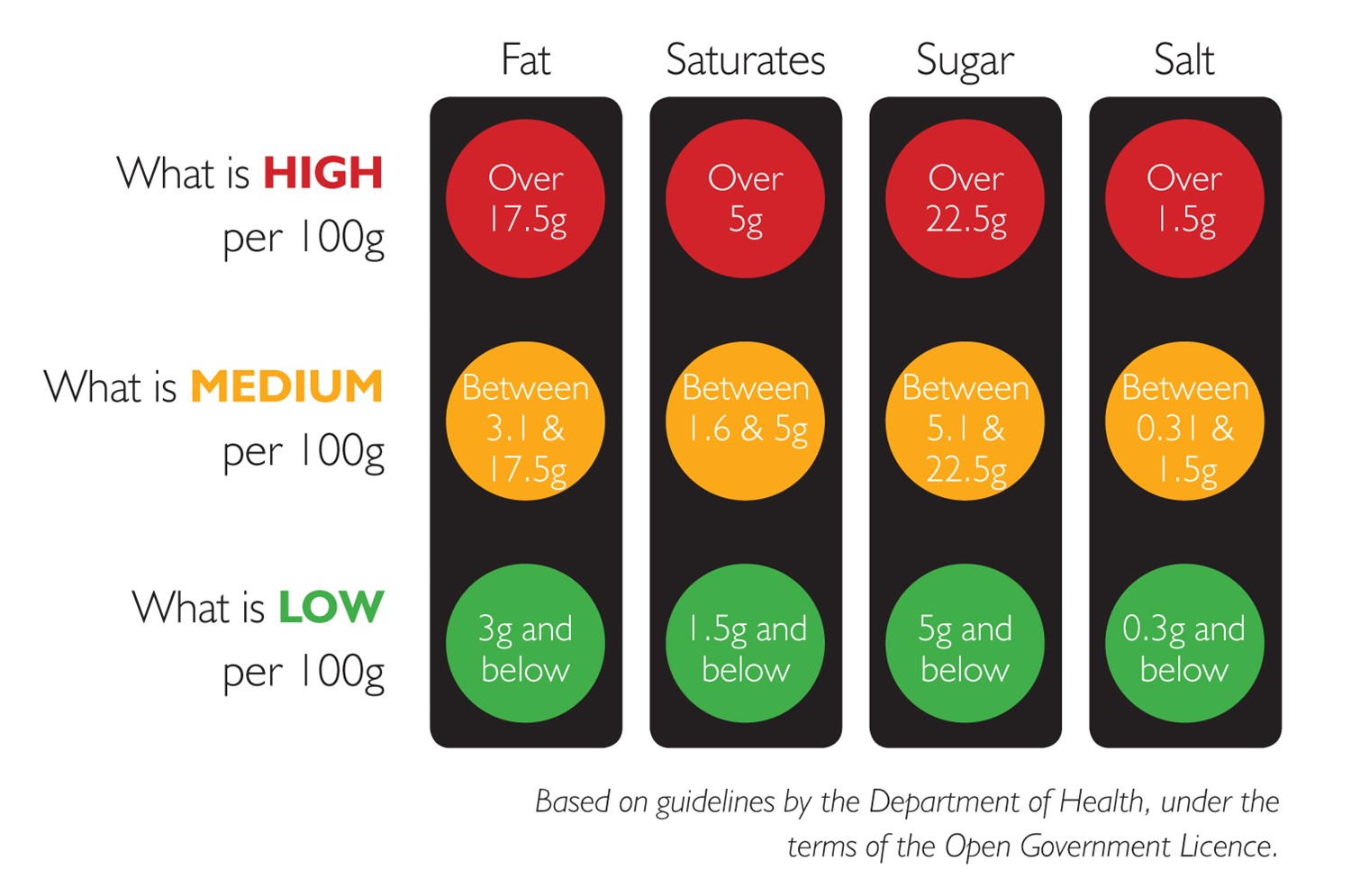
High (often shown in red) means that there is a lot of that nutrient within the food and therefore should not be eaten regularly, or in large amounts as it could be bad for your health in the long run.
Medium (often shown in orange) shows that it is neither high nor low and so can be consumed most of the time as part of a healthy diet.
Low (often shown in green) highlights items that do not contain much of the nutrients we need to be wary of (fat, sugar and salt) so they can be consumed regularly as part of your daily diet.
Consultant dietician and spokesperson for the British Dietetic Association, Sian Porter says: "Understanding and being able to use food labelling information is really helpful for making healthy food and drink choices. Comparing foods side by side can be useful. You don't have to be a maths genius to know if something has more sugar, say, than another food, or see if a food is mostly green and amber traffic lights versus mostly reds."
Pros and cons
But is it as simple as stopping when we see red? The simple answer is no. However, this opens a whole can of worms.
Traffic light labelling is a fantastic tool for giving a consumer an immediate look at whether an item is 'healthy' or 'unhealthy'. But what it fails to tell you is why it is red. And the system does not distinguish between nutritional quality; more beneficial and less beneficial types of fat, sugar and salt.
For example, take a 100 ml of orange juice and 100 ml of a fizzy drink. Both would be higher in sugar. So, some may think: "Well I may as well have the fizzy drink." This is where we need to be careful.
Yes, they both contain sugar, but the fresh orange juice also contributes towards your 5 a day and provides 60% of your vitamin C intake. A fizzy drink provides none of these benefits, as they are effectively 'empty calories'.
The problem with traffic light labelling at the moment is that it is not compulsory. And if companies do decide to display it there isn't tight enough regulation around how to use it or display it. This is why many of us get so confused.
This problem has been highlighted recently by the British Medical Association who released a report in 2016, 'Food For Thought', which highlighted that: "A mandatory, standardised approach for displaying nutritional information should be introduced for all pre-packaged food and drink products."
How to make the most of food labels
There are a few things you can do to check whether or not a food product is as good, or as bad, as it first appears.
Look further than red
If a value is in the red, take a closer look. Yes, we should not eat too much of that food or drink or too often, but some reds are better than others - eg, cheese versus lard, oily fish versus processed meat. Use the red flag or 'high' value as a signal to investigate further.
Check the ingredients list
See what is at the top of the list. Ingredients lists are given in order of quantity so the higher up the list, the more there is of it in the product.
Let's say you look at a dish and it has a 'red' for fat. If you check the back and one of the first ingredients is salmon then you know that the fats within the dish are likely to be coming from a naturally fatty food which provides omega 3. You can sometimes check this by looking at the nutritional information on the back of the pack, which gives you more information about what type of fats are present.
Conversely, if you look at the back of the pack and one of the first ingredients is palm oil then you know that this is not a fat we want to be eating a lot of. So it may be worth thinking again and not eating it too frequently.
Check the serving size
Has it said a quantity that you are expecting to eat?
Often manufacturers will say 'a serving of ... provides a set amount of kcal, fat, sat fat, sugar and salt'. But more often than not it is a lot less than you plan to eat. The snack packs of nuts are a great example of this. They will generally say a 25 g serving but when you check the weight of the snack pack it is actually 50 g, even though it isn't a resealable package.
If it is less, be mindful of how much you consume, perhaps save a bit for another day if it is something that you can keep.
Other offenders for this include cereals, chocolate bars with more than one piece, pizzas and soft drinks.
Porter says: "As we do not have standard portion sizes in the UK, I encourage people to know what is an appropriate portion for them such as a handful of nuts rather than what the manufacturer suggests or how a food is packaged."
When green doesn't mean 'go'
If it is all green but seems too good to be true, be a little wary. Diet drinks are a great example of this. Although, yes they aren't breaking the bank with regards to our regular offenders (kcal, sugar, fat and salt), they also aren't providing your body with many quality nutrients either.
The bottom line
Traffic light labelling and other nutritional information is a useful tool that we all should be aware of and utilise. But we need to get into the habit of thinking further than the front of pack information and appreciate that not all calories are equal.
Seeing red on one of our recipes?
We work hard to make sure that we provide a range of recipes to users, which suit all dietary wants and needs. Some of our recipes may be higher in fat or sugar. However, these will never be due to added fat or sugar but instead those naturally present in the food. For example, fat from nuts or sugar from dried fruit.
We do however advise that these dishes should be consumed in moderation and at the recommended serving size.
Patient picks for Healthy eating

Allergies, blood and immune system
Food allergy and intolerance
Food allergy and food intolerance are not the same thing. The following leaflet explores the difference between them, their causes, and how they are diagnosed and managed.
by Dr Hayley Willacy, FRCGP
Allergies, blood and immune system
Immunosuppression
Immune suppression describes a loss of immune function. It can occur for many reasons, including disease, medication, surgery, age or genetics.
by Dr Philippa Vincent, MRCGP
Allergies, blood and immune system
How to introduce your baby to allergenic foods
Moving your baby on to solid foods can be a fun process, especially as you watch their faces as they try new flavours and textures. But it can also be nerve-wracking to introduce your baby to foods that can trigger an allergic reaction, such as peanuts or shellfish. So how can you do it safely?
by Lawrence Higgins

General health and lifestyle
What is the endocannabinoid system - and why does it matter?
The endocannabinoid system (ECS) is one of the most important regulatory networks in the human body - yet most people have never heard of it. So what is it and why should we know about it?
by Heather Ainsworth

Healthy living
Blue light filters: do they really work?
Most of us spend several hours looking at digital screens every day, all of which emit varying levels of blue light. There's debate about the damage and effects blue light has on our vision and health, and if blue light filters help. We investigate the science to find out.
by Lynn Stephen
Allergies, blood and immune system
Which foods should you avoid if you have a soy allergy?
A soy allergy occurs when your body reacts to soy protein. A lot of products contain soy, meaning it can be hard to avoid it completely. So, we've got all the tips on what to avoid and the symptoms to look out for in a reaction.
by Emily Jane Bashforth
About the authorView full bio
Authored by

Rose Constantine Smith, ANutr
Nutritionist
BSc (Hons), ANutr
Rose has authored for several publications including The Healthy Food Guide and is a Nutrition and Wellbeing Manager for The Good Eating Co.
About the reviewerView full bio

Dr Sarah Jarvis
Clinical Consultant
MA (Cantab), BM, BCh (Oxon), DRCOG, FRCGP, MBE
After training in medicine at Cambridge and Oxford, Dr Sarah Jarvis MBE became a GP.
Article history
Article also available in English, German, Spanish, French, Italian, Portuguese, Hindi, Hebrew, Arabic, and Swedish.
4 Sept 2018 | Originally published
Authored by:
Rose Constantine Smith, ANutrPeer reviewed by
Dr Sarah Jarvis
Share your thoughts or experiences with others in our patient communities.
Sign up to the Patient newsletter
Your weekly dose of clear, trustworthy health advice - written to help you feel informed, confident and in control.
By subscribing you accept our Privacy Policy. You can unsubscribe at any time. We never sell your data.