
Getting to know your testicles
Peer reviewed by Dr John Cox, MRCGPAuthored by Dr Laurence KnottOriginally published 11 Oct 2017
Meets Patient’s editorial guidelines
- DownloadDownload
- Share
- Language
- Discussion
- Ask Patient
- Audio Version
- Add to preferred sources on Google
If you are a young man or teenage boy, you should be aware of how your testicles (testes) normally feel. Report any changes or lumps to your doctor.
Video picks for Testicle conditionsVideo library
Why should I know how my testicles (testes) feel?
Although uncommon, cancer of the testicles (testicular cancer) is the most common cancer in young men in the UK. About 1 man in 500, aged between 15 and 50 years, develops testicular cancer. The exact cause is not known. However, if caught early it is one of the easiest cancers to treat and cure. So, If you are a teenage boy or young man, you should get to know how each testicle (testis) normally feels. Any changes would then be easier to detect. This is especially important for brothers of people with testicular cancer, as they have a higher-than-average chance of developing this type of cancer.
Normal testicles (testes)
Cross-section view
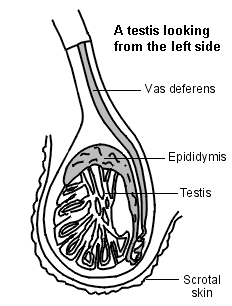
The best time to feel your testes is after a bath or shower when you are relaxed. Hold each testicle (testis) in turn in the palm of a hand and use your finger and thumb gently to feel the testes and nearby structures.
It is normal for one testis to be slightly bigger than the other and for one to hang slightly lower than the other. The testes themselves feel like smooth, soft balls inside the baggy scrotum. At the top and to the back of each testis is the epididymis (this stores the sperm). This feels like a soft swelling attached to the testis; it can be quite tender if you press it firmly. Leading from the epididymis is the vas deferens. You can feel each vas deferens at each side at the back and top of the scrotum. They feel like soft, narrow tubes which pass up and into the groin. (The vas deferens carries the sperm to the penis.) Some people confuse the normal epididymis or vas deferens with an abnormal lump.
What changes should I look out for?
If you notice any change in size or weight of a testicle (testis), or any abnormal lumps, swellings, or tender spots, see your doctor. Doctors are used to examining testicles (testes) and will be able to advise if the abnormality is serious or not.
Note: most abnormalities are not cancer. For example: collections of fluid, infections, and harmless cysts are common and treatable. Testicular cancer usually starts as a small, hard, painless lump on one testis, which you can feel away from the normal soft lump of the epididymis.
What if it is cancer?
Treatment of cancer of the testicle (testis) is often effective. In more than 9 in 10 cases, treatment can result in a complete cure. However, the earlier it is detected, the easier it is to treat. More than a third of people with this cancer consult their doctor after the cancer has spread, which makes treatment more difficult. Often this is because of unfounded fears, or just hoping it will go away.
Patient picks for Testicle conditions

Children's health
Undescended testicles
An undescended testicle (testis) is more common in boys who are born prematurely. Although in the majority of cases the testicle descends by the age of 6 months, some boys will need an operation. This is called an orchidopexy. This operation brings the testicle down from the tummy (abdomen) into the testicular sac (scrotum). There is an increased risk of infertility and also cancer if the testicle remains in the abdomen.
by Dr Laurence Knott

General health
AskPatient
AskPatient is a safer, clinically informed AI assistant designed to help you understand health information and find reliable guidance on Patient.info. Whether you have a symptom, want to understand a condition, or need help finding the right information, AskPatient can guide you to clear, trusted content written and reviewed by healthcare professionals. Start by typing your question below. Open in a new window
by Patient infomatics team
Podcasts
From bliss to blame
Have you ever found yourself thinking, ‘What on earth was I doing? This person is all wrong for me’, when only a few months ago they seemed perfect? How did that feeling of bliss when you’re finishing each other’s sentences and laughing at the same jokes turn to irritation, resentment and blaming them for everything that’s wrong? Clare and Aileen help you understand the natural cycle from falling-in-love bliss to relationship blame, why it happens, and how to navigate your way through it.
by Thomas Andrew Porteus, MBCS

Podcasts
Me-topia
If you always come last on the priority list, it’s time to learn why ‘Being Selfish for the Team’ helps everyone.
by Thomas Andrew Porteus, MBCS

General health and lifestyle
Ideas, Concerns and Expectations - a guide to filling in your GP’s online form
Booking a GP appointment has changed. Instead of waiting on the phone line at 8am, many people now complete an online consultation form through their practice website. At first glance, it may feel like another bureaucratic hurdle. But in fact, these forms are designed to help you, and your GP team, get to the heart of your problem more quickly. The way you fill them in makes a real difference. When you provide clear, thoughtful information, it not only helps the practice decide whether something is urgent, but also ensures you are directed to the right person in the wider primary care team. That might be your GP - but it could just as easily be a nurse, a pharmacist, a physiotherapist, or another professional who can meet your needs sooner. One of the simplest tools to guide you is known as Ideas, Concerns and Expectations, or ICE.
by Thomas Andrew Porteus, MBCS
Podcasts
Making work work
Work can take up so much of our waking hours but how often do we look at our relationship with work. Are you a workaholic or just going through the motions? Does it inspire or drain you? What about the people we work with: colleagues, managers and those unrequited crushes or unwanted attentions? When it comes to work, things can get complicated. Clare and Aileen delve into the tangled world of work to help you think about your relationship with work and give tips on how to navigate those complex relationships in the workplace.
by Thomas Andrew Porteus, MBCS
About the authorView full bio
Authored by

Dr Laurence Knott
General Practitioner, Medical Author
BSc (Hons) Biochemistry, MBBS
Dr Laurence Knott qualified in 1973 and has had extensive experience as a General Practitioner.
About the reviewerView full bio

Dr John Cox, MRCGP
MA, MB, B Chir, DCH, DRCOG, MRCP (UK), MRCGP
Dr John Cox worked as a Medical Registrar in the UK and New Zealand and as a locum Physician in New Zealand.
Article history
Article also available in English, German, Spanish, French, Italian, Portuguese, Hindi, Hebrew, Arabic, and Swedish.
11 Oct 2017 | Originally published
Authored by:
Dr Laurence KnottPeer reviewed by
Dr John Cox, MRCGP
Share your thoughts or experiences with others in our patient communities.
Sign up to the Patient newsletter
Your weekly dose of clear, trustworthy health advice - written to help you feel informed, confident and in control.
By subscribing you accept our Privacy Policy. You can unsubscribe at any time. We never sell your data.