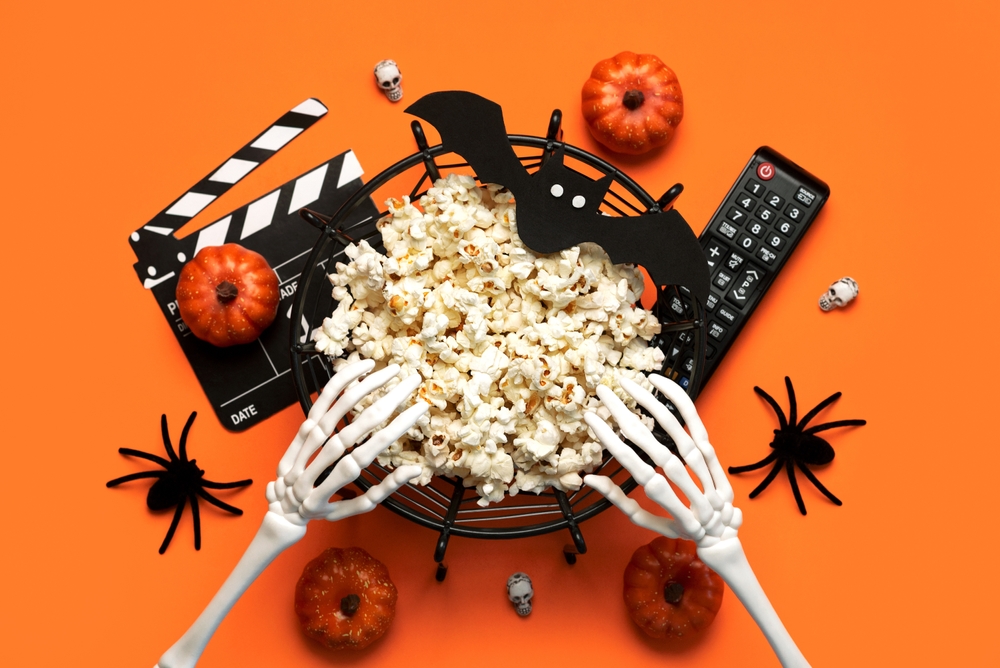
Why do we love horror films - even when they terrify us?
Peer reviewed by Dr Colin Tidy, MRCGPAuthored by Victoria RawOriginally published 21 Oct 2026
Meets Patient’s editorial guidelines
- DownloadDownload
- Share
- Language
- Discussion
- Audio Version
- Add to preferred sources on Google
For many, Halloween has become a second Christmas. Spooky decorations appear earlier each year, evoking the same sense of nostalgia and anticipation as the festive season. But despite its medley of frights, screams, and jump scares, why does a holiday built around fear make us feel so cosy?
We spoke to a psychotherapist about why feeling scared can sometimes feel good, and whether watching horror films could actually benefit our mental health.
Why do we love watching horror films?
As a small child, I loved nothing more than scaring myself silly watching Poltergeist alone in the dark. Whether you credit Tobe Hooper or Steven Spielberg for the film is another debate entirely, but one thing’s for sure - I was far too young to be watching it. Still, that strange mix of fear and excitement is one of my fondest childhood memories.
Many of us share the same fascination - the thrill of being scared when we know we’re safe. And for some of us, it’s a feeling we keep coming back for.
But what is it about being frightened that we find so appealing? To explore the psychology behind our love of a good scare, Mark Vahrmeyer, a UKCP-registered psychotherapist at Brighton and Hove Psychotherapy, explains what happens in our brains when we watch horror films.
“A jump scare works because your body reacts before your brain has time to catch up,” he says. “A sudden noise, movement, or image triggers your startle response, causing your brain and body to react, for a split second, as though they’ve detected a genuine threat.
"We can know perfectly well that we are sitting safely in a cinema or on the sofa and still physically jump. A fraction of a second later, of course, we realise that we are safe. Horror plays very effectively with that movement between alarm and reassurance.”
Mark Vahrmeyer

Why fear feels good when we know we're safe
Whether you love horror shows, haunted house attractions, or creepy podcasts, there is science behind why fear feels good in a safe setting.
Vahrmeyer explains that the key difference between screen-based fear and real-life danger lies in our sense of control. Horror allows us to experience the thrill of fear while knowing that, ultimately, we’re safe.
“If somebody genuinely threatens us in the street, there is nothing enjoyable about it because we do not know what is going to happen, whether we can get away, or whether we are actually safe,” he says. “Horror gives us something quite different - an experience of fear within a boundary.
“Part of us responds to what we are seeing as though the threat were real, whilst another part knows that it is not. We know where we are, we have chosen to be there, and, importantly, we can stop the experience. We can turn the film off, leave the cinema, or remind ourselves that what we are watching is fiction.”
Vahrmeyer notes that this creates an interesting psychological paradox - we can surrender ourselves to fear without surrendering control. He compares horror to a form of play, much like children who ask to be chased or frightened, only to want to do it all over again.
The fear becomes enjoyable because we can explore it without feeling genuinely threatened.
How horror brings people together
Fear can also be a surprisingly social experience, making Halloween the perfect excuse to embrace it as a group.
Vahrmeyer explains that watching a horror film with someone else lets us feel the fear while still feeling safe and reassured.
“We jump, laugh, grab somebody’s arm, and then look at one another,” he says. “The other person becomes part of the way in which the experience is contained.
“It can also be bonding because we have gone through something emotionally heightened together. Human beings form relationships not only through calm and pleasant experiences, but also through shared excitement, vulnerability, and relief.”
Vahrmeyer adds that Halloween gives us permission to explore our darker side. From death and darkness to the supernatural, we can embrace what might normally feel frightening, knowing it’s all part of the fun.
Sharing these experiences can bring us closer together, turning fear into something we can enjoy as a group.
The surprising ways horror films can help us relax
I’m definitely one of those people who finds watching true crime documentaries and horror films oddly relaxing. In fact, I’d go as far as to describe it as a cathartic experience.
Vahrmeyer, however, cautions against taking this idea too literally, as it suggests we can simply release a build-up of difficult emotions and emerge feeling somehow cleansed of them.
“Human emotions are rarely that tidy,” he explains. “What people may experience, though, is the contrast between heightened arousal and subsequent relief.
“For the duration of the film, anxiety is given an object. It becomes the monster, the intruder, the ghost, the killer. The threat is visible, external and, importantly, finite. The film has a beginning, a middle, and an end.”
The psychotherapist explains that this differs from much of the anxiety we experience in everyday life, which is often far less defined. We worry about our relationships, our health, our work or the future, without necessarily reaching a point where somebody turns on the lights and tells us the danger has passed.
There can, therefore, be something reassuring about fear that has a clear focus and a definite endpoint. We’ve been frightened, the experience is over, and we’re still here.
Could horror help us face our fears?
Some people believe that watching violent, disturbing, or gory films can help desensitise us to the things we fear.
Could watching horror films, or exposing ourselves to simulated danger, therefore act as a form of exposure therapy and improve our ability to regulate difficult emotions?
Potentially, says Vahrmeyer, although he advises against equating watching horror films with established clinical exposure therapy. However, there is some value in learning to experience difficult emotions without immediately trying to escape them.
“We may feel fear, tension, disgust, or uncertainty, but we remain in the cinema or on the sofa and discover that these feelings rise, peak, and eventually subside,” he says.
Building emotional regulation isn't about avoiding fear, but learning we can sit with it without becoming overwhelmed. While horror won't automatically build real-world trauma resilience, it offers a safe testing ground to practice managing difficult emotions.
When a scary film does more harm than good
Despite my love of the genre, horror isn’t for everyone. For people living with post-traumatic stress disorder (PTSD), anxiety, or those who struggle with sleep, it may be worth limiting scary films or balancing them with something a little lighter.
Vahrmeyer’s advice is simple - pay attention to whether you still feel safe and in control. If you experience intrusive images, heightened anxiety, or sleep loss, it’s time to take a break.
“The same applies where films touch directly on traumatic experiences,” says Vahrmeyer. “Someone living with PTSD does not necessarily need to avoid every frightening film, but deliberately exposing yourself to material connected to your own trauma is not the same thing as therapeutic exposure. Clinical exposure is carefully structured and undertaken for a particular purpose.”
He adds that if you watch a horror film late at night, you’re essentially increasing your physical and mental arousal. This isn’t the best thing to do if you’re trying to go to sleep, as it’s asking your body to do the opposite.
“Some people can switch a film off and go straight to bed,” Vahrmeyer explains. “Others continue replaying what they have seen long afterwards.”
How to enjoy a good scare without losing sleep
If you love a good scare, especially around Halloween, there are ways to enjoy your favourite horror films or TV shows without increasing anxiety or disrupting your sleep.
Vahrmeyer suggests you keep these tips in mind:
Know your limits - stick to content where you still feel in control.
Buffer before bed - give yourself downtime after a movie so your nervous system can settle.
Watch with company - sharing the experience balances fear with immediate human reassurance.
Vahrmeyer admits he isn’t much of a horror fan himself, but he understands the genre’s psychological appeal.
“In many ways, horror films give form to archetypal fears, and to parts of ourselves that are difficult to acknowledge directly,” he explains. “The monster, the intruder, the possessed child, the double, the haunted house - these can all be understood as external representations of anxieties, impulses, and conflicts that would otherwise remain internal.
“That may be part of why horror can feel so compelling. It allows us to encounter fear, aggression, death, loss of control, and some of the more primitive parts of ourselves at a safe distance.”
Patient picks for Mental wellbeing
Mental health
Halloween - making 'scary season' work for everyone
Whether it’s social pressure, a higher tolerance for ‘jump scares’, or a need to perform for the ‘gram, Halloween seems to have become a month-long fear-fest. But where does the shock and gore leave people who don’t want extreme horror? If your family or friendship group is a mix of fright fans and apple bobbing enthusiasts, read on to help everyone make the most of scary season.
by Claire Kenny
Mental health
Mind and body control - how to channel your ‘internal telekinesis’
The dark nights have arrived, and right on cue, Mike Flanagan has turned his attention to one of Stephen King’s most iconic tales of teenage torment and supernatural terror... Carrie. The story of a schoolgirl with telekinetic powers - the fictional ability to move objects using the mind alone - has gripped our morbid imaginations for decades. Little wonder, then, that this horror classic is getting a new lease of life in a television adaptation. But while we ourselves may not be able to bend spoons or move furniture, we do possess our own real-world form of ‘internal-telekinesis’. Through mental focus and controlled breathing, we can influence our heart rate and help calm an overworked nervous system.
by Hannah Boynton-Forshaw
About the authorView full bio
Authored by

Victoria Raw
Feature Writer
BA (Hons), English Literature
Victoria is a content writer at Patient, with special interests spanning mental wellbeing, societal trends and the impact of technology on our health.
About the reviewerView full bio

Dr Colin Tidy, MRCGP
General Practitioner, Medical Author
MBBS, MRCGP, MRCP (Paediatrics), DCH
Dr Colin Tidy is an NHS Doctor, based in Oxfordshire.
Article history
Article also available in English, German, Spanish, French, Italian, Portuguese, Hindi, Hebrew, Arabic, and Swedish.
Next review due: 21 Oct 2029
21 Oct 2026 | Originally published
Authored by:
Victoria RawPeer reviewed by
Dr Colin Tidy, MRCGP
Join the conversation
Share your thoughts or experiences with others in our patient communities.

Ask, share, connect.
Browse discussions, ask questions, and share experiences across hundreds of health topics.

Feeling unwell?
Assess your symptoms online for free
Sign up to the Patient newsletter
Your weekly dose of clear, trustworthy health advice - written to help you feel informed, confident and in control.
By subscribing you accept our Privacy Policy. You can unsubscribe at any time. We never sell your data.