Arrhythmogenic right ventricular cardiomyopathy
Last updated 18 Aug 2020
Meets Patient’s editorial guidelines
- DownloadDownload
- Share
- Language
- Discussion
- Ask Patient
- Audio Version
- Add to preferred sources on Google
Arrhythmogenic right ventricular cardiomyopathy (ARVC) is a form of heart disease that usually appears in adulthood. ARVC is a disorder of the myocardium, which is the muscular wall of the heart. This condition causes part of the myocardium to break down over time, increasing the risk of an abnormal heartbeat (arrhythmia) and sudden death.
Video picks for Genetic conditionsVideo library
Description
Arrhythmogenic right ventricular cardiomyopathy (ARVC) is a form of heart disease that usually appears in adulthood. ARVC is a disorder of the myocardium, which is the muscular wall of the heart. This condition causes part of the myocardium to break down over time, increasing the risk of an abnormal heartbeat (arrhythmia) and sudden death.
ARVC may not cause any symptoms in its early stages. However, affected individuals may still be at risk of sudden death, especially during strenuous exercise. When symptoms occur, they most commonly include a sensation of fluttering or pounding in the chest (palpitations), light-headedness, and fainting (syncope). Over time, ARVC can also cause shortness of breath and abnormal swelling in the legs or abdomen. If the myocardium becomes severely damaged in the later stages of the disease, it can lead to heart failure.
Inheritance patterns
The source lists the following possible inheritance patterns: Autosomal dominant; Autosomal recessive. More than one pattern can apply in different cases.
Related genes
Other names
Arrhythmogenic right ventricular cardiomyopathy-dysplasia
Arrhythmogenic right ventricular dysplasia
Arrhythmogenic right ventricular dysplasia/cardiomyopathy
ARVC
ARVD
ARVD/C
Right ventricular dysplasia, arrhythmogenic
Ventricular dysplasia, right, arrhythmogenic
Patient picks for Genetic conditions

Heart health and blood vessels
Is cardiomyopathy genetically inherited?
Around one in 250 people are affected by cardiomyopathy, a group of conditions that affect the structure of the heart. Cardiomyopathy can be caused by other heart and circulatory conditions, but some cardiomyopathies can also be inherited.
by Lydia Smith
Heart health and blood vessels
Dilated cardiomyopathy
Dilated cardiomyopathy is a condition where the heart muscle becomes stretched and thin. The heart becomes enlarged (dilates) and pumps blood less well. Symptoms vary according to severity and the treatment depends on the type of symptoms and whether any complications develop. Some forms of dilated cardiomyopathy run in families.
by Dr Doug McKechnie, MRCGP
Heart health and blood vessels
Hypertrophic cardiomyopathy
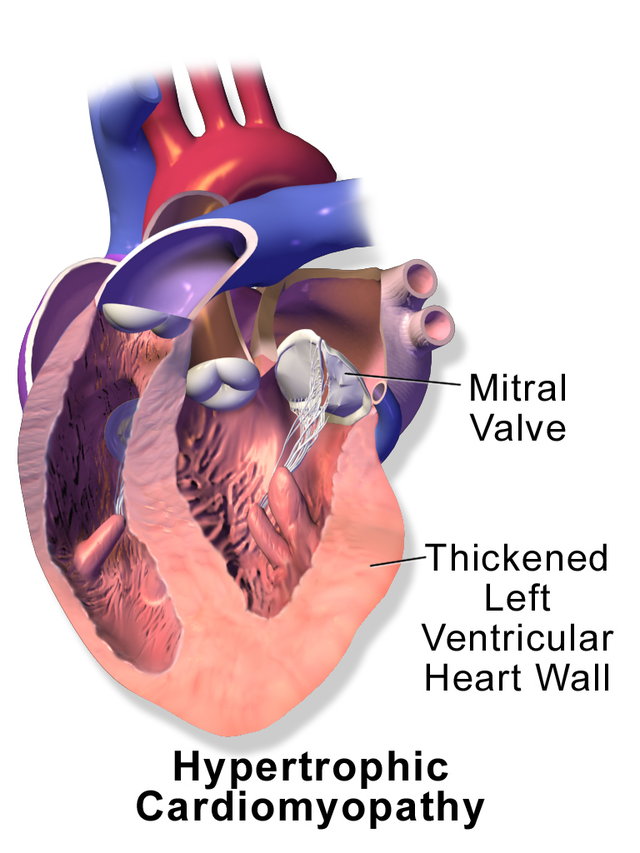
In hypertrophic cardiomyopathy the heart muscle becomes thickened (hypertrophies) in parts of the heart. In the normal heart, the muscle cells are regular and patterned. In hypertrophic cardiomyopathy the cells of the heart muscle become irregular and disordered.
by Dr Colin Tidy, MRCGP

Heart health and blood vessels
Dilated cardiomyopathy causes: what are the risk factors?
Having dilated cardiomyopathy means that your heart muscle is weakened, which affects how your heart pumps blood around your body. There are a wide range of dilated cardiomyopathy causes, including genetics, other health conditions, alcohol consumption and a poor diet. While we can't control some of these risk factors, we can make positive lifestyle changes to reduce our risk of developing dilated cardiomyopathy.
by Amberley Davis

Heart health and blood vessels
Drug trials of new hypertrophic cardiomyopathy treatment brings hope to patients
Hypertrophic cardiomyopathy is a condition where the heart muscle walls are thickened. This interferes with the heart's ability to pump blood around the body. Current medication focuses on hypertrophic cardiomyopathy symptom management, but a new drug that may treat the underlying cause is under review.
by Amberley Davis

Heart health and blood vessels
How to manage stress when living with cardiomyopathy
Living with a long-term condition such as cardiomyopathy can be challenging and easily lead to stress, whether it is about ongoing health problems or treatments, lifestyle changes or the future. Left unchecked, however, stress can exacerbate many health problems.
by Lydia Smith
Related patient information and medicines
Patient information leaflet
Heart disease
There are a number of different conditions that can affect how the heart works. What is heart disease. Dilated cardiomyopathy Dilated c... Restrictive cardiomyopathy: this is a rare form of cardiomyopathy in which the heart muscle is not able to relax completely between heartbeats. Arrhythmogenic right ventricular cardiomyopathy: this is rare and.
Patient information leaflet
Dilated cardiomyopathy
Dilated cardiomyopathy is a condition where the heart muscle becomes stretched and thin. The heart becomes enlarged (dilates) and pumps blood less well. ... These changes often start in the left ventricle (the part of the heart which pumps blood around most of the body), and can then later affect the right ventricle (which pumps blood to the.
Patient information leaflet
Hypertrophic cardiomyopathy
In hypertrophic cardiomyopathy the heart muscle becomes thickened (hypertrophies) in parts of the heart. In the normal heart, the muscle cells are regular and patterned. What is hypertrophic cardiomyopathy. Hypertrophic cardiomyopathy is a disease in which the heart muscle becomes thickened. The muscle surrounding the left ventricle is the area.
Patient information leaflet
Abnormal heart rhythms
An arrhythmia is an abnormal rate and/or rhythm of the heartbeat due to some problem with the electrical conducting system of the heart. What is an arrhythmia. An arrhythmia is an abnormal rate and/or rhythm of the heartbeat. There are various types but all are due to some problem with the electrical conducting system of the heart. Some.
Patient information leaflet
Coronary artery spasm
Coronary artery spasm is a temporary, sudden narrowing of one or more of the coronary arteries. What is a coronary artery spasm. The spasm slows or stops blood... See the separate leaflet called Abnormal heart rhythms (Arrhythmias) for more details Abnormal heart rhythms. Complications of a coronary artery spasm Coronary artery spasm may cause an.
Patient information leaflet
Coronary artery bypass graft
This means stopping smoking How to quit smoking... Complications Heart attack (myocardial infarction). Acute kidney injury Acute kidney injury - kidney problems. Ventricular arrhythmias Abnormal heart rhythms - abnormal heart rhythms which can sometimes be serious. Blood clots developing in the legs ( deep vein thrombosis Deep vein thrombosis ) or.
Further reading and references
- Arrhythmogenic right ventricular cardiomyopathy; MedlinePlus, National Library of Medicine.
- Corrado D, Link MS, Calkins H. Arrhythmogenic Right Ventricular Cardiomyopathy. N Engl J Med. 2017 Jan 5;376(1):61-72. doi: 10.1056/NEJMra1509267. No abstract available.
- Corrado D, Wichter T, Link MS, Hauer RN, Marchlinski FE, Anastasakis A, Bauce B, Basso C, Brunckhorst C, Tsatsopoulou A, Tandri H, Paul M, Schmied C, Pelliccia A, Duru F, Protonotarios N, Estes NM 3rd, McKenna WJ, Thiene G, Marcus FI, Calkins H. Treatment of Arrhythmogenic Right Ventricular Cardiomyopathy/Dysplasia: An International Task Force Consensus Statement. Circulation. 2015 Aug 4;132(5):441-53. doi: 10.1161/CIRCULATIONAHA.115.017944. Epub 2015 Jul 27.
- Marcus FI, McKenna WJ, Sherrill D, Basso C, Bauce B, Bluemke DA, Calkins H, Corrado D, Cox MG, Daubert JP, Fontaine G, Gear K, Hauer R, Nava A, Picard MH, Protonotarios N, Saffitz JE, Sanborn DM, Steinberg JS, Tandri H, Thiene G, Towbin JA, Tsatsopoulou A, Wichter T, Zareba W. Diagnosis of arrhythmogenic right ventricular cardiomyopathy/dysplasia: proposed modification of the task force criteria. Circulation. 2010 Apr 6;121(13):1533-41. doi: 10.1161/CIRCULATIONAHA.108.840827. Epub 2010 Feb 19.
- McNally E, MacLeod H, Dellefave-Castillo L. Arrhythmogenic Right Ventricular Cardiomyopathy Overview. 2005 Apr 18 [updated 2023 May 11]. In: Adam MP, Bick S, Mirzaa GM, Wallace SE, Amemiya A, editors. GeneReviews(R) [Internet]. Seattle (WA): University of Washington, Seattle; 1993-2026. Available from http://www.ncbi.nlm.nih.gov/books/NBK1131/
- Poloni G, De Bortoli M, Calore M, Rampazzo A, Lorenzon A. Arrhythmogenic right-ventricular cardiomyopathy: molecular genetics into clinical practice in the era of next generation sequencing. J Cardiovasc Med (Hagerstown). 2016 Jun;17(6):399-407. doi: 10.2459/JCM.0000000000000385.
- Quarta G, Syrris P, Ashworth M, Jenkins S, Zuborne Alapi K, Morgan J, Muir A, Pantazis A, McKenna WJ, Elliott PM. Mutations in the Lamin A/C gene mimic arrhythmogenic right ventricular cardiomyopathy. Eur Heart J. 2012 May;33(9):1128-36. doi: 10.1093/eurheartj/ehr451. Epub 2011 Dec 23.
- Taylor M, Graw S, Sinagra G, Barnes C, Slavov D, Brun F, Pinamonti B, Salcedo EE, Sauer W, Pyxaras S, Anderson B, Simon B, Bogomolovas J, Labeit S, Granzier H, Mestroni L. Genetic variation in titin in arrhythmogenic right ventricular cardiomyopathy-overlap syndromes. Circulation. 2011 Aug 23;124(8):876-85. doi: 10.1161/CIRCULATIONAHA.110.005405. Epub 2011 Aug 1.
- Te Riele AS, Hauer RN. Arrhythmogenic right ventricular dysplasia/cardiomyopathy: clinical challenges in a changing disease spectrum. Trends Cardiovasc Med. 2015 Apr;25(3):191-8. doi: 10.1016/j.tcm.2014.11.003. Epub 2014 Nov 15.
- van der Zwaag PA, van Rijsingen IA, Asimaki A, Jongbloed JD, van Veldhuisen DJ, Wiesfeld AC, Cox MG, van Lochem LT, de Boer RA, Hofstra RM, Christiaans I, van Spaendonck-Zwarts KY, Lekanne dit Deprez RH, Judge DP, Calkins H, Suurmeijer AJ, Hauer RN, Saffitz JE, Wilde AA, van den Berg MP, van Tintelen JP. Phospholamban R14del mutation in patients diagnosed with dilated cardiomyopathy or arrhythmogenic right ventricular cardiomyopathy: evidence supporting the concept of arrhythmogenic cardiomyopathy. Eur J Heart Fail. 2012 Nov;14(11):1199-207. doi: 10.1093/eurjhf/hfs119. Epub 2012 Jul 20.
Share your thoughts or experiences with others in our patient communities.
Simple access to trusted treatments and health services online.
Common conditions
Get help with common conditions through the NHS, without a GP appointment.





Sign up to the Patient newsletter
Your weekly dose of clear, trustworthy health advice - written to help you feel informed, confident and in control.
By subscribing you accept our Privacy Policy. You can unsubscribe at any time. We never sell your data.