Autosomal dominant leukodystrophy with autonomic disease
Last updated 20 Nov 2025
Meets Patient’s editorial guidelines
- DownloadDownload
- Share
- Language
- Discussion
- Ask Patient
- Audio Version
- Add to preferred sources on Google
Autosomal dominant leukodystrophy with autonomic disease (ADLD) is one of a group of genetic disorders called leukodystrophies. Leukodystrophies are characterised by abnormalities of the nervous system's white matter, which consists of nerve fibers covered by a fatty substance called myelin. Myelin insulates and protects nerve fibers and promotes the rapid transmission of nerve impulses.
Video picks for Genetic conditionsVideo library
Description
Autosomal dominant leukodystrophy with autonomic disease (ADLD) is one of a group of genetic disorders called leukodystrophies. Leukodystrophies are characterised by abnormalities of the nervous system's white matter, which consists of nerve fibers covered by a fatty substance called myelin. Myelin insulates and protects nerve fibers and promotes the rapid transmission of nerve impulses.
People with ADLD develop signs and symptoms of the condition in adulthood, typically in their forties or fifties. The first signs of the condition often involve problems with the autonomic nervous system, which controls involuntary body processes such as the regulation of blood pressure and body temperature. These problems include difficulty with bowel and bladder function, a sharp drop in blood pressure upon standing (orthostatic hypotension), and erectile dysfunction in men. Rarely, people experience an inability to sweat (anhidrosis), which can lead to a dangerously high body temperature.
In ADLD, movement difficulties often develop after the autonomic nervous system problems. Affected individuals can have muscle stiffness (spasticity) or weakness and involuntary rhythmic shaking, called intention tremor because it worsens during movement. People with ADLD often have difficulty coordinating movements (ataxia), including movements that involve judging distance or scale (dysmetria), such as picking up a distant object, and rapidly alternating movements (dysdiadochokinesia), including hand clapping or foot stomping. These movement problems usually first affect the legs, but as the condition worsens, the arms and eventually the face become involved. In some people with ADLD, the symptoms worsen during episodes of fever, infection, or exposure to heat. Due to difficulty walking and an unsteady gait, many affected individuals need a cane, walker, or wheelchair for assistance.
Intelligence is usually unaffected; however, people who have had ADLD for a long time may have a decline in intellectual function (dementia). ADLD worsens slowly, and affected individuals usually survive 10 to 20 years after the onset of symptoms.
Inheritance patterns
The source lists the following possible inheritance patterns: Autosomal dominant. More than one pattern can apply in different cases.
Related genes
Other names
ADLD
Adult-onset autosomal dominant leukodystrophy with autonomic symptoms
Autosomal dominant adult-onset demyelinating leukodystrophy
LMNB1-related adult-onset autosomal dominant leukodystrophy
Patient picks for Genetic conditions

General health and lifestyle
Book a Pharmacy First online consultation
NHS Pharmacy First is a new scheme from the Government and NHS in England. It allows patients to get treatment, including prescription medications where necessary, for common conditions without the need for a GP appointment. Through NHS Pharmacy First, My Local Surgery offers fast, free private online consultations with an NHS pharmacist for quick.
by Thomas Andrew Porteus, MBCS

Children's health
Congenital heart disease
Congenital heart disease is a condition where an abnormality (defect) develops in the heart before birth. There are a number of types of congenital heart defect. Some are mild and cause few problems; others are life-threatening for the baby.
by Dr Mary Harding, MRCGP

Podcasts
Losing it!
Why losing your erection doesn’t have to be the catastrophe you might think it is. Clare and Janet discuss ways to help with erection problems.
by Thomas Andrew Porteus, MBCS

Heart health and blood vessels
Being 'pear-shaped' may lower risk of heart disease in women
A new study of postmenopausal women has shown that women who are 'apple-shaped' rather than 'pear-shaped' are at greater risk of heart and blood vessel problems.
by Milly Evans

Kidney and urinary tract
IgA nephropathy
IgA nephropathy is a condition in which a protein causes damage to the kidneys. The protein is called immunoglobulin A or IgA. Nephropathy means an illness that damages the kidney.
by Dr Colin Tidy, MRCGP

Heart health and blood vessels
Heart disease
The heart is a muscle pump located in the chest, which pumps blood around the body. It keeps pumping from a few weeks after conception until we die. There are a number of different conditions that can affect how the heart works.
by Dr Rachel Hudson, MRCGP
Related patient information and medicines

Patient information leaflet
Huntington's disease
Huntington's disease is a genetically inherited condition that causes parts of the brain and nervous system to stop working properly over time. It is a slowly progressive condition that interferes with the movements of your body, thinking and judgement, and can lead to a change in your behaviour. Huntington's disease is an autosomal dominant.
Patient information leaflet
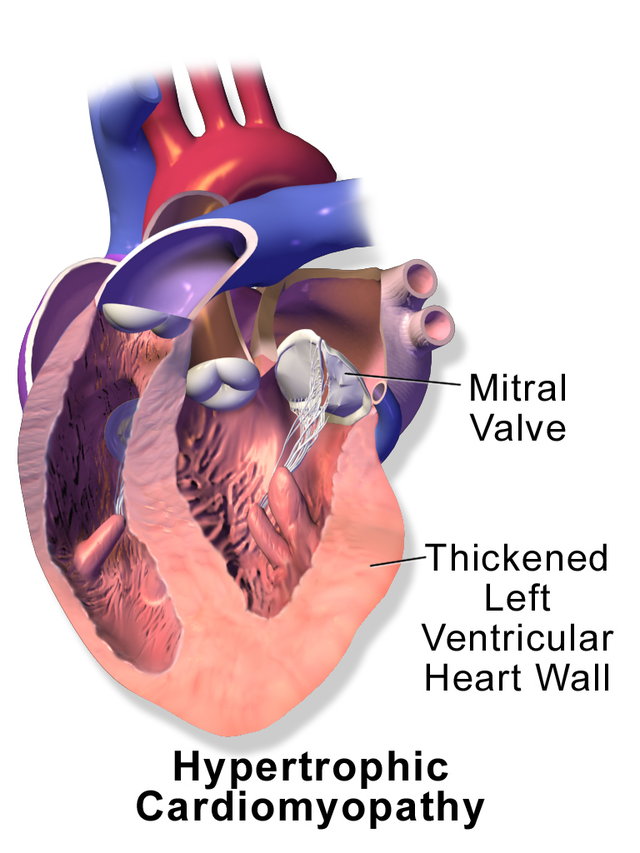
Hypertrophic cardiomyopathy
In hypertrophic cardiomyopathy the heart muscle becomes thickened (hypertrophies) in parts of the heart. In the normal heart, the muscle cells are regular and patterned. Genetics In most cases the condition is inherited. If a couple (where one person has HCM) has a child, there is a 1 in 2 chance of the child being affected. This pattern of.

Patient information leaflet
Wilson's disease
Wilson's disease is a genetic disorder in which copper builds up in the body, mainly in the liver and brain. Without any treatment, the build-up of copper can cause serious symptoms. How is Wilson's disease inherited. Wilson's disease is an autosomal recessive disorder. This means that, in order to develop Wilson's disease, two abnormal ATP7B.

Patient information leaflet
Parkinson's disease
Treatment often provides good relief of symptoms for several... What is Parkinson's disease. Parkinson's disease is a progressive neurological degeneration of certain cells (called dopaminergic cells) within a specific part of the brain (substantia nigra). The deficiency of dopamine leads to a movement disorder with Parkinson's disease symptoms..

Patient information leaflet
Polycystic kidney disease
Polycystic kidney disease (PKD) causes many fluid-filled sacs (cysts) to develop in the kidneys. The most common type of PKD is an inherited condition called autosomal dominant polycystic kidney disease (ADPKD). With ADPKD, problems commonly do not develop until the age of 30-50, with some people never developing any problems. The two common.

Patient information leaflet
Addison's disease
Addison's disease is a condition in which your adrenal glands are not working as well as they should. In Addison's disease the adrenal glands do not produce as much of the steroid hormones (such as cortisol) as they normally do. Treatment is with replacement hormone tablets which you need to take every day. What is Addison's disease. Addison's.
Further reading and references
- Autosomal dominant leukodystrophy with autonomic disease; MedlinePlus, National Library of Medicine.
- Bartoletti-Stella A, Gasparini L, Giacomini C, Corrado P, Terlizzi R, Giorgio E, Magini P, Seri M, Baruzzi A, Parchi P, Brusco A, Cortelli P, Capellari S. Messenger RNA processing is altered in autosomal dominant leukodystrophy. Hum Mol Genet. 2015 May 15;24(10):2746-56. doi: 10.1093/hmg/ddv034. Epub 2015 Jan 30.
- Ferrera D, Canale C, Marotta R, Mazzaro N, Gritti M, Mazzanti M, Capellari S, Cortelli P, Gasparini L. Lamin B1 overexpression increases nuclear rigidity in autosomal dominant leukodystrophy fibroblasts. FASEB J. 2014 Sep;28(9):3906-18. doi: 10.1096/fj.13-247635. Epub 2014 May 22.
- Finnsson J, Sundblom J, Dahl N, Melberg A, Raininko R. LMNB1-related autosomal-dominant leukodystrophy: Clinical and radiological course. Ann Neurol. 2015 Sep;78(3):412-25. doi: 10.1002/ana.24452. Epub 2015 Jul 27.
- Giorgio E, Robyr D, Spielmann M, Ferrero E, Di Gregorio E, Imperiale D, Vaula G, Stamoulis G, Santoni F, Atzori C, Gasparini L, Ferrera D, Canale C, Guipponi M, Pennacchio LA, Antonarakis SE, Brussino A, Brusco A. A large genomic deletion leads to enhancer adoption by the lamin B1 gene: a second path to autosomal dominant adult-onset demyelinating leukodystrophy (ADLD). Hum Mol Genet. 2015 Jun 1;24(11):3143-54. doi: 10.1093/hmg/ddv065. Epub 2015 Feb 20.
- Giorgio E, Rolyan H, Kropp L, Chakka AB, Yatsenko S, Di Gregorio E, Lacerenza D, Vaula G, Talarico F, Mandich P, Toro C, Pierre EE, Labauge P, Capellari S, Cortelli P, Vairo FP, Miguel D, Stubbolo D, Marques LC, Gahl W, Boespflug-Tanguy O, Melberg A, Hassin-Baer S, Cohen OS, Pjontek R, Grau A, Klopstock T, Fogel B, Meijer I, Rouleau G, Bouchard JP, Ganapathiraju M, Vanderver A, Dahl N, Hobson G, Brusco A, Brussino A, Padiath QS. Analysis of LMNB1 duplications in autosomal dominant leukodystrophy provides insights into duplication mechanisms and allele-specific expression. Hum Mutat. 2013 Aug;34(8):1160-71. doi: 10.1002/humu.22348. Epub 2013 May 28.
- Heng MY, Lin ST, Verret L, Huang Y, Kamiya S, Padiath QS, Tong Y, Palop JJ, Huang EJ, Ptacek LJ, Fu YH. Lamin B1 mediates cell-autonomous neuropathology in a leukodystrophy mouse model. J Clin Invest. 2013 Jun;123(6):2719-29. doi: 10.1172/JCI66737. Epub 2013 May 15.
- Padiath QS, Saigoh K, Schiffmann R, Asahara H, Yamada T, Koeppen A, Hogan K, Ptacek LJ, Fu YH. Lamin B1 duplications cause autosomal dominant leukodystrophy. Nat Genet. 2006 Oct;38(10):1114-23. doi: 10.1038/ng1872. Epub 2006 Sep 3.
- Rolyan H, Tyurina YY, Hernandez M, Amoscato AA, Sparvero LJ, Nmezi BC, Lu Y, Estecio MR, Lin K, Chen J, He RR, Gong P, Rigatti LH, Dupree J, Bayir H, Kagan VE, Casaccia P, Padiath QS. Defects of Lipid Synthesis Are Linked to the Age-Dependent Demyelination Caused by Lamin B1 Overexpression. J Neurosci. 2015 Aug 26;35(34):12002-17. doi: 10.1523/JNEUROSCI.1668-15.2015.
Share your thoughts or experiences with others in our patient communities.
Simple access to trusted treatments and health services online.
Common conditions
Get help with common conditions through the NHS, without a GP appointment.





Sign up to the Patient newsletter
Your weekly dose of clear, trustworthy health advice - written to help you feel informed, confident and in control.
By subscribing you accept our Privacy Policy. You can unsubscribe at any time. We never sell your data.