calcium voltage-gated channel subunit alpha1 F
Last updated 21 Jun 2024
Meets Patient’s editorial guidelines
- DownloadDownload
- Share
- Language
- Discussion
- Ask Patient
- Audio Version
- Add to preferred sources on Google
The CACNA1F gene belongs to a family of genes that provide instructions for making calcium channels. These channels, which transport positively charged calcium atoms (calcium ions) across cell membranes, play a key role in a cell's ability to generate and transmit electrical signals.
Video picks for GenesVideo library
Normal function
The CACNA1F gene belongs to a family of genes that provide instructions for making calcium channels. These channels, which transport positively charged calcium atoms (calcium ions) across cell membranes, play a key role in a cell's ability to generate and transmit electrical signals.
The CACNA1F gene provides instructions for making one part (the alpha-1 subunit) of a calcium channel called CaV1.4. This subunit forms the hole (pore) in the cell membrane through which calcium ions can flow. CaV1.4 channels are found in many types of cells, although they play a particularly important role in a specialized tissue at the back of the eye called the retina. Within the retina, the channels are located in light-detecting cells called photoreceptors. The retina contains two types of photoreceptors: rods and cones. Rods are needed for vision in low light. Cones are needed for vision in bright light, including colour vision.
CaV1.4 channels play a critical role in normal vision. Studies suggest they help relay visual signals from rods and cones to other retinal cells called bipolar cells. This signaling is an essential step in the transmission of visual information from the eyes to the brain.
Conditions referring to this gene or chromosome
Other names
CAC1F_HUMAN
Cav1.4
Cav1.4alpha1
Patient picks for Genes

Treatment and medication
Calcium channel blockers
Calcium channel blockers (sometimes called calcium antagonists) are a group of medicines that affect the way calcium passes into certain muscle cells. They are commonly prescribed to manage high blood pressure, angina, Raynaud's phenomenon and some abnormal heart rhythms (arrhythmias). They are also used to try to stop premature labour in pregnancy. A calcium-channel blocker can be used alone. However, one is often combined with another medicine to treat high blood pressure or angina, when one medicine alone has not worked so well.
by Dr Toni Hazell, FRCGP

Drug interactions checker
Can I take Levothyroxine and Calcium together?
Taking calcium at the same time as levothyroxine can stop your thyroid medication from working properly. This can lead to symptoms of an underactive thyroid, such as feeling very tired, feeling cold, or gaining weight.

Drug interactions checker
Can I take Calcium and Doxycycline together?
Taking calcium at the same time as doxycycline can stop the antibiotic from working properly. The calcium attaches to the medicine in your stomach, which prevents your body from absorbing it into your bloodstream. This means the infection you are treating might not clear up as it should.
Mental health
Mind and body control - how to channel your ‘internal telekinesis’
The dark nights have arrived, and right on cue, Mike Flanagan has turned his attention to one of Stephen King’s most iconic tales of teenage torment and supernatural terror... Carrie. The story of a schoolgirl with telekinetic powers - the fictional ability to move objects using the mind alone - has gripped our morbid imaginations for decades. Little wonder, then, that this horror classic is getting a new lease of life in a television adaptation. But while we ourselves may not be able to bend spoons or move furniture, we do possess our own real-world form of ‘internal-telekinesis’. Through mental focus and controlled breathing, we can influence our heart rate and help calm an overworked nervous system.
by Hannah Boynton-Forshaw

Medicine
Verapamil - a calcium-channel blocker
You can take verapamil either before or after meals. Do not drink grapefruit juice whilst you are on verapamil. The most common side-effect of treatment is constipation.
by Michael Stewart, MRPharmS

Drug interactions checker
Can I take Calcium and Ezetimibe together?
There is no known interaction between calcium supplements and ezetimibe. Taking these two together is generally considered safe and should not affect how well your cholesterol medication works.
Related patient information and medicines

Patient information leaflet
Heart valve disease
A heart valve that is diseased or damaged can affect the flow of blood through the heart. If rheumatic fever is the cause then symptoms often start between the ages of 20 and 50 years, ... Other causes of heart valve disease Other causes of heart valve disease include: Deposits of calcium (calcification) in parts of the valve. This is the most.

Patient information leaflet
Swollen legs
This type may be called 'dependent oedema' by a healthcare professional. For most people, this oedema affects their legs and tends to improve overnight after you have had your legs up... Conditions causing low protein levels include malnutrition, nephrotic syndrome, liver failure, Liver failure and a gut condition called protein-losing.

Patient information leaflet
Angina
Angina is a pain that comes from the heart. It is usually caused by narrowing of the heart's ... Other treatments that may be advised Other medicines to prevent angina pains A beta-blocker may be sufficient to prevent angina pains but other medicines are available if required. They fall into three main groups: Calcium-channel blockers Calcium.
Patient information leaflet
Raynaud's phenomenon
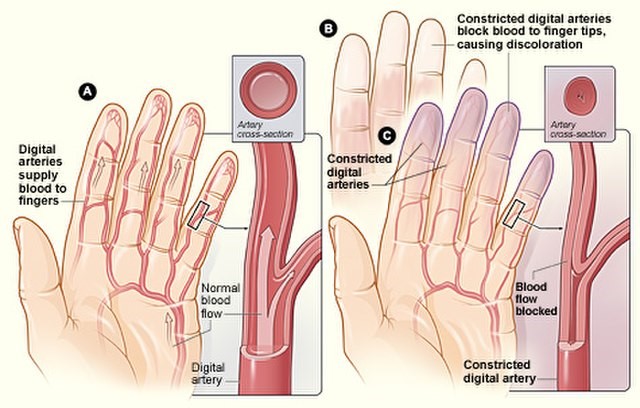
Treatment... Symptoms are much less likely to occur, and be less severe, if you keep warm (described above). Other treatments are needed only in some cases. Medication A calcium-channel blocker Calcium channel blockers called nifedipine Nifedipine may be advised if symptoms are severe. It works by 'opening up' (dilating) the small blood vessels..

Patient information leaflet
Anal fissure
These types of fissures are not dealt with in this leaflet. ServiceUpsellPlaceholder How common are anal fissures. Anal fissures are common and probably affect about 1 in 350 people each year. Other medicines Some studies have shown that other medicines may also help relax the anal... For example, medicines called calcium-channel blockers Calcium.

Patient information leaflet
Kidney cancer
A swelling in the area over a kidney. Anaemia, which can cause tiredness and paleness. Some renal cell tumours produce abnormal amounts of certain hormones. This can lead to problems such as: A high blood calcium level which can cause various symptoms, such as increased thirst, feeling sick, tiredness, and constipation. Too many red blood cells.
Further reading and references
- calcium voltage-gated channel subunit alpha1 F; MedlinePlus, National Library of Medicine.
- Bech-Hansen NT, Naylor MJ, Maybaum TA, Pearce WG, Koop B, Fishman GA, Mets M, Musarella MA, Boycott KM. Loss-of-function mutations in a calcium-channel alpha1-subunit gene in Xp11.23 cause incomplete X-linked congenital stationary night blindness. Nat Genet. 1998 Jul;19(3):264-7. doi: 10.1038/947.
- Boycott KM, Maybaum TA, Naylor MJ, Weleber RG, Robitaille J, Miyake Y, Bergen AA, Pierpont ME, Pearce WG, Bech-Hansen NT. A summary of 20 CACNA1F mutations identified in 36 families with incomplete X-linked congenital stationary night blindness, and characterization of splice variants. Hum Genet. 2001 Feb;108(2):91-7. doi: 10.1007/s004390100461.
- Hoda JC, Zaghetto F, Koschak A, Striessnig J. Congenital stationary night blindness type 2 mutations S229P, G369D, L1068P, and W1440X alter channel gating or functional expression of Ca(v)1.4 L-type Ca2+ channels. J Neurosci. 2005 Jan 5;25(1):252-9. doi: 10.1523/JNEUROSCI.3054-04.2005.
- Hoda JC, Zaghetto F, Singh A, Koschak A, Striessnig J. Effects of congenital stationary night blindness type 2 mutations R508Q and L1364H on Cav1.4 L-type Ca2+ channel function and expression. J Neurochem. 2006 Mar;96(6):1648-58. doi: 10.1111/j.1471-4159.2006.03678.x. Epub 2006 Feb 10.
- Jalkanen R, Bech-Hansen NT, Tobias R, Sankila EM, Mantyjarvi M, Forsius H, de la Chapelle A, Alitalo T. A novel CACNA1F gene mutation causes Aland Island eye disease. Invest Ophthalmol Vis Sci. 2007 Jun;48(6):2498-502. doi: 10.1167/iovs.06-1103.
- Jalkanen R, Mantyjarvi M, Tobias R, Isosomppi J, Sankila EM, Alitalo T, Bech-Hansen NT. X linked cone-rod dystrophy, CORDX3, is caused by a mutation in the CACNA1F gene. J Med Genet. 2006 Aug;43(8):699-704. doi: 10.1136/jmg.2006.040741. Epub 2006 Feb 27.
- Koschak A, Fernandez-Quintero ML, Heigl T, Ruzza M, Seitter H, Zanetti L. Cav1.4 dysfunction and congenital stationary night blindness type 2. Pflugers Arch. 2021 Sep;473(9):1437-1454. doi: 10.1007/s00424-021-02570-x. Epub 2021 Jul 1.
- MacDonald IM, Hoang S, Tuupanen S. X-Linked Congenital Stationary Night Blindness. 2008 Jan 16 [updated 2019 Jul 3]. In: Adam MP, Bick S, Mirzaa GM, Wallace SE, Amemiya A, editors. GeneReviews(R) [Internet]. Seattle (WA): University of Washington, Seattle; 1993-2026. Available from http://www.ncbi.nlm.nih.gov/books/NBK1245/
- McRory JE, Hamid J, Doering CJ, Garcia E, Parker R, Hamming K, Chen L, Hildebrand M, Beedle AM, Feldcamp L, Zamponi GW, Snutch TP. The CACNA1F gene encodes an L-type calcium channel with unique biophysical properties and tissue distribution. J Neurosci. 2004 Feb 18;24(7):1707-18. doi: 10.1523/JNEUROSCI.4846-03.2004.
- Peloquin JB, Rehak R, Doering CJ, McRory JE. Functional analysis of congenital stationary night blindness type-2 CACNA1F mutations F742C, G1007R, and R1049W. Neuroscience. 2007 Dec 5;150(2):335-45. doi: 10.1016/j.neuroscience.2007.09.021. Epub 2007 Sep 14.
- Strom TM, Nyakatura G, Apfelstedt-Sylla E, Hellebrand H, Lorenz B, Weber BH, Wutz K, Gutwillinger N, Ruther K, Drescher B, Sauer C, Zrenner E, Meitinger T, Rosenthal A, Meindl A. An L-type calcium-channel gene mutated in incomplete X-linked congenital stationary night blindness. Nat Genet. 1998 Jul;19(3):260-3. doi: 10.1038/940.
- Wutz K, Sauer C, Zrenner E, Lorenz B, Alitalo T, Broghammer M, Hergersberg M, de la Chapelle A, Weber BH, Wissinger B, Meindl A, Pusch CM. Thirty distinct CACNA1F mutations in 33 families with incomplete type of XLCSNB and Cacna1f expression profiling in mouse retina. Eur J Hum Genet. 2002 Aug;10(8):449-56. doi: 10.1038/sj.ejhg.5200828.
- Wygledowska-Promienska D, Swierczynska M, Spiewak D, Pojda-Wilczek D, Tronina A, Dorecka M, Smedowski A. Aland Island Eye Disease with Retinoschisis in the Clinical Spectrum of CACNA1F-Associated Retinopathy-A Case Report. Int J Mol Sci. 2024 Mar 2;25(5):2928. doi: 10.3390/ijms25052928.
- Zeitz C, Robson AG, Audo I. Congenital stationary night blindness: an analysis and update of genotype-phenotype correlations and pathogenic mechanisms. Prog Retin Eye Res. 2015 Mar;45:58-110. doi: 10.1016/j.preteyeres.2014.09.001. Epub 2014 Oct 13.
Share your thoughts or experiences with others in our patient communities.
Simple access to trusted treatments and health services online.
Common conditions
Get help with common conditions through the NHS, without a GP appointment.





Sign up to the Patient newsletter
Your weekly dose of clear, trustworthy health advice - written to help you feel informed, confident and in control.
By subscribing you accept our Privacy Policy. You can unsubscribe at any time. We never sell your data.