cyclic nucleotide gated channel subunit beta 3
Last updated 14 Aug 2025
Meets Patient’s editorial guidelines
- DownloadDownload
- Share
- Language
- Discussion
- Ask Patient
- Audio Version
- Add to preferred sources on Google
The CNGB3 gene provides instructions for making one part (the beta subunit) of the cyclic nucleotide-gated (CNG) channel. These channels are found exclusively in light-sensing (photoreceptor) cells called cones, which are located in a specialized tissue at the back of the eye (retina). Cones provide colour vision and vision in bright light (daytime vision). Other photoreceptor cells, called rods, provide vision in low light (night vision).
Video picks for GenesVideo library
Normal function
The CNGB3 gene provides instructions for making one part (the beta subunit) of the cyclic nucleotide-gated (CNG) channel. These channels are found exclusively in light-sensing (photoreceptor) cells called cones, which are located in a specialized tissue at the back of the eye (retina). Cones provide colour vision and vision in bright light (daytime vision). Other photoreceptor cells, called rods, provide vision in low light (night vision).
CNG channels are openings in the cell membrane that transport positively charged atoms (ions) into cells. The CNG channels in cones remain open in low light, allowing ions to flow in. When light enters the eye, these channels close, stopping the flow of ions. This change in ion transport alters the cone's electrical charge, which ultimately generates a signal. This signal is sent to the brain, where it combines with other visual information and is interpreted as vision. The process of translating light into an electrical signal is called phototransduction.
Conditions referring to this gene or chromosome
Other names
ACHM3
achromatopsia (rod monochromacy) 3
cyclic nucleotide gated channel beta 3
Patient picks for Genes

Mental health
Mind and body control - how to channel your ‘internal telekinesis’
The dark nights have arrived, and right on cue, Mike Flanagan has turned his attention to one of Stephen King’s most iconic tales of teenage torment and supernatural terror... Carrie. The story of a schoolgirl with telekinetic powers - the fictional ability to move objects using the mind alone - has gripped our morbid imaginations for decades. Little wonder, then, that this horror classic is getting a new lease of life in a television adaptation. But while we ourselves may not be able to bend spoons or move furniture, we do possess our own real-world form of ‘internal-telekinesis’. Through mental focus and controlled breathing, we can influence our heart rate and help calm an overworked nervous system.
by Hannah Boynton-Forshaw

Treatment and medication
Extended-spectrum beta-lactamases
Extended-spectrum beta-lactamases (ESBLs) have so far only been reported in certain bacteria called Gram-negative bacterial infections.
by Dr Colin Tidy, MRCGP

Treatment and medication
Calcium channel blockers
Calcium channel blockers (sometimes called calcium antagonists) are a group of medicines that affect the way calcium passes into certain muscle cells. They are commonly prescribed to manage high blood pressure, angina, Raynaud's phenomenon and some abnormal heart rhythms (arrhythmias). They are also used to try to stop premature labour in pregnancy. A calcium-channel blocker can be used alone. However, one is often combined with another medicine to treat high blood pressure or angina, when one medicine alone has not worked so well.
by Dr Toni Hazell, FRCGP

Drug interactions checker
Can I take Betahistine and Citalopram together?
There are no known significant interactions between betahistine and citalopram. It is generally considered safe to take these two medicines together.

Treatment and medication
Beta-blockers
Beta-blockers are medicines that are used to treat a variety of conditions. Their full correct name is beta-adrenoceptor blocking medicines (or beta-adrenergic blocking agents), but they are commonly just called beta-blockers.
by Dr Rosalyn Adleman, MRCGP
Digestive health
Cyclical vomiting syndrome
Cyclical vomiting syndrome is a condition which occurs mainly in children but can also affect adults. It is more common in people who have migraines. Children have severe episodes of feeling sick (nausea) and being sick (vomiting), sometimes with other symptoms. In between these episodes the person is completely well. There are various treatments available to reduce the frequency of these episodes and also to improve the symptoms when they occur.
by Dr Philippa Vincent, MRCGP
Related patient information and medicines

Patient information leaflet
Thalassaemia
Thalassaemia is an inherited condition affecting the blood. For the more severe forms of thalassaemia, modern treatment gives a good outlook, but lifelong monitoring and treatment are needed. Thalassaemia is an inherited (genetic) condition affecting the blood. The cause is an inherited (genetic) change, involving the genes which tell the body how.

Patient information leaflet
Heart valve disease
Heart valves sit in between the chambers of the heart and control the blood flow through the heart. There are four common types of heart valve problem - mitral stenosis, mitral regurgitation , aortic stenosis and aortic regurgitation. The leaflet called Anatomy of the heart includes details about the function of the heart and how the heart beats..
Patient information leaflet
Raynaud's phenomenon
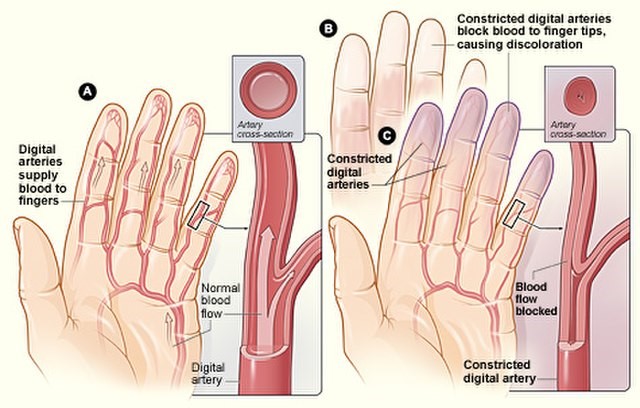
Raynaud's phenomenon (often just called Raynaud's), is a condition where the small blood vessels of the fingers become narrow (constrict). This happens most often when they are in a cool environment. If you have severe symptoms, or symptoms that are easily triggered then portable heat packs and battery-heated gloves and socks are useful. The.

Patient information leaflet
Can I take Bisoprolol and Trimbow together?
Bisoprolol may cause the airways to narrow, making it harder to breathe and potentially triggering asthma or COPD symptoms. It also makes the formoterol in the Trimbow inhaler less effective at opening your airways. Why this happens Bisoprolol is a 'beta-blocker' and formoterol (in Trimbow) is a 'beta-agonist'. They compete for the same receptors.
Patient information leaflet
Migraine treatment
Prochlorperazine Prochlorperazine comes in a buccal form which dissolves between the gum and cheek. The National Institute for Health and Care Excellence (NICE) has updated its guidance on using metoclopramide or prochlorperazine for people with migraine. Combinations of medicines Some brands of migraine tablets contain both a painkiller and an.

Patient information leaflet
Glaucoma
Mos... However, in order to preserve your sight, it is very important that you follow the treatment plan outlined by your doctor. Is glaucoma a disability. Glaucoma can be considered a disability if it causes significant vision loss that affects daily life. In the UK, you may be eligible for certain benefits or support if your sight is severely.
Further reading and references
- cyclic nucleotide gated channel subunit beta 3; MedlinePlus, National Library of Medicine.
- Hirji N, Aboshiha J, Georgiou M, Bainbridge J, Michaelides M. Achromatopsia: clinical features, molecular genetics, animal models and therapeutic options. Ophthalmic Genet. 2018 Apr;39(2):149-157. doi: 10.1080/13816810.2017.1418389. Epub 2018 Jan 5.
- Johnson S, Michaelides M, Aligianis IA, Ainsworth JR, Mollon JD, Maher ER, Moore AT, Hunt DM. Achromatopsia caused by novel mutations in both CNGA3 and CNGB3. J Med Genet. 2004 Feb;41(2):e20. doi: 10.1136/jmg.2003.011437. No abstract available.
- Kohl S, Baumann B, Broghammer M, Jagle H, Sieving P, Kellner U, Spegal R, Anastasi M, Zrenner E, Sharpe LT, Wissinger B. Mutations in the CNGB3 gene encoding the beta-subunit of the cone photoreceptor cGMP-gated channel are responsible for achromatopsia (ACHM3) linked to chromosome 8q21. Hum Mol Genet. 2000 Sep 1;9(14):2107-16. doi: 10.1093/hmg/9.14.2107.
- Kohl S, Jagle H, Wissinger B, Zobor D. Achromatopsia. 2004 Jun 24 [updated 2018 Sep 20]. In: Adam MP, Bick S, Mirzaa GM, Wallace SE, Amemiya A, editors. GeneReviews(R) [Internet]. Seattle (WA): University of Washington, Seattle; 1993-2026. Available from http://www.ncbi.nlm.nih.gov/books/NBK1418/
- Kohl S, Varsanyi B, Antunes GA, Baumann B, Hoyng CB, Jagle H, Rosenberg T, Kellner U, Lorenz B, Salati R, Jurklies B, Farkas A, Andreasson S, Weleber RG, Jacobson SG, Rudolph G, Castellan C, Dollfus H, Legius E, Anastasi M, Bitoun P, Lev D, Sieving PA, Munier FL, Zrenner E, Sharpe LT, Cremers FP, Wissinger B. CNGB3 mutations account for 50% of all cases with autosomal recessive achromatopsia. Eur J Hum Genet. 2005 Mar;13(3):302-8. doi: 10.1038/sj.ejhg.5201269.
- Michaelides M, Aligianis IA, Ainsworth JR, Good P, Mollon JD, Maher ER, Moore AT, Hunt DM. Progressive cone dystrophy associated with mutation in CNGB3. Invest Ophthalmol Vis Sci. 2004 Jun;45(6):1975-82. doi: 10.1167/iovs.03-0898.
- Michalakis S, Gerhardt M, Rudolph G, Priglinger S, Priglinger C. Achromatopsia: Genetics and Gene Therapy. Mol Diagn Ther. 2022 Jan;26(1):51-59. doi: 10.1007/s40291-021-00565-z. Epub 2021 Dec 3.
- Sundin OH, Yang JM, Li Y, Zhu D, Hurd JN, Mitchell TN, Silva ED, Maumenee IH. Genetic basis of total colourblindness among the Pingelapese islanders. Nat Genet. 2000 Jul;25(3):289-93. doi: 10.1038/77162.
- Thiadens AA, Roosing S, Collin RW, van Moll-Ramirez N, van Lith-Verhoeven JJ, van Schooneveld MJ, den Hollander AI, van den Born LI, Hoyng CB, Cremers FP, Klaver CC. Comprehensive analysis of the achromatopsia genes CNGA3 and CNGB3 in progressive cone dystrophy. Ophthalmology. 2010 Apr;117(4):825-30.e1. doi: 10.1016/j.ophtha.2009.09.008. Epub 2010 Jan 15.
- Wiszniewski W, Lewis RA, Lupski JR. Achromatopsia: the CNGB3 p.T383fsX mutation results from a founder effect and is responsible for the visual phenotype in the original report of uniparental disomy 14. Hum Genet. 2007 May;121(3-4):433-9. doi: 10.1007/s00439-006-0314-y. Epub 2007 Jan 31.
Share your thoughts or experiences with others in our patient communities.
Simple access to trusted treatments and health services online.
Common conditions
Get help with common conditions through the NHS, without a GP appointment.





Sign up to the Patient newsletter
Your weekly dose of clear, trustworthy health advice - written to help you feel informed, confident and in control.
By subscribing you accept our Privacy Policy. You can unsubscribe at any time. We never sell your data.