collagen like tail subunit of asymmetric acetylcholinesterase
Last updated 13 Feb 2026
Meets Patient’s editorial guidelines
- DownloadDownload
- Share
- Language
- Discussion
- Ask Patient
- Audio Version
- Add to preferred sources on Google
The COLQ gene provides instructions for making a protein called acetylcholinesterase collagenic tail peptide. This protein plays an important role in the neuromuscular junction, which is the area between nerve cells and muscle cells where signals are passed on to trigger muscle movement.
Video picks for GenesVideo library
Normal function
The COLQ gene provides instructions for making a protein called acetylcholinesterase collagenic tail peptide. This protein plays an important role in the neuromuscular junction, which is the area between nerve cells and muscle cells where signals are passed on to trigger muscle movement.
The acetylcholinesterase collagenic tail peptide anchors another protein called acetylcholinesterase to the muscle cell at the neuromuscular junction. The acetylcholinesterase collagenic tail peptide is made up of three identical parts (subunits). Each subunit attaches (binds) to a bundle of four acetylcholinesterase proteins. Acetylcholinesterase plays a role in regulating the signaling between nerve cells and muscle cells by breaking down the signaling protein acetylcholine.
Conditions referring to this gene or chromosome
Other names
acetylcholinesterase collagenic tail peptide
acetylcholinesterase-associated collagen
AChE Q subunit
collagenic tail of endplate acetylcholinesterase
COLQ_HUMAN
Patient picks for Genes

Drug interactions checker
Can I take Adcal-D3 and Collagen together?
There is no known harmful interaction between Adcal-D3 and collagen supplements. In fact, they are often used together to support bone and joint health.

Drug interactions checker
Can I take Candesartan and Collagen together?
There are no known significant interactions between candesartan and collagen supplements. It is generally considered safe to take these together.

Drug interactions checker
Can I take Carbocisteine and Collagen together?
There are no known interactions between carbocisteine and collagen supplements. It is generally considered safe to take these two substances together.

Drug interactions checker
Can I take Biotin and Collagen together?
There are no known harmful interactions between biotin and collagen. In fact, they are frequently taken together in 'hair, skin, and nails' supplements because they work in different ways to support the body's connective tissues.
Diet and nutrition
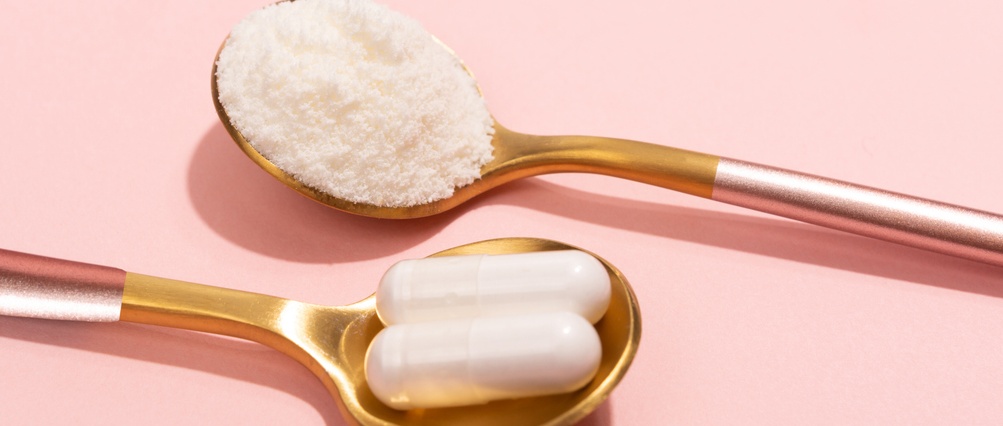
Can collagen supplements boost your health?
As we age, our body's natural collagen production decreases. This fact has prompted many people to consider taking collagen supplements - not only for their cosmetic benefits but for potential health improvements too.
by Victoria Raw

Drug interactions checker
Can I take Collagen and Omega-3 together?
There are no known harmful interactions between collagen and omega-3 supplements. In fact, they are often taken together to support skin, joint, and heart health.
Related patient information and medicines

Patient information leaflet
Alzheimer's disease
Other ways to help with anxiety, depression and difficulties with behaviour include aromatherapy, music and dance, using animals as therapy, massage and exercise. Medicines used for Alzheimer's disease include acetylcholinesterase (AChE) inhibitors ( donepezil Donepezil for dementia , galantamine Galantamine or rivastigmine Rivastigmine ) or.

Patient information leaflet
Medication and treatment for dementia
Medicines for dementia work by increasing the levels of certain chemical messengers in the brain. Acetylcholinesterase inhibitors These include donepezil , rivastigmine and galantamine. They work by increasing the level of acetylcholine. Also, an acetylcholinesterase inhibitor medicine may sometimes be suggested for people with dementia with Lewy.

Patient information leaflet
Lip enhancement
This leaflet is provided by the British Association of Aesthetic Plastic Surgeons , the professional body responsible for the advancement of education and safety in aesthetic plastic surgery. This is suitable for anyone who would like larger or f... The bulk of the lip can be increased by injections into the muscle but these tend to dissolve at a.
Patient information leaflet
Systemic sclerosis
Systemic sclerosis is a type of scleroderma, which means hard skin. If you have scleroderma, you have areas of hardening of the skin. A number of different influences seem to... What is known is that cells called fibroblasts are affected by the immune system in some way and make too much of a protein called collagen. The collagen gets deposited in.

Patient information leaflet
Dupuytren's contracture
Injection treatment Steroid injections may be beneficial for some people with painful nodules and cords in the palm, but only if there is no contracture or loss of function. In some cases, injection of a collagenase (which dissolves collagen), or of a biologic drug (which suppresses the immune system) may be helpful. These last two are not.
Patient information leaflet
Can I take Adcal-D3 and Collagen together?
There is no known harmful interaction between Adcal-D3 and collagen supplements. In fact, they are often used together to support bone and joint health. Why this happens Adcal-D3 provides calcium and vitamin D3, while collagen provides amino acids. These substances are processed by the body through different pathways and do not interfere with each.
Further reading and references
- collagen like tail subunit of asymmetric acetylcholinesterase; MedlinePlus, National Library of Medicine.
- Abicht A, Muller JS, Lochmuller H. Congenital Myasthenic Syndromes Overview. 2003 May 9 [updated 2021 Dec 23]. In: Adam MP, Bick S, Mirzaa GM, Wallace SE, Amemiya A, editors. GeneReviews(R) [Internet]. Seattle (WA): University of Washington, Seattle; 1993-2026. Available from http://www.ncbi.nlm.nih.gov/books/NBK1168/
- Eshaghian T, Rabbani B, Badv RS, Mikaeeli S, Gharib B, Iyadurai S, Mahdieh N. COLQ-related congenital myasthenic syndrome: An integrative view. Neurogenetics. 2023 Jul;24(3):189-200. doi: 10.1007/s10048-023-00719-7. Epub 2023 May 25.
- Ohno K, Ito M, Ohkawara B. Review of 40 genes causing congenital myasthenic syndromes. J Hum Genet. 2025 Jun 18. doi: 10.1038/s10038-025-01355-9. Online ahead of print.
- Shao S, Shi G, Bi FF, Huang K. Pharmacological Treatments for Congenital Myasthenic Syndromes Caused by COLQ Mutations. Curr Neuropharmacol. 2023;21(7):1594-1605. doi: 10.2174/1570159X21666230126145652.
- Spendiff S, Lochmuller H, Maselli RA. Congenital myasthenic syndromes. Int Rev Neurobiol. 2025;182:253-274. doi: 10.1016/bs.irn.2025.04.025. Epub 2025 May 16.
Share your thoughts or experiences with others in our patient communities.
Simple access to trusted treatments and health services online.
Common conditions
Get help with common conditions through the NHS, without a GP appointment.





Sign up to the Patient newsletter
Your weekly dose of clear, trustworthy health advice - written to help you feel informed, confident and in control.
By subscribing you accept our Privacy Policy. You can unsubscribe at any time. We never sell your data.