ring finger protein 216
Last updated 18 Aug 2020
Meets Patient’s editorial guidelines
- DownloadDownload
- Share
- Language
- Discussion
- Ask Patient
- Audio Version
- Add to preferred sources on Google
The RNF216 gene provides instructions for making a protein that plays a role in the ubiquitin-proteasome system, which is the cell machinery that breaks down (degrades) unwanted proteins. Specifically, this protein functions as an E3 ubiquitin ligase. E3 ubiquitin ligases form part of a protein complex that tags damaged or excess proteins with molecules called ubiquitin. Ubiquitin serves as a signal to specialized cell structures known as proteasomes, which attach (bind) to the tagged proteins and degrade them.
Video picks for GenesVideo library
Normal function
The RNF216 gene provides instructions for making a protein that plays a role in the ubiquitin-proteasome system, which is the cell machinery that breaks down (degrades) unwanted proteins. Specifically, this protein functions as an E3 ubiquitin ligase. E3 ubiquitin ligases form part of a protein complex that tags damaged or excess proteins with molecules called ubiquitin. Ubiquitin serves as a signal to specialized cell structures known as proteasomes, which attach (bind) to the tagged proteins and degrade them.
The RNF216 protein tags proteins involved in an early immune response called inflammation to help control the response. RNF216 also regulates the amount of a protein in nerve cells (neurons) called Arc, which plays a role in a process called synaptic plasticity. Synaptic plasticity is the ability of the connections between neurons (synapses) to change and adapt over time in response to experience. This process is critical for learning and memory. It is likely that the RNF216 protein also regulates proteins involved in other body processes, although these proteins have not been identified.
Conditions referring to this gene or chromosome
Other names
CAHH
E3 ubiquitin-protein ligase RNF216 isoform a
E3 ubiquitin-protein ligase RNF216 isoform b
RING-type E3 ubiquitin transferase RNF216
triad domain-containing protein 3
TRIAD3
U7I1
UBCE7IP1
ubiquitin-conjugating enzyme 7-interacting protein 1
ZIN
zinc finger protein inhibiting NF-kappa-B
Patient picks for Genes

Skin, nail and hair health
Eczema, psoriasis, and ringworm: what's the difference?
Red skin rashes are very common but it's often difficult to find what causes them because their symptoms are often similar. Three of the most common causes are eczema, psoriasis and ringworm. Getting the diagnosis right is important because the treatment for each of them is very different.
by Dr Colin Tidy, MRCGP
Diet and nutrition
How a protein-packed breakfast can boost your health
When we think of breakfast, we often picture a bowl of cornflakes with milk. While it’s a classic morning staple, it might not be the most effective way to start your day, as it lacks protein. Adding more protein to your breakfast can boost your energy levels and help keep you feeling full for longer.
by Victoria Raw

Diet and nutrition
How much protein do you need to build muscle?
If you wish to build muscle, there is no escaping the importance of protein. Why do we need protein to build muscle, and how much protein intake do we need to maximise muscle gain?
by Amberley Davis

Bones, joints and muscles
Trigger finger
A trigger finger does not straighten easily. The cause is not clear. Sometimes it settles and goes away without treatment. An injection of steroid will usually cure the problem. A small operation is needed in a small number of cases.
by Dr Hayley Willacy, FRCGP

Kidney and urinary tract
Proteinuria
Proteins are molecules that are found in almost every part of the body, including in the blood. The kidneys normally have a filter which stops protein from entering the urine, except in very tiny amounts; however, kidney problems can cause higher levels of protein to be found in the urine.
by Dr Doug McKechnie, MRCGP
Diet and nutrition
Plant-based proteins could help prevent high blood pressure
Eating a greater amount of minimally processed plant-based proteins - such as beans, nuts and lentils - may lower your chance of developing high blood pressure, according to new research.
by Laura Williamson
Related patient information and medicines
Patient information leaflet
Dupuytren's contracture
Dupuytren's contracture causes thickening of tissues (fascia) in the palm. A fascia is a band or sheet of tissue beneath the skin. If Dupuytren's contracture progresses, one or more fingers bend (contract) into the palm and you cannot... What is Dupuytren's contracture. Dupuytren's contracture on a woman's hand Dupuytren's contracture Dupuytren's.

Patient information leaflet
Contact lenses
Are contact lenses difficult to look after. Taking care of your eyes means taking care of your contact lenses too. Care of contact lenses is aimed at preventing them from becoming contaminated with chemicals or debris, or with bugs (pathogens... If a lens slips away from the front of your eye as you try to put it in or take it out, and you can't.
Patient information leaflet
Systemic sclerosis
Instead, the diagnosis is mad... This may involve seeing a specialist - usually a rheumatologist, who is a doctor specialising in joint and connective tissue diseases. Tests which can be helpful are: Examination of the fingernails, using a skin microscope: this looks at the tiny blood vessels (capillaries) in the nail area, which can show changes.

Patient information leaflet
Teething
Teething occurs when the teeth emerge through the gums. It can be a frustrating time for many parents, as babies and children can become unsett... So, gels which contain choline salicylate should also be avoided. Dr Hazell is on the medical advisory board for the website BabyCentre - this includes paid work reviewing articles on subjects similar.
Patient information leaflet
Tendinopathy and tenosynovitis
Tendinopathy is a general term for disease of a tendon. Tendinosis is another name for this. Tenosynovitis is a general term for disease of the sheath surrounding a tendon. What are tendinopathy and tenosynovitis. Tendinopathy and tenosynovitis are types of tendon injury. They can often occur together. Strictly speaking: Tendonitis means.
Patient information leaflet
Raynaud's phenomenon
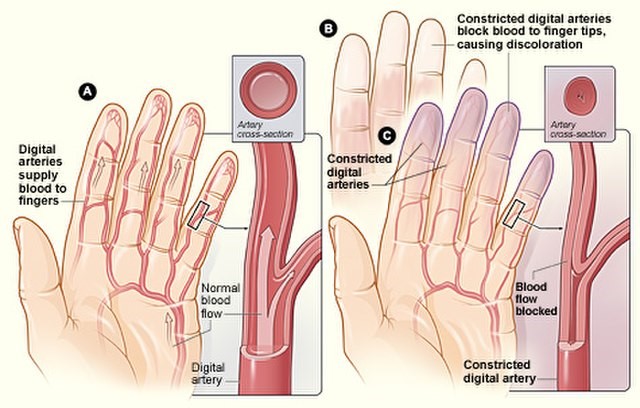
Raynaud's phenomenon (often just called Raynaud's), is a condition where the small blood vessels of the fingers become narrow (constrict). This happens most often when they are in a cool environment. Blood vessels to other extremities such as the toes, ears and nose may also be affected. It is named after Dr Maurice Raynaud, the man who first.
Further reading and references
- ring finger protein 216; MedlinePlus, National Library of Medicine.
- Alqwaifly M, Bohlega S. Ataxia and Hypogonadotropic Hypogonadism with Intrafamilial Variability Caused by RNF216 Mutation. Neurol Int. 2016 Jun 15;8(2):6444. doi: 10.4081/ni.2016.6444. eCollection 2016 Jun 15.
- Chuang TH, Ulevitch RJ. Triad3A, an E3 ubiquitin-protein ligase regulating Toll-like receptors. Nat Immunol. 2004 May;5(5):495-502. doi: 10.1038/ni1066. Epub 2004 Apr 25.
- Husain N, Yuan Q, Yen YC, Pletnikova O, Sally DQ, Worley P, Bichler Z, Shawn Je H. TRIAD3/RNF216 mutations associated with Gordon Holmes syndrome lead to synaptic and cognitive impairments via Arc misregulation. Aging Cell. 2017 Apr;16(2):281-292. doi: 10.1111/acel.12551. Epub 2016 Dec 20.
- Mabb AM, Je HS, Wall MJ, Robinson CG, Larsen RS, Qiang Y, Correa SA, Ehlers MD. Triad3A regulates synaptic strength by ubiquitination of Arc. Neuron. 2014 Jun 18;82(6):1299-316. doi: 10.1016/j.neuron.2014.05.016.
- Margolin DH, Kousi M, Chan YM, Lim ET, Schmahmann JD, Hadjivassiliou M, Hall JE, Adam I, Dwyer A, Plummer L, Aldrin SV, O'Rourke J, Kirby A, Lage K, Milunsky A, Milunsky JM, Chan J, Hedley-Whyte ET, Daly MJ, Katsanis N, Seminara SB. Ataxia, dementia, and hypogonadotropism caused by disordered ubiquitination. N Engl J Med. 2013 May 23;368(21):1992-2003. doi: 10.1056/NEJMoa1215993. Epub 2013 May 8.
Share your thoughts or experiences with others in our patient communities.
Simple access to trusted treatments and health services online.
Common conditions
Get help with common conditions through the NHS, without a GP appointment.





Sign up to the Patient newsletter
Your weekly dose of clear, trustworthy health advice - written to help you feel informed, confident and in control.
By subscribing you accept our Privacy Policy. You can unsubscribe at any time. We never sell your data.