
Dosette box vs blister pack vs pouches: which is right for you?
Peer reviewed by Dr Colin Tidy, MRCGPAuthored by PillTime Originally published 19 Nov 2026
Meets Patient’s editorial guidelines
- DownloadDownload
- Share
- Language
- Discussion
- Ask Patient
- Audio Version
- Add to preferred sources on Google
Managing medication at home can get complicated, especially if you, or someone you care for, take several medicines at different times of the day. The good news is that there are tools and services designed to make this easier and safer, and to support a steady medication routine.
In this article we compare three common ways to organise medication at home - pouching, blister packs, and dosette boxes. We explain what each involves, who it might suit, and the pros and cons of each, so you can have a more informed conversation with your pharmacist or GP.
Sponsored
The simplest way to stay on top of your medication
No more sorting pills, checking blister packs, or wondering whether you’ve already taken today’s dose. PillTime is an NHS pharmacy that delivers your medication pre-sorted in clearly dated, labelled, easy-to-open pouches delivered straight to your door, all for free. Trusted by over 10,000 people across England. Sign up online, keep your GP, then just tear and take.

Video picks for Medicine informationVideo library
Pouching
What is pouching?
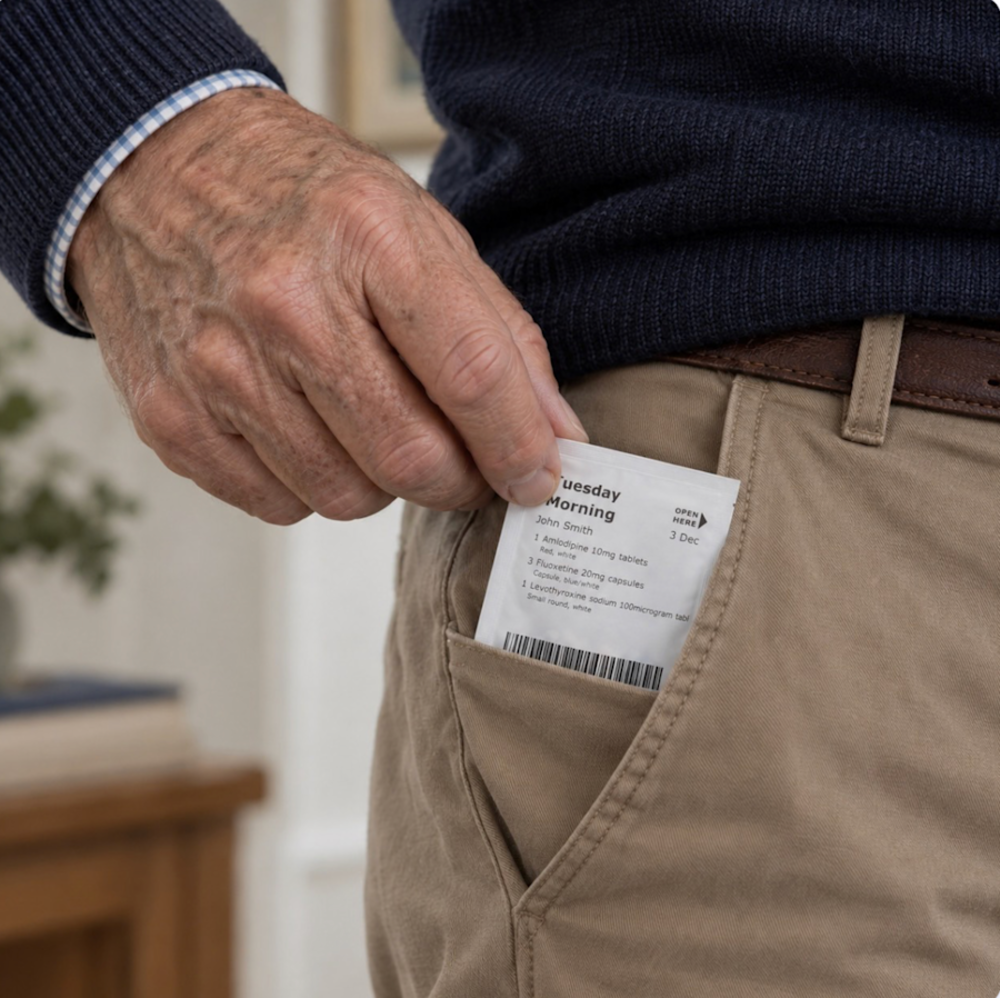
Pouching is a service where your medication is sorted and packed by a pharmacy into small, clearly labelled pouches. Each pouch holds everything you need to take at one specific time, for example Monday at 8 am or Thursday at 6 pm.
The pouches come on a roll. You tear off the next one when it's due, so it's easy to see what to take and when. They're delivered to your door by a pharmacy service such as PillTime - a free NHS pharmacy service.
The benefits of pouching
Your medication is sorted by professionals, not at home - pouches are prepared at the pharmacy according to your prescription and then checked for accuracy. That takes away the worry of mixing up tablets at home, which can be particularly helpful if you or the person you care for has memory problems, sight loss, or simply a busy life.
It suits complex routines - if you take medicines at several points in the day, such as morning, lunchtime, evening, and bedtime, each pouch is labelled with the day and time, so there's no need to work out what comes next.
It's easy to take with you - tearing off the pouches you need for the day is simpler than carrying bottles or a bulky box. Each pouch also lists the medicines and doses inside, which can be handy if you're away from home.
It can support independence - many people find that having everything pre-sorted gives them the confidence to manage their own medication or reduces how much help they need from others.
Delivery is built in - prescriptions are delivered already pouched, so there's no sorting or organising to do at home.
Things to bear in mind
Not every medicine can be pouched - some medicines, such as liquids, as-needed medicines or those that are sensitive to moisture or light, will need to be supplied separately but always in the same delivery. Your pharmacist can tell you what's suitable.
Changes take time - if your dose changes, a new supply of pouches will need to be prepared, rather than adjusting things yourself.
Curious how pouching works in practice? See how PillTime works
Blister pack medication
Blister packs have some similarities with pouching, in that different medicines are grouped to be taken on set days and times. They're usually made of plastic with a foil backing so you can push each dose out when it's due. A pack often holds a full week's worth of medication and is filled by a pharmacy.
The benefits of blister packs
You can see at a glance whether a dose has been taken.
The medication is sorted and checked by a pharmacy.
They can be delivered to your door by a pharmacy service.
The potential downsides
Less flexibility for complex routines - some packs are divided into time slots, but if you need doses at unusual times, the pack may not be able to show it clearly.
Environmental impact- combining plastic and foil makes blister packs difficult to recycle.
Bulky to carry - a week or more of medication in one pack isn't very practical for days out or travel.
They can be misread - if a pack is read in the wrong direction, for example across the rows instead of down the columns, doses can be taken at the wrong time. Ask your pharmacy to show you how to read yours.
Dosette boxes
Dosette boxes - also called pill organisers or pill boxes - are reusable plastic boxes divided into compartments labelled with the day and time. Unlike the other two options, someone at home - either you or a carer - needs to fill the compartments.
The benefits of dosette boxes
Reusable - they can be refilled each week, so they create minimal waste.
Flexible - if your medication changes, you can adjust the compartments straight away.
Available in different sizes - a small daily box can be easy to carry, while a larger weekly box suits use at home.
The potential downsides
More room for error - with no pharmacist checking the contents, there's a higher chance of a tablet ending up in the wrong compartment.
A lot rests on the person filling it - if that person is also elderly or has their own health needs, an unintended mistake is more likely, and worrying about it can cause real anxiety.
It takes time - sorting a week of medication into the box can be fiddly and time-consuming.
Not tamper-proof - compartments can sometimes open by accident, so medication can be spilled or lost.
Not suitable for every medicine - some medicines should stay in their original packaging, so check with your pharmacist before moving anything into a box.
Which option is right for you?
There's no single right answer. It depends on your medication, your routine, and the support you have at home. These questions can help you think it through.
How many times a day do you take medication?
If it's more than two or three, a pre-sorted option such as pouching may be clearer and easier to manage.
Do your medicines or timings change often?
A dosette box can be updated straight away at home, without waiting for a new supply, though this also increases the chance of mistakes.
Are you confident filling a dosette box yourself?
If you're unsure, PillTime pouches, which are prepared by a pharmacy, can reduce the risk of errors.
Are you often out when doses are due, or do you travel?
Tear-off pouches are very portable, while a weekly blister pack is not.
Do you have difficulty with sight, dexterity, or memory?
Tell your pharmacist. Pharmacies are expected to consider reasonable adjustments for people with disabilities, so it's worth asking what they can offer.
Not sure if pouching is right for you? Give us a call
Give us a call and we can talk you through whether pouching is right for your specific medication.
You can also speak to your GP or pharmacist at any time before changing how you take your medicines.

Ready to take the guesswork out of daily medication?
If pouching sounds like a good fit, find out how PillTime works, who it's available for, and how to get started.
Patient picks for Medicine information

Treatment and medication
Making sure your medicine is safe at home
If you've ever rummaged through the back of your medicine cabinet for painkillers, you may find half-finished packs of tablets you took for a bad back some time ago, or a bottle medicine you opened a few weeks back. For #MedSafetyWeek we have a look at what you need to know about making sure your medications are safe and effective to take.
by Victoria Raw
Treatment and medication
What to do if your medication isn't available
If you take medicine then you're no stranger to regularly picking up a prescription - but what happens when it isn't available? There are many reasons why medicine may become unavailable and it's important you know what to do if this happens to your prescription.
by Victoria Raw

Heart health and blood vessels
What happens to your blood pressure when you're not measuring it?
Think about the last time you had your blood pressure checked. Perhaps you were sitting in your GP's surgery, waiting for the cuff to inflate. Seconds later, two numbers appeared on the screen. Those numbers provide useful information about your blood pressure at that moment. But blood pressure changes throughout the day and night. Some people even have higher readings at the GP's surgery than at home - known as white coat hypertension - while others have normal readings in the surgery but higher blood pressure elsewhere (masked hypertension).
by Hilo

Pregnancy
What to pack on your babymoon
If you've just booked your 'babymoon' (ie the last holiday you take before the baby arrives), you probably have high expectations. More so than your average holiday, the babymoon is under pressure to deliver - after all, this might be your last child-free break in quite some time.
by Abi Millar

Treatment and medication
Check your medicines for interactions
Use this medicine and drug interaction checker to see whether your medicines, supplements, vitamins, foods, or certain health conditions may interact with each other. It can help you understand potential risks, avoid unwanted side effects, and decide when it’s important to speak to a pharmacist, GP, or other healthcare professional. The tool is suitable for checking both prescription and over-the-counter medicines, as well as common supplements and herbal remedies. Open in a new window

Healthy living
What is rucking and is it right for you?
It's well known that a brisk walk benefits your health, but if you want to take your walking routine up a notch, you might be interested in rucking. In this guide, we’ll break down what rucking is, explore its health benefits, and help you decide if it’s the right fit for you.
by Victoria Raw
About the authorView full bio
Authored by

PillTime
About the reviewerView full bio

Dr Colin Tidy, MRCGP
General Practitioner, Medical Author
MBBS, MRCGP, MRCP (Paediatrics), DCH
Dr Colin Tidy is an NHS Doctor, based in Oxfordshire.
Article history
Article also available in English, German, Spanish, French, Italian, Portuguese, Hindi, Hebrew, Arabic, and Swedish.
Next review due: 19 Nov 2029
19 Nov 2026 | Originally published
Authored by:
PillTimePeer reviewed by
Dr Colin Tidy, MRCGP
Share your thoughts or experiences with others in our patient communities.
Sign up to the Patient newsletter
Your weekly dose of clear, trustworthy health advice - written to help you feel informed, confident and in control.
By subscribing you accept our Privacy Policy. You can unsubscribe at any time. We never sell your data.