Catecholaminergic polymorphic ventricular tachycardia
Last updated 18 Aug 2020
Meets Patient’s editorial guidelines
- DownloadDownload
- Share
- Language
- Discussion
- Ask Patient
- Audio Version
- Add to preferred sources on Google
Catecholaminergic polymorphic ventricular tachycardia (CPVT) is a condition characterised by an abnormal heart rhythm (arrhythmia). As the heart rate increases in response to physical activity or emotional stress, it can trigger an abnormally fast heartbeat called ventricular tachycardia. Episodes of ventricular tachycardia can cause light-headedness, dizziness, and fainting (syncope). In people with CPVT, these episodes typically begin in childhood.
Video picks for Genetic conditionsVideo library
Description
Catecholaminergic polymorphic ventricular tachycardia (CPVT) is a condition characterised by an abnormal heart rhythm (arrhythmia). As the heart rate increases in response to physical activity or emotional stress, it can trigger an abnormally fast heartbeat called ventricular tachycardia. Episodes of ventricular tachycardia can cause light-headedness, dizziness, and fainting (syncope). In people with CPVT, these episodes typically begin in childhood.
If CPVT is not recognized and treated, an episode of ventricular tachycardia may cause the heart to stop beating (cardiac arrest), leading to sudden death. Researchers suspect that CPVT may be a significant cause of sudden death in children and young adults without recognized heart abnormalities.
Inheritance patterns
The source lists the following possible inheritance patterns: Autosomal dominant; Autosomal recessive. More than one pattern can apply in different cases.
Related genes
Other names
Bidirectional tachycardia induced by catecholamines
Catecholamine-induced polymorphic ventricular tachycardia
CPVT
Familial polymorphic ventricular tachycardia
FPVT
Patient picks for Genetic conditions
Heart health and blood vessels
Heart palpitations
Heart palpitations are the sensation of your heart beating and are common. Most cases are harmless. They usually only last for a short time and can be accompanied by other symptoms such as breathlessness, dizziness, chest tightness and a feeling of anxiety. Palpitations that are severe or don't settle quickly may need urgent medical attention. The most common causes are mentioned below.
by Dr Hayley Willacy, FRCGP

Heart health and blood vessels
Supraventricular tachycardia
Supraventricular tachycardia (SVT) causes an abnormally fast heart rate. It can cause symptoms such as palpitations, dizziness and shortness of breath. Many episodes of SVT don't last very long and stop without any treatment. Sometimes treatment is needed to stop an episode of SVT.
by Dr Caroline Wiggins, MRCGP
Heart health and blood vessels
Ventricular septal defect
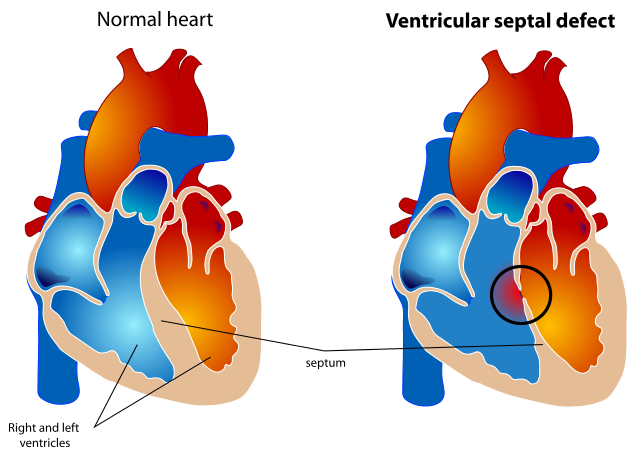
Ventricular septal defect (VSD) is a gap or defect in the septum between the heart's two lower chambers (ventricles). The septum is a wall that separates the heart's right and left side of the heart. Septal defects are sometimes called a 'hole' in the heart. It is the most common heart problem that babies are born with. Many defects in the ventricular septum close themselves and cause no problems. Otherwise, medicines or surgery can help. Most babies born with a defect in the septum have normal survival.
by Dr Hayley Willacy, FRCGP
Heart health and blood vessels
Postural tachycardia syndrome
Postural tachycardia syndrome (PoTS) is an abnormal response of your body when you are upright (usually when standing). Your heart rate increases too much after getting up from lying or sitting down. It is caused by a problem with the nervous system which controls the autonomic functions in the body. This part of the nervous system is called the autonomic nervous system. The symptoms of PoTS occur when you are upright and are relieved when lying down. These symptoms are associated with an abnormally high and persistent increase in heart rate within ten minutes of standing. Lifestyle adjustments are usually very effective for the treatment of PoTS but some people with PoTS need medication to control the symptoms. The outcome (prognosis) is very good for most people with PoTS but some may have severe long-term difficulties with normal daily activities.
by Dr Rosalyn Adleman, MRCGP

Skin, nail and hair health
Polymorphic light eruption
Polymorphic light eruption is a skin rash that can happen when you go out in the sun.
by Dr Hayley Willacy, FRCGP
Related patient information and medicines

Patient information leaflet
Abnormal heart rhythms
An arrhythmia is an abnormal rate and/or rhythm of the heartbeat due to some problem with the electrical conducting system of the heart. What is an arrhythmia. An arrhythmia is an abnormal rate and/or rhythm of the heartbeat. There are various types but all are ... The atria contract at about 300 bpm but the ventricles are unable to beat that.

Patient information leaflet
Wolff-Parkinson-White syndrome
Wolff-Parkinson-White syndrome is not common but can cause a fast heart rate or other heart rhythm abnormalities from time to time. Treatment can be given for the fast heart rate and also to prevent any further episodes. In Wolff-Parkinson-White (WPW) syndrome there is an extra connection (an accessory pathway) between the atria and ventricles..

Patient information leaflet
Heart disease
The heart is a muscle pump located in the chest, which pumps blood around the body. It keeps pumping from a few weeks after conception until we die. There are a number of different conditions that can affect how the heart works. What is heart disease. There are many different conditions which can affect the heart, including those which affect the.

Patient information leaflet
Long COVID
However, some people have ongoing symptoms that remain for weeks, months, or longer, which is usually called "long COVID". In the UK, the National Institute for Health and Care Excellence (NICE), Scottish Intercollegiate Guidelines Network (SIGN) and Royal College of General Practitioners (RCGP) have described two conditions, both of which are.
Patient information leaflet
Heart palpitations
Heart palpitations are the sensation of your heart beating and are common. ...ttps://patient.info/](https://patient.info/) Facebook: [https://www.facebook.com/patient](https://www.facebook.com/patient) Twitter: [https://twitter.com/patient](https://twitter.com/patient) Pinterest:.

Patient information leaflet
Beta-blockers
Beta-blockers are medicines that are used to treat a variety of conditions. Their full correct name is beta-adrenoceptor blocking medicines (or beta-adrenergic blocking agents), but they are commonly just called beta-blockers. Lower your blood pressure if you have high blood pressure... Treat postural tachycardia syndrome (PoTS) Postural.
Further reading and references
- Catecholaminergic polymorphic ventricular tachycardia; MedlinePlus, National Library of Medicine.
- Crotti L, Spazzolini C, Tester DJ, Ghidoni A, Baruteau AE, Beckmann BM, Behr ER, Bennett JS, Bezzina CR, Bhuiyan ZA, Celiker A, Cerrone M, Dagradi F, De Ferrari GM, Etheridge SP, Fatah M, Garcia-Pavia P, Al-Ghamdi S, Hamilton RM, Al-Hassnan ZN, Horie M, Jimenez-Jaimez J, Kanter RJ, Kaski JP, Kotta MC, Lahrouchi N, Makita N, Norrish G, Odland HH, Ohno S, Papagiannis J, Parati G, Sekarski N, Tveten K, Vatta M, Webster G, Wilde AAM, Wojciak J, George AL, Ackerman MJ, Schwartz PJ. Calmodulin mutations and life-threatening cardiac arrhythmias: insights from the International Calmodulinopathy Registry. Eur Heart J. 2019 Sep 14;40(35):2964-2975. doi: 10.1093/eurheartj/ehz311.
- Gomez-Hurtado N, Boczek NJ, Kryshtal DO, Johnson CN, Sun J, Nitu FR, Cornea RL, Chazin WJ, Calvert ML, Tester DJ, Ackerman MJ, Knollmann BC. Novel CPVT-Associated Calmodulin Mutation in CALM3 (CALM3-A103V) Activates Arrhythmogenic Ca Waves and Sparks. Circ Arrhythm Electrophysiol. 2016 Aug;9(8):10.1161/CIRCEP.116.004161 e004161. doi: 10.1161/CIRCEP.116.004161.
- Leenhardt A, Denjoy I, Guicheney P. Catecholaminergic polymorphic ventricular tachycardia. Circ Arrhythm Electrophysiol. 2012 Oct;5(5):1044-52. doi: 10.1161/CIRCEP.111.962027. Epub 2012 Sep 27. No abstract available.
- Lieve KV, van der Werf C, Wilde AA. Catecholaminergic Polymorphic Ventricular Tachycardia. Circ J. 2016 May 25;80(6):1285-91. doi: 10.1253/circj.CJ-16-0326. Epub 2016 May 13.
- Moscu-Gregor A, Marschall C, Muntjes C, Schonecker A, Schuessler-Hahn F, Hohendanner F, Parwani AS, Boldt LH, Ott CE, Bennewiz A, Paul T, Krause U, Rost I. Novel variants in TECRL cause recessive inherited CPVT type 3 with severe and variable clinical symptoms. J Cardiovasc Electrophysiol. 2020 Jun;31(6):1527-1535. doi: 10.1111/jce.14446. Epub 2020 Mar 22.
- Napolitano C, Mazzanti A, Bloise R, Priori SG. Catecholaminergic Polymorphic Ventricular Tachycardia. 2004 Oct 14 [updated 2022 Jun 23]. In: Adam MP, Bick S, Mirzaa GM, Wallace SE, Amemiya A, editors. GeneReviews(R) [Internet]. Seattle (WA): University of Washington, Seattle; 1993-2026. Available from http://www.ncbi.nlm.nih.gov/books/NBK1289/
- Nyegaard M, Overgaard MT, Sondergaard MT, Vranas M, Behr ER, Hildebrandt LL, Lund J, Hedley PL, Camm AJ, Wettrell G, Fosdal I, Christiansen M, Borglum AD. Mutations in calmodulin cause ventricular tachycardia and sudden cardiac death. Am J Hum Genet. 2012 Oct 5;91(4):703-12. doi: 10.1016/j.ajhg.2012.08.015.
- Obeyesekere MN, Sy RW, Leong-Sit P, Gula LJ, Yee R, Skanes AC, Klein GJ, Krahn AD. Treatment of asymptomatic catecholaminergic polymorphic ventricular tachycardia. Future Cardiol. 2012 May;8(3):439-50. doi: 10.2217/fca.12.12.
- Pflaumer A, Davis AM. Guidelines for the diagnosis and management of Catecholaminergic Polymorphic Ventricular Tachycardia. Heart Lung Circ. 2012 Feb;21(2):96-100. doi: 10.1016/j.hlc.2011.10.008. Epub 2011 Nov 25.
- Refaat MM, Hassanieh S, Scheinman M. Catecholaminergic Polymorphic Ventricular Tachycardia. Card Electrophysiol Clin. 2016 Mar;8(1):233-7. doi: 10.1016/j.ccep.2015.10.035.
- Roston TM, Cunningham TC, Sanatani S. Advances in the diagnosis and treatment of catecholaminergic polymorphic ventricular tachycardia. Cardiol Young. 2017 Jan;27(S1):S49-S56. doi: 10.1017/S1047951116002237.
- Roston TM, Van Petegem F, Sanatani S. Catecholaminergic polymorphic ventricular tachycardia: a model for genotype-specific therapy. Curr Opin Cardiol. 2017 Jan;32(1):78-85. doi: 10.1097/HCO.0000000000000360.
- Roux-Buisson N, Cacheux M, Fourest-Lieuvin A, Fauconnier J, Brocard J, Denjoy I, Durand P, Guicheney P, Kyndt F, Leenhardt A, Le Marec H, Lucet V, Mabo P, Probst V, Monnier N, Ray PF, Santoni E, Tremeaux P, Lacampagne A, Faure J, Lunardi J, Marty I. Absence of triadin, a protein of the calcium release complex, is responsible for cardiac arrhythmia with sudden death in human. Hum Mol Genet. 2012 Jun 15;21(12):2759-67. doi: 10.1093/hmg/dds104. Epub 2012 Mar 14.
- van der Werf C, Wilde AA. Catecholaminergic polymorphic ventricular tachycardia: from bench to bedside. Heart. 2013 Apr;99(7):497-504. doi: 10.1136/heartjnl-2012-302033. Epub 2013 Feb 6. No abstract available.
- van der Werf C, Zwinderman AH, Wilde AA. Therapeutic approach for patients with catecholaminergic polymorphic ventricular tachycardia: state of the art and future developments. Europace. 2012 Feb;14(2):175-83. doi: 10.1093/europace/eur277. Epub 2011 Sep 4.
- Wall JJ, Iyer RV. Catecholaminergic Polymorphic Ventricular Tachycardia. Pediatr Emerg Care. 2017 Jun;33(6):427-431. doi: 10.1097/PEC.0000000000001156.
- Wleklinski MJ, Kannankeril PJ, Knollmann BC. Molecular and tissue mechanisms of catecholaminergic polymorphic ventricular tachycardia. J Physiol. 2020 Jul;598(14):2817-2834. doi: 10.1113/JP276757. Epub 2020 Apr 27.
- Ylanen K, Poutanen T, Hiippala A, Swan H, Korppi M. Catecholaminergic polymorphic ventricular tachycardia. Eur J Pediatr. 2010 May;169(5):535-42. doi: 10.1007/s00431-010-1154-2. Epub 2010 Feb 9.
Share your thoughts or experiences with others in our patient communities.
Simple access to trusted treatments and health services online.
Common conditions
Get help with common conditions through the NHS, without a GP appointment.





Sign up to the Patient newsletter
Your weekly dose of clear, trustworthy health advice - written to help you feel informed, confident and in control.
By subscribing you accept our Privacy Policy. You can unsubscribe at any time. We never sell your data.