Critical congenital heart disease
Last updated 24 May 2024
Meets Patient’s editorial guidelines
- DownloadDownload
- Share
- Language
- Discussion
- Audio Version
- Add to preferred sources on Google
Critical congenital heart disease (CCHD) is a term that refers to a group of serious heart defects that are present from birth. These abnormalities result from problems with the formation of one or more parts of the heart during the early stages of embryonic development. CCHD prevents the heart from pumping blood effectively or reduces the amount of oxygen in the blood. As a result, organs and tissues throughout the body do not receive enough oxygen, which can lead to organ damage and life-threatening complications. Individuals with CCHD usually require surgery soon after birth.
Description
Critical congenital heart disease (CCHD) is a term that refers to a group of serious heart defects that are present from birth. These abnormalities result from problems with the formation of one or more parts of the heart during the early stages of embryonic development. CCHD prevents the heart from pumping blood effectively or reduces the amount of oxygen in the blood. As a result, organs and tissues throughout the body do not receive enough oxygen, which can lead to organ damage and life-threatening complications. Individuals with CCHD usually require surgery soon after birth.
Although babies with CCHD may appear healthy for the first few hours or days of life, signs and symptoms soon become apparent. These can include an abnormal heart sound during a heartbeat (heart murmur), rapid breathing (tachypnea), low blood pressure (hypotension), low levels of oxygen in the blood (hypoxemia), and a blue or purple tint to the skin caused by a shortage of oxygen (cyanosis). If untreated, CCHD can lead to shock, coma, and death. However, most people with CCHD now survive past infancy due to improvements in early detection, diagnosis, and treatment.
Some people with treated CCHD have few related health problems later in life. However, long-term effects of CCHD can include delayed development and reduced stamina during exercise. Adults with these heart defects have an increased risk of abnormal heart rhythms, heart failure, sudden cardiac arrest, stroke, and premature death.
Each of the heart defects associated with CCHD affects the flow of blood into, out of, or through the heart. Some of the heart defects involve structures within the heart itself, such as the two lower chambers of the heart (the ventricles) or the valves that control blood flow through the heart. Others affect the structure of the large blood vessels leading into and out of the heart (including the aorta and pulmonary artery). Still others involve a combination of these structural abnormalities.
People with CCHD have one or more specific heart defects. The heart defects classified as CCHD include coarctation of the aorta, double-outlet right ventricle, D-transposition of the great arteries, Ebstein anomaly, hypoplastic left heart syndrome, interrupted aortic arch, pulmonary atresia with intact septum, single ventricle, total anomalous pulmonary venous connection, tetralogy of Fallot, tricuspid atresia, and truncus arteriosus.
Inheritance patterns
The source lists the following possible inheritance patterns: Pattern unknown. More than one pattern can apply in different cases.
Related genes
Other names
CCHD
Critical congenital heart defects
Related patient information and medicines

Patient information leaflet
Heart disease
The heart is a muscle pump located in the chest, which pumps blood around the body. It keeps pumping from a few weeks after conception until we die. Acute coronary syndrome, which includes a heart attack (myocardial infarction). Congenital heart disease Some babies are born with problems in their hearts. This is one of the things that the doctor.

Patient information leaflet
Congenital heart disease
Congenital heart disease is a condition where an abnormality (defect) develops in the heart before birth. There are a number of types of congenital heart defect. Some are mild and cause few problems; others are life-threatening for the baby. What is congenital heart disease. Abnormalities or defects of the heart which develop before birth are.

Patient information leaflet
Addison's disease
In some parts of the world where TB is still c... Cancers of other parts of the body, which can spread and destroy the adrenals. Rare hereditary conditions - for example, adrenoleukodystrophy (ALD) and congenital adrenal hyperplasia (CAH). Being critically unwell - for example, after a heart attack (myocardial infarction). Damage to the adrenal.
Patient information leaflet
Aortic stenosis
The aortic valve is a heart valve that lies between the left ventricle and the aorta. Some types of congenital heart disease (abnormalities of the heart present at birth), such as a bicuspid aortic valve, can also cause aortic stenosis later in life. Rheumatic fever used to be a common cause of aortic stenosis - t... A cardiology referral should.
Patient information leaflet
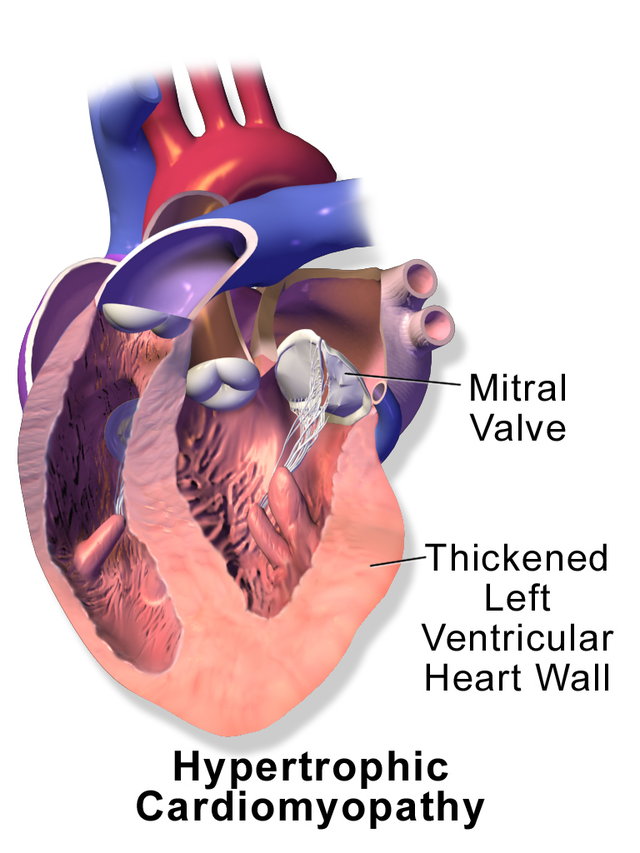
Hypertrophic cardiomyopathy
In hypertrophic cardiomyopathy the heart muscle becomes thickened (hypertrophies) in parts of the heart. Hypertrophic cardiomyopathy is a disease in which the heart muscle becomes thickened. Genetics In most cases the condition is inherited. If a couple (where one person has HCM) has a child, there is a 1 in 2 chance of the child being affected..

Patient information leaflet
Cardiac catheterisation
Cardiac catheterisation is a way to find out detailed information about your heart and coronary arteries and it is also possible to provide treatment for some conditions at the same time. This can give detailed pictures from within coronary arteries. Cardiac catheterisation tests in children Cardiac catheterisation is commonly done to assess the.
Further reading and references
- Critical congenital heart disease; MedlinePlus, National Library of Medicine.
- Fahed AC, Gelb BD, Seidman JG, Seidman CE. Genetics of congenital heart disease: the glass half empty. Circ Res. 2013 Feb 15;112(4):707-20. doi: 10.1161/CIRCRESAHA.112.300853.
- Grochowski CM, Loomes KM, Spinner NB. Jagged1 (JAG1): Structure, expression, and disease associations. Gene. 2016 Jan 15;576(1 Pt 3):381-4. doi: 10.1016/j.gene.2015.10.065. Epub 2015 Nov 6.
- Jenkins KJ, Correa A, Feinstein JA, Botto L, Britt AE, Daniels SR, Elixson M, Warnes CA, Webb CL; American Heart Association Council on Cardiovascular Disease in the Young. Noninherited risk factors and congenital cardiovascular defects: current knowledge: a scientific statement from the American Heart Association Council on Cardiovascular Disease in the Young: endorsed by the American Academy of Pediatrics. Circulation. 2007 Jun 12;115(23):2995-3014. doi: 10.1161/CIRCULATIONAHA.106.183216. Epub 2007 May 22.
- Mahle WT, Newburger JW, Matherne GP, Smith FC, Hoke TR, Koppel R, Gidding SS, Beekman RH 3rd, Grosse SD; American Heart Association Congenital Heart Defects Committee of the Council on Cardiovascular Disease in the Young, Council on Cardiovascular Nursing, and Interdisciplinary Council on Quality of Care and Outcomes Research; American Academy of Pediatrics Section on Cardiology And Cardiac Surgery; Committee On Fetus And Newborn. Role of pulse oximetry in examining newborns for congenital heart disease: a scientific statement from the AHA and AAP. Pediatrics. 2009 Aug;124(2):823-36. doi: 10.1542/peds.2009-1397. Epub 2009 Jul 6.
- Richards AA, Garg V. Genetics of congenital heart disease. Curr Cardiol Rev. 2010 May;6(2):91-7. doi: 10.2174/157340310791162703.
- van der Bom T, Zomer AC, Zwinderman AH, Meijboom FJ, Bouma BJ, Mulder BJ. The changing epidemiology of congenital heart disease. Nat Rev Cardiol. 2011 Jan;8(1):50-60. doi: 10.1038/nrcardio.2010.166. Epub 2010 Nov 2.
- Wessels MW, Willems PJ. Genetic factors in non-syndromic congenital heart malformations. Clin Genet. 2010 Aug;78(2):103-23. doi: 10.1111/j.1399-0004.2010.01435.x. Epub 2010 May 17.
- Zaidi S, Choi M, Wakimoto H, Ma L, Jiang J, Overton JD, Romano-Adesman A, Bjornson RD, Breitbart RE, Brown KK, Carriero NJ, Cheung YH, Deanfield J, DePalma S, Fakhro KA, Glessner J, Hakonarson H, Italia MJ, Kaltman JR, Kaski J, Kim R, Kline JK, Lee T, Leipzig J, Lopez A, Mane SM, Mitchell LE, Newburger JW, Parfenov M, Pe'er I, Porter G, Roberts AE, Sachidanandam R, Sanders SJ, Seiden HS, State MW, Subramanian S, Tikhonova IR, Wang W, Warburton D, White PS, Williams IA, Zhao H, Seidman JG, Brueckner M, Chung WK, Gelb BD, Goldmuntz E, Seidman CE, Lifton RP. De novo mutations in histone-modifying genes in congenital heart disease. Nature. 2013 Jun 13;498(7453):220-3. doi: 10.1038/nature12141. Epub 2013 May 12.
Join the conversation
Share your thoughts or experiences with others in our patient communities.

Ask, share, connect.
Browse discussions, ask questions, and share experiences across hundreds of health topics.
Sign up to the Patient newsletter
Your weekly dose of clear, trustworthy health advice - written to help you feel informed, confident and in control.
By subscribing you accept our Privacy Policy. You can unsubscribe at any time. We never sell your data.