Raynaud phenomenon
Last updated 22 Dec 2025
Meets Patient’s editorial guidelines
- DownloadDownload
- Share
- Language
- Discussion
- Ask Patient
- Audio Version
- Add to preferred sources on Google
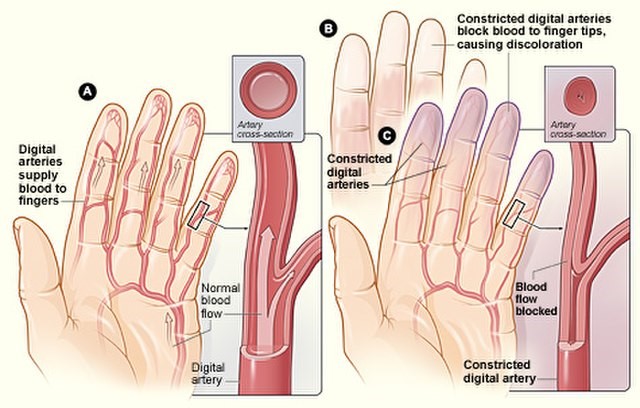
Raynaud phenomenon is a condition in which the body's normal response to cold or emotional stress is exaggerated, resulting in abnormal spasms (vasospasms) in small blood vessels called arterioles. The disorder mainly affects the fingers but can also involve the ears, nose, nipples, knees, or toes. The vasospasms reduce blood circulation, leading to discomfort and skin colour changes.
Video picks for Genetic conditionsVideo library
Description
Raynaud phenomenon is a condition in which the body's normal response to cold or emotional stress is exaggerated, resulting in abnormal spasms (vasospasms) in small blood vessels called arterioles. The disorder mainly affects the fingers but can also involve the ears, nose, nipples, knees, or toes. The vasospasms reduce blood circulation, leading to discomfort and skin colour changes.
Raynaud phenomenon is episodic, meaning that it comes and goes. A typical episode lasts about 15 minutes after the cold exposure or stressor has ended and involves mild discomfort such as numbness or a feeling of "pins and needles." The affected areas usually turn white or blue when exposed to cold or when emotional stress occurs, and then turn red when re-warmed or when the stress eases.
Raynaud phenomenon is categorized as primary when there is no underlying disorder that accounts for the exaggerated response of the blood vessels. It is called secondary when it is associated with another condition. Secondary Raynaud phenomenon is often associated with autoimmune disorders, which occur when the immune system malfunctions and attacks the body's own tissues and organs. Autoimmune disorders with which Raynaud phenomenon can be associated include systemic lupus erythematosus, scleroderma, rheumatoid arthritis, and Sjögren syndrome.
Primary Raynaud phenomenon is much more common and usually less severe than secondary Raynaud phenomenon. In severe cases of secondary Raynaud phenomenon, sores on the pads of the fingers or tissue death (necrosis) can occur. Primary Raynaud phenomenon often begins between the ages of 15 and 25, while secondary Raynaud phenomenon usually starts after age 30. Some people with Raynaud phenomenon alone later go on to develop another associated condition; regardless of which comes first, these cases are classified as secondary Raynaud phenomenon.
Inheritance patterns
The source lists the following possible inheritance patterns: Pattern unknown. More than one pattern can apply in different cases.
Other names
Raynaud disease
Raynaud's
Raynaud's disease
Raynaud's phenomenon
Raynaud's syndrome
Patient picks for Genetic conditions
Heart health and blood vessels
Raynaud's phenomenon
Raynaud's phenomenon (often just called Raynaud's), is a condition where the small blood vessels of the fingers become narrow (constrict). This happens most often when they are in a cool environment. Blood vessels to other extremities such as the toes, ears and nose may also be affected. It is named after Dr Maurice Raynaud, the man who first described it in 1862.
by Dr Hayley Willacy, FRCGP
Heart health and blood vessels
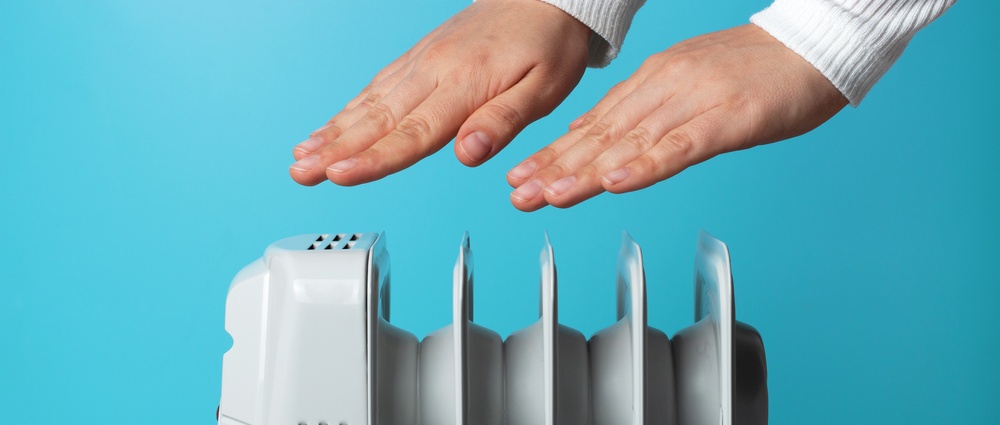
How to deal with Raynaud's in the winter months
Raynaud's phenomenon is a common condition in which the blood vessels in the extremities - your fingers, toes, ears, or nose - overreact to cold or stress. During winter, how can people with Raynaud's manage their condition?
by Lynn Stephen

Blood & circulation
Living with Raynaud's Disease: Lizzi's Story
Raynaud’s disease is a health condition that makes your blood vessels super sensitive to temperature changes – even minor ones. According to Scleroderma and Raynaud's UK, around one in six people in the UK are affected by it. And while anyone can get Raynaud's, it actually affects women four times more than men. In this video, we speak with Lizzi Hooks - a clinical specialist, dance practitioner, and mother of three, who has lived with Raynaud's since her teenage years. She'll share her experience with Raynaud's, explain some of her personal triggers and offer practical insights into managing this condition. Audio: Victoria Raw Visuals: Ben Hudson
by Victoria Raw
Blood & circulation
How to deal with Raynaud's in the winter months
Raynaud’s disease makes your fingers, toes, ears, and nose overreact to cold or stress. Here's how to manage this winter: [https://patient.info/features/heart-health/how-to-deal-with-raynauds-in-the-winter-months](https://patient.info/features/heart-health/how-to-deal-with-raynauds-in-the-winter-months) *Design, video and audio production: Victoria Raw* #Raynauds #RaynaudsPhenomenon #ColdWeatherTips #WinterWellness #PatientInfo
by Victoria Raw
Related patient information and medicines
Patient information leaflet
Raynaud's phenomenon
Raynaud's phenomenon (often just called Raynaud's), is a condition where the small blood vessels of the fingers become narrow (constrict). This happens most often when they are in a cool environment. It is named after Dr Maurice... Raynaud's phenomenon occurs when the extremities of the body, usually the fingers and toes, change colour and may.
Patient information leaflet
Systemic sclerosis
Raynaud's phenomenon The earliest symptom of systemic sclerosis is a problem called Raynaud's phenomenon. In this condition there are temporary changes to the skin in response to cold or stress - usually in the fingers, toes and nose. The skin turns very pale, blue and then red. It returns to normal when warm or no longer stressed. This is caused.
Patient information leaflet
Peripheral vasodilators
Peripheral vasodilators are medicines that are used to treat conditions that affect blood vessels in outer (peripheral) parts of the body such as the arms and legs. For example, they are used to treat peripheral arter... In Raynaud's phenomenon Raynaud's phenomenon they are used to dilate the small blood vessels and prevent them from constricting..

Patient information leaflet
Hand-arm vibration syndrome
Hand-arm vibration syndrome (sometimes abbreviated to HAVS) causes changes in the sensation of the fingers which can lead to permanent numbness of fingers, muscle weakness and, in some cases, bouts of white finger. Raynaud's phenomenon Raynaud's phenomenon later develops which results from changes in the blood vessels and causes white fingers..

Patient information leaflet
Frostbite
Frostbite is an injury that is caused by exposure of parts of the body to the cold. There are different degrees of frostbite. You are then less likely to get out of the cold, or protect yourself from it. People who have Raynaud's phenomenon Raynaud's phenomenon (a condition where the small blood vessels of the fingers constrict) also have an.

Patient information leaflet
Benefits of stopping smoking
Gum disease. Tooth loss. 'Thinning' of the bones ( osteoporosis Osteoporosis ). Raynaud's phenomenon Raynaud's phenomenon - in this condition, fingers turn white or blue when exposed to cold. Reduce the risk of pregnancy complications if you are pregnant. If you have smoked since being a teenager or young adult: If you stop smoking before the age.
Further reading and references
- Raynaud phenomenon; MedlinePlus, National Library of Medicine.
- Belch J, Carlizza A, Carpentier PH, Constans J, Khan F, Wautrecht JC, Visona A, Heiss C, Brodeman M, Pecsvarady Z, Roztocil K, Colgan MP, Vasic D, Gottsater A, Amann-Vesti B, Chraim A, Poredos P, Olinic DM, Madaric J, Nikol S, Herrick AL, Sprynger M, Klein-Weigel P, Hafner F, Staub D, Zeman Z. ESVM guidelines - the diagnosis and management of Raynaud's phenomenon. Vasa. 2017 Oct;46(6):413-423. doi: 10.1024/0301-1526/a000661. Epub 2017 Sep 12.
- Fardoun MM, Nassif J, Issa K, Baydoun E, Eid AH. Raynaud's Phenomenon: A Brief Review of the Underlying Mechanisms. Front Pharmacol. 2016 Nov 16;7:438. doi: 10.3389/fphar.2016.00438. eCollection 2016.
- Hughes M, Herrick AL. Raynaud's phenomenon. Best Pract Res Clin Rheumatol. 2016 Feb;30(1):112-32. doi: 10.1016/j.berh.2016.04.001. Epub 2016 May 11.
- Kuryliszyn-Moskal A, Kita J, Hryniewicz A. Raynaud's phenomenon: new aspects of pathogenesis and the role of nailfold videocapillaroscopy. Reumatologia. 2015;53(2):87-93. doi: 10.5114/reum.2015.51508. Epub 2015 May 18.
- Prete M, Fatone MC, Favoino E, Perosa F. Raynaud's phenomenon: from molecular pathogenesis to therapy. Autoimmun Rev. 2014 Jun;13(6):655-67. doi: 10.1016/j.autrev.2013.12.001. Epub 2014 Jan 10.
- Temprano KK. A Review of Raynaud's Disease. Mo Med. 2016 Mar-Apr;113(2):123-6.
- Wigley FM, Flavahan NA. Raynaud's Phenomenon. N Engl J Med. 2016 Aug 11;375(6):556-65. doi: 10.1056/NEJMra1507638. No abstract available.
Share your thoughts or experiences with others in our patient communities.
Simple access to trusted treatments and health services online.
Common conditions
Get help with common conditions through the NHS, without a GP appointment.





Sign up to the Patient newsletter
Your weekly dose of clear, trustworthy health advice - written to help you feel informed, confident and in control.
By subscribing you accept our Privacy Policy. You can unsubscribe at any time. We never sell your data.