sarcoglycan alpha
Last updated 19 Nov 2025
Meets Patient’s editorial guidelines
- DownloadDownload
- Share
- Language
- Discussion
- Ask Patient
- Audio Version
- Add to preferred sources on Google
The SGCA gene provides instructions for making the alpha component (subunit) of a group of proteins called the sarcoglycan protein complex. The sarcoglycan protein complex is located in the membrane surrounding muscle cells. It helps maintain the structure of muscle tissue by attaching (binding) to and stabilizing the dystrophin complex, which is made up of proteins called dystrophins and dystroglycans. The large dystrophin complex strengthens muscle fibers and protects them from injury as muscles tense (contract) and relax. It acts as an anchor, connecting each muscle cell's structural framework (cytoskeleton) with the lattice of proteins and other molecules outside the cell (extracellular matrix).
Video picks for GenesVideo library
Normal function
The SGCA gene provides instructions for making the alpha component (subunit) of a group of proteins called the sarcoglycan protein complex. The sarcoglycan protein complex is located in the membrane surrounding muscle cells. It helps maintain the structure of muscle tissue by attaching (binding) to and stabilizing the dystrophin complex, which is made up of proteins called dystrophins and dystroglycans. The large dystrophin complex strengthens muscle fibers and protects them from injury as muscles tense (contract) and relax. It acts as an anchor, connecting each muscle cell's structural framework (cytoskeleton) with the lattice of proteins and other molecules outside the cell (extracellular matrix).
Conditions referring to this gene or chromosome
Other names
50 kDa dystrophin-associated glycoprotein
50-DAG
50DAG
50kD DAG
adhalin
ADL
alpha-sarcoglycan
alpha-SG
DAG2
DMDA2
dystroglycan-2
LGMD2D
sarcoglycan, alpha (50kDa dystrophin-associated glycoprotein)
SCARMD1
SG-alpha
SGCA_HUMAN
Patient picks for Genes
Treatment and medication
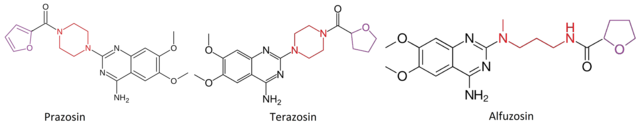
Alpha-blockers
Alpha-blockers are medicines that are mainly used to treat high blood pressure (hypertension) and problems with passing urine in men who have enlargement of the prostate gland. Prostate gland enlargement is also called benign prostatic hyperplasia (BPH).
by Dr Doug McKechnie, MRCGP

Children's health
Alpha-1 antitrypsin deficiency
Alpha-1 antitrypsin deficiency is an inherited genetic condition. A genetic condition is one that can be passed on from parents through genes. In alpha-1 antitrypsin deficiency the result of a genetic abnormality leads to lung and, in some people, liver damage. Lung symptoms are the most common and include shortness of breath, cough and wheezing. Symptoms can worsen over time. At present, there is no cure for alpha-1 antitrypsin deficiency. Treatment aims at slowing down the progression of the disease.
by Dr Philippa Vincent, MRCGP

Medicine
Prazosin - an alpha-blocker
Your first dose of prazosin may make you feel dizzy or faint, or start sweating. Take your first dose at bedtime and remain lying down until these symptoms have completely passed. Prazosin can cause dizziness which may affect your ability to drive. Make sure your reactions are normal before you drive and before you use tools or machines.
by Michael Stewart, MRPharmS
Medicine
Phenoxybenzamine - an alpha-blocker
Adults will normally start with one capsule a day. This dose may then be increased over the next few days. It is common to feel dizzy or light-headed initially. This should soon settle. You may be given other medicines to take alongside phenoxybenzamine.
by Michael Stewart, MRPharmS

Medicine
Indoramin - an alpha-blocker
Indoramin is prescribed for two different medical conditions: 20 mg strength tablets are prescribed for men with prostate problems, and 25 mg strength tablets are prescribed for people with high blood pressure. You are advised not to drink alcohol while you are on indoramin. Do not drive and do not use tools or machines if you feel tired or dizzy.
by Michael Stewart, MRPharmS

Medicine
Terazosin - an alpha-blocker
Take terazosin once every day. Your first dose of terazosin may make you feel dizzy or faint, or start sweating. Take your first dose at bedtime and remain lying down until these symptoms have completely passed. Terazosin can cause dizziness which may affect your ability to drive. Make sure your reactions are normal before you drive and before you use tools or machines.
by Michael Stewart, MRPharmS
Related patient information and medicines

Patient information leaflet
Primary liver cancer
What is the liver. Liver function Liver function The liver is in the upper right part of the tummy (abdomen). It has many functions which include: Storing fuel for the body (called glycogen), which is made from sugars. When required, glycogen is broken down into glucose which is released into the bloodstream. Helping to process fats and proteins.

Patient information leaflet
Liver function tests
The liver performs hundreds of different functions, so there are many other possible tests that look at its health. These would normally be done if an abnormality is found with the basic liver function tests described here, or if a specific problem is suspected. They might include: Virus tests - for example, for hepatitis Hepatitis A, B Hepatitis.
Patient information leaflet
High blood pressure
Dr Yassir Javaid High blood pressure happens when the force on the walls of blood vessels (caused by the blood within them) is more than normal. Healthcare professionals sometimes call high blood pressure 'hypertension'. [https://patient.info/health/high-blood-pressure-hypertension](https://patient.info/health/high-blood-pressure-hypertension).

Patient information leaflet
Testicular cancer
Testicular cancer is a cancer that arises from a testicle (testis). Around half of all cases occur in men aged under 35 but testicular cancer rarely occurs before puberty. Another useful test i... The tumour markers commonly tested for are alpha-fetoprotein (AFP), beta human chorionic gonadotrophin (beta-hCG), lactic dehydrogenase (LDH) and.

Patient information leaflet
Restless legs syndrome
Lack of iron (iron. If this is the cause then the symptoms of RLS usually go if you take iron tablets. As a side-effect of some medicines. For example, it occurs in some people who take antidepressants Antidepressants , antipsychotic medicines Antipsychotic medicines , beta-blockers Beta-blockers , lithium Lithium tablets and liquid medicine ,.

Patient information leaflet
SARS and MERS virus
Severe acute respiratory syndrome (SARS) and Middle East respiratory syndrome (MERS) are viral infections. Both infections can cause very serious illnesses that particularly affect the lungs. SARS caused many infections, especially in Asia, in 2002-2004 but was not heard of for some time. A SARS-CoV-2 (COVID-19) outbreak emerged in Wuhan, China in.
Further reading and references
- sarcoglycan alpha; MedlinePlus, National Library of Medicine.
- Broglio L, Tentorio M, Cotelli MS, Mancuso M, Vielmi V, Gregorelli V, Padovani A, Filosto M. Limb-girdle muscular dystrophy-associated protein diseases. Neurologist. 2010 Nov;16(6):340-52. doi: 10.1097/NRL.0b013e3181d35b39.
- Guglieri M, Magri F, Comi GP. Molecular etiopathogenesis of limb girdle muscular and congenital muscular dystrophies: boundaries and contiguities. Clin Chim Acta. 2005 Nov;361(1-2):54-79. doi: 10.1016/j.cccn.2005.05.020.
- Guglieri M, Straub V, Bushby K, Lochmuller H. Limb-girdle muscular dystrophies. Curr Opin Neurol. 2008 Oct;21(5):576-84. doi: 10.1097/WCO.0b013e32830efdc2.
- Hack AA, Groh ME, McNally EM. Sarcoglycans in muscular dystrophy. Microsc Res Tech. 2000 Feb 1-15;48(3-4):167-80. doi: 10.1002/(SICI)1097-0029(20000201/15)48:3/43.0.CO;2-T.
- Laval SH, Bushby KM. Limb-girdle muscular dystrophies--from genetics to molecular pathology. Neuropathol Appl Neurobiol. 2004 Apr;30(2):91-105. doi: 10.1111/j.1365-2990.2004.00555.x.
- Meena AK, Sreenivas D, Sundaram C, Rajasekhar R, Sita JS, Borgohain R, Suvarna A, Kaul S. Sarcoglycanopathies: a clinico-pathological study. Neurol India. 2007 Apr-Jun;55(2):117-21. doi: 10.4103/0028-3886.32781.
- Ozawa E, Mizuno Y, Hagiwara Y, Sasaoka T, Yoshida M. Molecular and cell biology of the sarcoglycan complex. Muscle Nerve. 2005 Nov;32(5):563-76. doi: 10.1002/mus.20349.
- Sandona D, Betto R. Sarcoglycanopathies: molecular pathogenesis and therapeutic prospects. Expert Rev Mol Med. 2009 Sep 28;11:e28. doi: 10.1017/S1462399409001203.
- Straub V, Bushby K. The childhood limb-girdle muscular dystrophies. Semin Pediatr Neurol. 2006 Jun;13(2):104-14. doi: 10.1016/j.spen.2006.06.006.
- Trabelsi M, Kavian N, Daoud F, Commere V, Deburgrave N, Beugnet C, Llense S, Barbot JC, Vasson A, Kaplan JC, Leturcq F, Chelly J. Revised spectrum of mutations in sarcoglycanopathies. Eur J Hum Genet. 2008 Jul;16(7):793-803. doi: 10.1038/ejhg.2008.9. Epub 2008 Feb 20.
Share your thoughts or experiences with others in our patient communities.
Simple access to trusted treatments and health services online.
Common conditions
Get help with common conditions through the NHS, without a GP appointment.





Sign up to the Patient newsletter
Your weekly dose of clear, trustworthy health advice - written to help you feel informed, confident and in control.
By subscribing you accept our Privacy Policy. You can unsubscribe at any time. We never sell your data.