Alpha-blockers
Peer reviewed by Dr Rosalyn Adleman, MRCGPLast updated by Dr Doug McKechnie, MRCGPLast updated 14 Jun 2023
Meets Patient’s editorial guidelines
- DownloadDownload
- Share
- Language
- Discussion
- Audio Version
- Add to preferred sources on Google
Alpha-blockers are medicines that are mainly used to treat high blood pressure (hypertension) and problems with passing urine in men who have enlargement of the prostate gland. Prostate gland enlargement is also called benign prostatic hyperplasia (BPH).
At a glance
Alpha-blockers are medicines that treat high blood pressure and enlarged prostate.
They work by relaxing blood vessels and muscles in the bladder and prostate.
Six types are available in the UK, taken as tablets or capsules.
Common side effects can include drowsiness, headaches, and dizziness, especially early on.
Some medicines should be avoided when taking alpha-blockers due to a risk of sudden blood pressure drop.
You can report any suspected side-effects using the Yellow Card Scheme.

Unsure about mixing medicines?
Check for possible interactions between medicines, supplements and foods before taking them together.
What are alpha-blockers used for?
In the past, some alpha-blockers were also used to treat heart failure and Raynaud's phenomenon. However, they are very rarely used to treat these conditions now because there are other medicines that are thought to work better.
Alpha-blockers are also sometimes used to treat ureteric stones. These are stones that have formed in the kidney and have then got stuck in the ureter, which is the tube that goes from the kidney to the bladder. They cause pain called renal or ureteric colic. An alpha-blocker may help to speed up the time it takes for the stone to get into the bladder and stop causing pain. For more information about ureteric stones see the separate leaflet called Kidney Stones.
Types of alpha-blocker
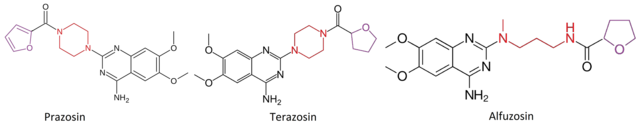
There are six alpha-blockers available to prescribe in the UK. They are:
Alpha-blockers come as tablets or capsules which may be taken once a day or up to three times a day. They come in various brand names.
What are alpha-blockers prescribed for?
For high blood pressure (hypertension)
Alpha-blockers are usually prescribed after most other medicines have been tried. Alpha-blockers are normally only started if:
Other medicines such as beta-blockers, angiotensin-converting enzyme (ACE)inhibitors or 'water' tablets (diuretics) are not working. They may be used as well as these other medicines.
There is a reason you cannot take a beta-blocker, an ACE inhibitor or a diuretic.
Having hypertension increases your risk of having a heart attack or a stroke, or developing chronic kidney disease or heart failure. There are many studies which show that medicines such as beta-blockers, ACE inhibitors and diuretics are better than alpha-blockers at lowering the risk of having these conditions, which is why they are used first.
For prostate gland enlargement
Alpha-blockers can help symptoms of an enlarged prostate.
If you have an enlarged prostate, deciding whether or not to take an alpha-blocker depends on how much the symptoms are affecting you. If the symptoms are bothering you, taking an alpha-blocker is a good idea. If the symptoms are mild and not really affecting you much, then you don't need to take an alpha-blocker unless you want to.
An enlarged prostate gland can cause problems with passing urine, such as:
Having to wait before your urine starts to flow.
Taking longer to pass urine.
Dribbling urine.
Feeling that your bladder is not quite empty.
How do alpha-blockers work?
Alpha-blockers work by blocking the transmission of certain nerve impulses. The ends of some nerves release a chemical (neurotransmitter) called noradrenaline (norepinephrine) when the nerve is stimulated.
This chemical then stimulates alpha-adrenergic receptors. These receptors are tiny structures which occur on cells in various parts of the body, including the heart, involuntary (smooth) muscles and blood vessels. When these receptors are stimulated, they cause various effects.
The alpha-blocker medicine attaches to alpha-adrenergic receptors and stops (blocks) the receptor from being stimulated. This can have various effects in the body:
For high blood pressure (hypertension): alpha-blockers work by relaxing blood vessels. This allows blood and oxygen to circulate more freely around your body, lowering blood pressure and reducing strain on your heart.
For prostate gland enlargement: alpha-blockers work by relaxing the muscles of your bladder and around your prostate gland so that you can pass urine more easily.
Which alpha-blocker is usually prescribed?
For high blood pressure (hypertension): once-daily preparations of doxazosin or terazosin are usually recommended. Once-daily preparations are generally thought to be easier for people to take and to remember to take. Prazosin and indoramin need to be taken two or three times each day and prazosin is more likely to cause a large drop in blood pressure after the first dose has been taken.
For prostate gland enlargement: once-daily preparations of alfuzosin, doxazosin, tamsulosin or terazosin are generally recommended. This is because once-daily preparations cause fewer side-effects than the preparations that need to be taken up to three times a day.
How long can you take alpha-blockers?
Most people with high blood pressure (hypertension) need to take medication for life. However, in some people whose blood pressure has been well controlled for three years or more, medication may be able to be stopped. In particular, in people who have made significant changes to lifestyle (such as having lost a lot of weight or having stopped smoking or heavy drinking, etc). Your doctor can advise you.
For people with symptoms caused by prostate gland enlargement, alpha-blockers are also usually taken long-term. Your doctor will usually review your symptoms 4-6 weeks after you start treatment. Once your symptoms have settled down, your treatment is usually reviewed every year. This is to make sure it is still working.
Taking other medicines
There are a number of medicines that should usually be avoided if you also take an alpha-blocker. These include:
Phosphodiesterase-5 inhibitors - for example, sildenafil for erectile dysfunction.
Antidepressants such as tricyclic antidepressants, mirtazapine or venlafaxine.
When these medicines are combined with an alpha-blocker, you may have a sudden drop in blood pressure (postural hypotension).
Alpha-blocker side-effects
Although side-effects are uncommon, they occur in some people. Side-effects are more likely to occur in the first two weeks of treatment and usually go away on their own. The most common side-effects are slight drowsiness, headaches and dizziness. More rarely they can cause sexual problems.
Alpha-blockers are also associated with an increased risk of falling and of breaking a bone (fracture) when they are first started. This is probably because they may lower blood pressure too much in some people. If you are prescribed an alpha-blocker, read the leaflet that comes with the medicine packet for a full list of possible side-effects and cautions.
Patient picks for Heart and blood medicines

Treatment and medication
Nitrate medication
Nitrate medicines include glyceryl trinitrate (GTN), isosorbide dinitrate and isosorbide mononitrate. Each has various brand names. Nitrate drugs do not alter the underlying cause of angina. (Angina is usually caused by narrowing of the heart arteries due to a build-up of a fatty substance called atheroma. See the separate leaflet called Angina.) However, nitrate medicines are good at easing and preventing angina pains.
by Dr Hayley Willacy, FRCGP

Treatment and medication
Peripheral vasodilators
Peripheral vasodilators are medicines that are used to treat conditions that affect blood vessels in outer (peripheral) parts of the body such as the arms and legs. For example, they are used to treat peripheral arterial disease and Raynaud's phenomenon. They ease the symptoms of these conditions by dilating the blood vessels, preventing them from becoming narrower (constricting). These medicines are usually only prescribed after self-help measures have been tried and symptoms do not improve.
by Dr Surangi Mendis, MRCGP
Frequently asked questions
Are older alpha-blockers still used for any conditions?
In the past, some alpha-blockers were used for heart failure and Raynaud's phenomenon. However, they are now very rarely prescribed for these conditions because other medicines are considered more effective.
What specifically are some of the side effects of alpha-blockers that might make me more prone to falls?
Alpha-blockers can cause slight drowsiness, headaches, and dizziness, especially in the first two weeks of treatment. These effects can contribute to a sudden drop in blood pressure, which increases the risk of falling and bone fractures during the initial treatment period.
Why are once-daily alpha-blocker preparations often preferred over those taken multiple times a day?
Once-daily preparations are generally recommended because they are easier for people to remember to take and are associated with fewer side-effects compared to preparations that need to be taken two or three times a day. For high blood pressure, they are also less likely to cause a large drop in blood pressure after the first dose.
What is the reason alpha-blockers are not usually the first choice for treating high blood pressure?
Alpha-blockers are usually prescribed for high blood pressure after other medicines have been tried, or if you cannot take other types of medication. This is because studies show that other medicines, such as beta-blockers, ACE inhibitors, and diuretics, are generally more effective at lowering the risk of conditions like heart attack, stroke, chronic kidney disease, or heart failure.
Can I take alpha-blockers for an enlarged prostate if my symptoms are mild?
For an enlarged prostate, if your symptoms are mild and not significantly affecting you, you don't necessarily need to take an alpha-blocker. The decision to take one depends on how much your symptoms are bothering you.
Further reading and references
- British National Formulary (BNF); NICE Evidence Services (UK access only)
- Lower urinary tract symptoms in men: assessment and management; NICE Guidelines (June 2015)
- Wright JM, Musini VM, Gill R; First-line drugs for hypertension. Cochrane Database Syst Rev. 2018 Apr 18;4:CD001841. doi: 10.1002/14651858.CD001841.pub3.
- Belayneh M, Korownyk C; Treatment of lower urinary tract symptoms in benign prostatic hypertrophy with alpha-blockers. Can Fam Physician. 2016 Sep;62(9):e523.
- Campschroer T, Zhu X, Vernooij RW, et al; Alpha-blockers as medical expulsive therapy for ureteral stones. Cochrane Database Syst Rev. 2018 Apr 5;4:CD008509. doi: 10.1002/14651858.CD008509.pub3.
- LUTS in men; NICE CKS, June 2025 (UK access only)
About the authorView full bio
Updated by

Dr Doug McKechnie, MRCGP
Medical Writer
MA, MBBS, MSc, DRCOG, MRCP(UK), MRCGP(2021), FHEA
Dr Doug McKechnie is an NHS GP working in London. He works full-time clinically and is also the Deputy Lead for the Clinical and Professional Practice module at University College London Medical School.
About the reviewerView full bio
Dr Rosalyn Adleman, MRCGP
MRCGP
Dr Rosalyn Adleman, is an NHS GP working in north London.
Join the conversation
Share your thoughts or experiences with others in our patient communities.

Ask, share, connect.
Browse discussions, ask questions, and share experiences across hundreds of health topics.

Feeling unwell?
Assess your symptoms online for free
Sign up to the Patient newsletter
Your weekly dose of clear, trustworthy health advice - written to help you feel informed, confident and in control.
By subscribing you accept our Privacy Policy. You can unsubscribe at any time. We never sell your data.