Alpha-mannosidosis
Last updated 10 Nov 2023
Meets Patient’s editorial guidelines
- DownloadDownload
- Share
- Language
- Discussion
- Ask Patient
- Audio Version
- Add to preferred sources on Google
Alpha-mannosidosis is a rare inherited disorder that causes problems in many organs and tissues of the body. Affected individuals may have intellectual disability, distinctive facial features, and skeletal abnormalities. Characteristic facial features can include a large head, prominent forehead, low hairline, rounded eyebrows, large ears, flattened bridge of the nose, protruding jaw, widely spaced teeth, overgrown gums, and large tongue. The skeletal abnormalities that can occur in this disorder include reduced bone density (osteopenia), thickening of the bones at the top of the skull (calvaria), deformations of the bones in the spine (vertebrae), knock knees, and deterioration of the bones and joints.
Video picks for Genetic conditionsVideo library
Description
Alpha-mannosidosis is a rare inherited disorder that causes problems in many organs and tissues of the body. Affected individuals may have intellectual disability, distinctive facial features, and skeletal abnormalities. Characteristic facial features can include a large head, prominent forehead, low hairline, rounded eyebrows, large ears, flattened bridge of the nose, protruding jaw, widely spaced teeth, overgrown gums, and large tongue. The skeletal abnormalities that can occur in this disorder include reduced bone density (osteopenia), thickening of the bones at the top of the skull (calvaria), deformations of the bones in the spine (vertebrae), knock knees, and deterioration of the bones and joints.
Affected individuals may also experience difficulty in coordinating movements (ataxia); muscle weakness (myopathy); delay in developing motor skills such as sitting and walking; speech impairments; increased risk of infections; enlargement of the liver and spleen (hepatosplenomegaly); a buildup of fluid in the brain (hydrocephalus); hearing loss; and a clouding of the lens of the eye (cataract). Some people with alpha-mannosidosis experience psychiatric symptoms such as depression, anxiety, or hallucinations; episodes of psychiatric disturbance may be triggered by stressors such as having undergone surgery, emotional upset, or changes in routine.
The signs and symptoms of alpha-mannosidosis can range from mild to severe. The disorder may appear in infancy with rapid progression and severe neurological deterioration. Individuals with this early-onset form of alpha-mannosidosis often do not survive past childhood. In the most severe cases, an affected fetus may die before birth. Other individuals with alpha-mannosidosis experience milder signs and symptoms that appear later and progress more slowly. People with later-onset alpha-mannosidosis may survive into their fifties. The mildest cases may be detected only through laboratory testing and result in few if any symptoms.
Inheritance patterns
The source lists the following possible inheritance patterns: Autosomal recessive. More than one pattern can apply in different cases.
Related genes
Other names
Alpha-D-mannosidosis
Alpha-mannosidase B deficiency
Alpha-mannosidase deficiency
Deficiency of alpha-mannosidase
Lysosomal alpha B mannosidosis
Lysosomal alpha-D-mannosidase deficiency
Mannosidosis
Patient picks for Genetic conditions

Children's health
Alpha-1 antitrypsin deficiency
Alpha-1 antitrypsin deficiency is an inherited genetic condition. A genetic condition is one that can be passed on from parents through genes. In alpha-1 antitrypsin deficiency the result of a genetic abnormality leads to lung and, in some people, liver damage. Lung symptoms are the most common and include shortness of breath, cough and wheezing. Symptoms can worsen over time. At present, there is no cure for alpha-1 antitrypsin deficiency. Treatment aims at slowing down the progression of the disease.
by Dr Philippa Vincent, MRCGP
Treatment and medication
Alpha-blockers
Alpha-blockers are medicines that are mainly used to treat high blood pressure (hypertension) and problems with passing urine in men who have enlargement of the prostate gland. Prostate gland enlargement is also called benign prostatic hyperplasia (BPH).
by Dr Doug McKechnie, MRCGP

Medicine
Phenoxybenzamine - an alpha-blocker
Adults will normally start with one capsule a day. This dose may then be increased over the next few days. It is common to feel dizzy or light-headed initially. This should soon settle. You may be given other medicines to take alongside phenoxybenzamine.
by Michael Stewart, MRPharmS

Medicine
Indoramin - an alpha-blocker
Indoramin is prescribed for two different medical conditions: 20 mg strength tablets are prescribed for men with prostate problems, and 25 mg strength tablets are prescribed for people with high blood pressure. You are advised not to drink alcohol while you are on indoramin. Do not drive and do not use tools or machines if you feel tired or dizzy.
by Michael Stewart, MRPharmS

Medicine
Alfacalcidol capsules and drops
Alfacalcidol is a type of vitamin D. You will need to have regular blood tests while you are taking the medicine so that your doctor can adjust your dose. Make sure you know the symptoms of too much calcium in your blood - these are losing your appetite, feeling thirsty, being sick (vomiting), feeling tired and losing weight. Please let your doctor know if you develop these symptoms.
by Michael Stewart, MRPharmS

Medicine
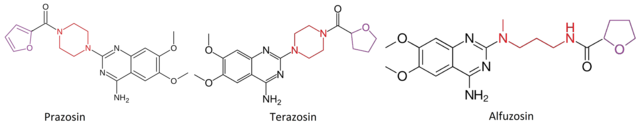
Prazosin - an alpha-blocker
Your first dose of prazosin may make you feel dizzy or faint, or start sweating. Take your first dose at bedtime and remain lying down until these symptoms have completely passed. Prazosin can cause dizziness which may affect your ability to drive. Make sure your reactions are normal before you drive and before you use tools or machines.
by Michael Stewart, MRPharmS
Related patient information and medicines

Patient information leaflet
Liver failure
Liver failure occurs when large parts of the liver become damaged and can't be repaired. The liver is unable to work properly. Liver failure can make you feel very unwell. Acute liver failure is life-threatening and needs emergency medical care. Liver failure often develops slowly over many years. This is called chronic liver disease. See the.

Patient information leaflet
Testicular cancer
Testicular cancer is a cancer that arises from a testicle (testis). Around half of all cases occur in men aged under 35 but testicular cancer rarely occurs before puberty. Another useful test i... The tumour markers commonly tested for are alpha-fetoprotein (AFP), beta human chorionic gonadotrophin (beta-hCG), lactic dehydrogenase (LDH) and.

Patient information leaflet
Ankylosing spondylitis
The type of inflammation in AS causes the affected joints to join together, therefore reducing mobility. Ankylosing spondylitis is an auto-immune disease. It is not known exactly why ankylosing spondylitis occurs but there is a genetic predisposition. 6 out of 100 people who have a particular gene variant called HLA-B27 have ankylosing spondylitis.

Patient information leaflet
Liver function tests
Hepatitis of any cause. Bile duct blockage of any cause. Isolated raised ALP can occur in: Sarcoidosis. Sarcoidosis Bone fractures. Paget's disease of bone Paget's disease of bone. Osteomalacia Vitamin D deficiency. Primary sclerosing cholangitis Primary sclerosing cholangitis. Primary biliary cholangitis Primary biliary cholangitis. There is a.

Patient information leaflet
Spina bifida
Very mild forms (spinal bifida occulta), in which there are no symptoms, may never be detected. Before birth The most common screening methods used to look for spina bifida during pregnancy are the blood test for alpha-fetoprotein and an ultrasound scan, which are routinely performed at 16-18 weeks of pregnancy. See the separate leaflet called.

Patient information leaflet
COVID-19
COVID-19 is an infectious disease caused by a virus that was first identified in December 2019 in Wuhan, China. This leaflet deals with the symptoms, causes and treatment of COVID-19. What is COVID-19. COVID-19 is an infectious disease caused by a virus (SARS CoV-2). COVID-19 is short for "coronavirus disease 2019", because the disease was first.
Further reading and references
- Alpha-mannosidosis; MedlinePlus, National Library of Medicine.
- Beck M, Olsen KJ, Wraith JE, Zeman J, Michalski JC, Saftig P, Fogh J, Malm D. Natural history of alpha mannosidosis a longitudinal study. Orphanet J Rare Dis. 2013 Jun 20;8:88. doi: 10.1186/1750-1172-8-88.
- Ficicioglu C, Stepien KM. Alpha-Mannosidosis. 2001 Oct 11 [updated 2024 Jun 13]. In: Adam MP, Bick S, Mirzaa GM, Wallace SE, Amemiya A, editors. GeneReviews(R) [Internet]. Seattle (WA): University of Washington, Seattle; 1993-2026. Available from http://www.ncbi.nlm.nih.gov/books/NBK1396/
- Grewal SS, Shapiro EG, Krivit W, Charnas L, Lockman LA, Delaney KA, Davies SM, Wenger DA, Rimell FL, Abel S, Grovas AC, Orchard PJ, Wagner JE, Peters C. Effective treatment of alpha-mannosidosis by allogeneic hematopoietic stem cell transplantation. J Pediatr. 2004 May;144(5):569-73. doi: 10.1016/j.jpeds.2004.01.025.
- Gutschalk A, Harting I, Cantz M, Springer C, Rohrschneider K, Meinck HM. Adult alpha-mannosidosis: clinical progression in the absence of demyelination. Neurology. 2004 Nov 9;63(9):1744-6. doi: 10.1212/01.wnl.0000143057.25471.4f.
- Hansen G, Berg T, Riise Stensland HM, Heikinheimo P, Klenow H, Evjen G, Nilssen O, Tollersrud OK. Intracellular transport of human lysosomal alpha-mannosidase and alpha-mannosidosis-related mutants. Biochem J. 2004 Jul 15;381(Pt 2):537-46. doi: 10.1042/BJ20031499.
- Lyons MJ, Wood T, Espinoza L, Stensland HM, Holden KR. Early onset alpha-mannosidosis with slow progression in three Hispanic males. Dev Med Child Neurol. 2007 Nov;49(11):854-7. doi: 10.1111/j.1469-8749.2007.00854.x.
- Malm D, Nilssen O. Alpha-mannosidosis. Orphanet J Rare Dis. 2008 Jul 23;3:21. doi: 10.1186/1750-1172-3-21.
- Malm D, Pantel J, Linaker OM. Psychiatric symptoms in alpha-mannosidosis. J Intellect Disabil Res. 2005 Nov;49(Pt 11):865-71. doi: 10.1111/j.1365-2788.2005.00765.x.
- Pittis MG, Montalvo AL, Heikinheimo P, Sbaragli M, Balducci C, Persichetti E, Van Maldergem L, Filocamo M, Bembi B, Beccari T. Funtional characterization of four novel MAN2B1 mutations causing juvenile onset alpha-mannosidosis. Clin Chim Acta. 2007 Jan;375(1-2):136-9. doi: 10.1016/j.cca.2006.06.034. Epub 2006 Jul 6.
- Sbaragli M, Bibi L, Pittis MG, Balducci C, Heikinheimo P, Ricci R, Antuzzi D, Parini R, Spaccini L, Bembi B, Beccari T. Identification and characterization of five novel MAN2B1 mutations in Italian patients with alpha-mannosidosis. Hum Mutat. 2005 Mar;25(3):320. doi: 10.1002/humu.9310.
- Sun H, Wolfe JH. Recent progress in lysosomal alpha-mannosidase and its deficiency. Exp Mol Med. 2001 Mar 31;33(1):1-7. doi: 10.1038/emm.2001.1.
Share your thoughts or experiences with others in our patient communities.
Simple access to trusted treatments and health services online.
Common conditions
Get help with common conditions through the NHS, without a GP appointment.





Sign up to the Patient newsletter
Your weekly dose of clear, trustworthy health advice - written to help you feel informed, confident and in control.
By subscribing you accept our Privacy Policy. You can unsubscribe at any time. We never sell your data.