Cytogenetically normal acute myeloid leukemia
Last updated 27 Mar 2023
Meets Patient’s editorial guidelines
- DownloadDownload
- Share
- Language
- Discussion
- Audio Version
- Add to preferred sources on Google
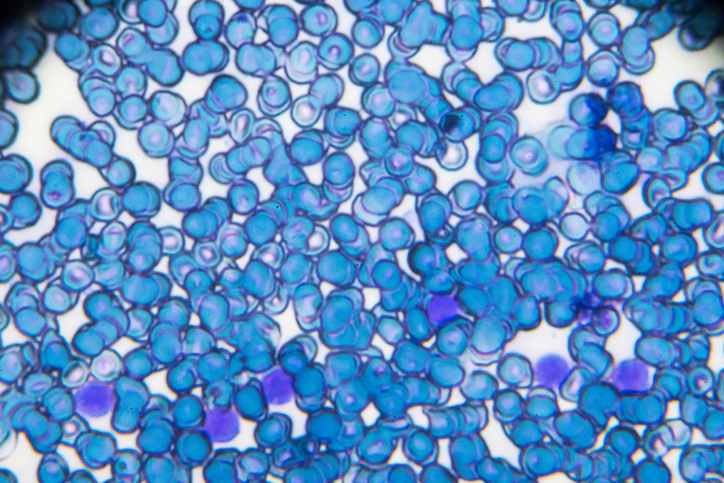
Cytogenetically normal acute myeloid leukemia (CN-AML) is one form of a cancer of the blood-forming tissue (bone marrow) called acute myeloid leukemia. In normal bone marrow, early blood cells called hematopoietic stem cells develop into several types of blood cells: white blood cells (leukocytes) that protect the body from infection, red blood cells (erythrocytes) that carry oxygen, and platelets (thrombocytes) that are involved in blood clotting. In acute myeloid leukemia, the bone marrow makes large numbers of abnormal, immature white blood cells called myeloid blasts. Instead of developing into normal white blood cells, the myeloid blasts develop into cancerous leukemia cells. The large number of abnormal cells in the bone marrow interferes with the production of functional white blood cells, red blood cells, and platelets.
Description
Cytogenetically normal acute myeloid leukemia (CN-AML) is one form of a cancer of the blood-forming tissue (bone marrow) called acute myeloid leukemia. In normal bone marrow, early blood cells called hematopoietic stem cells develop into several types of blood cells: white blood cells (leukocytes) that protect the body from infection, red blood cells (erythrocytes) that carry oxygen, and platelets (thrombocytes) that are involved in blood clotting. In acute myeloid leukemia, the bone marrow makes large numbers of abnormal, immature white blood cells called myeloid blasts. Instead of developing into normal white blood cells, the myeloid blasts develop into cancerous leukemia cells. The large number of abnormal cells in the bone marrow interferes with the production of functional white blood cells, red blood cells, and platelets.
People with CN-AML have a shortage of all types of mature blood cells: a shortage of white blood cells (leukopenia) leads to increased susceptibility to infections, a low number of red blood cells (anaemia) causes fatigue and weakness, and a reduction in the amount of platelets (thrombocytopenia) can result in easy bruising and abnormal bleeding. Other symptoms of CN-AML may include fever and weight loss.
The age at which CN-AML begins ranges from childhood to late adulthood. CN-AML is said to be an intermediate-risk cancer because the prognosis varies: some affected individuals respond well to normal treatment while others may require stronger treatments. The age at which the condition begins and the prognosis are affected by the specific genetic factors involved in the condition.
Inheritance patterns
The source lists the following possible inheritance patterns: Autosomal dominant; Not inherited. More than one pattern can apply in different cases.
Related genes
Other names
Acute myelogenous leukemia with normal karyotype
CN-AML
NK-AML
Normal karyotype acute myeloid leukemia
Related patient information and medicines

Patient information leaflet
Acute myeloid leukaemia
Acute myeloid leukaemia is where the bone marrow makes large numbers of abnormal immatu... These are sometimes called more descriptive names such as acute myelomonocytic leukaemia (this is M4 where the blast cell is one which would normally have developed into a monocyte) and AML with minimal evidence of myeloid differentiation (this is M0 where.

Patient information leaflet
Childhood leukaemias
Leukaemia is a cancer of the cells which develop into blood cells. There are different types of leukaemia. The outlook (prognosis) for children with leuk... This leaflet gives a general overview of childhood leukaemias. What is leukaemia. The main types of leukaemia that occur in childhood are: Acute lymphoblastic leukaemia (ALL). Acute myeloid.
Patient information leaflet
Leukaemia
Leukaemia is a cancer of blood-forming cells. There are different types of leukaemia. If you develop leukaemia it is important to know what type it is. Before discussing the different types of leukaemia it may help to know some basics... The main types of leukaemia Acute lymphoblastic leukaemia (ALL). Chronic lymphocytic leukaemia (CLL). Acute.

Patient information leaflet
Chronic myeloid leukaemia
Chronic myeloid leukaemia (CML) is sometimes called chronic myelogenous leukaemia, chronic granulocytic leukaemia, or chronic myelocytic leukaemia. What is chronic myeloid leukaemia. Chronic myeloid leukaemia (CML) is sometimes called ch... Large numbers of these cells are made in the bone marrow and spill into the bloodstream. (In contrast, in.

Patient information leaflet
Myelofibrosis
Myelofibrosis is a condition affecting the bone marrow and its blood cell production. What is myelofibrosis. Myelofibrosis is a serious bone marrow disorder that disrupts your body's normal production of blood cells. Some people with myelofibrosis eventually develop a type of acute leukaemia called acute myelogenous leukaemia. Myelofibrosis.

Patient information leaflet
Acute lymphoblastic leukaemia
Acute lymphoblastic leukaemia (ALL) is a condition where the bone marrow makes large numbers of abnormal immature lymphocytes. What is acute lymphoblastic leukaemia. Acute lymphoblastic leukaemia (ALL) is a condition where the bone marrow makes large numbers of abnormal immature lymphocytes. The immature cells are called lymphoblasts. The abnormal.
Further reading and references
- Cytogenetically normal acute myeloid leukemia; MedlinePlus, National Library of Medicine.
- Arber DA, Orazi A, Hasserjian RP, Borowitz MJ, Calvo KR, Kvasnicka HM, Wang SA, Bagg A, Barbui T, Branford S, Bueso-Ramos CE, Cortes JE, Dal Cin P, DiNardo CD, Dombret H, Duncavage EJ, Ebert BL, Estey EH, Facchetti F, Foucar K, Gangat N, Gianelli U, Godley LA, Gokbuget N, Gotlib J, Hellstrom-Lindberg E, Hobbs GS, Hoffman R, Jabbour EJ, Kiladjian JJ, Larson RA, Le Beau MM, Loh ML, Lowenberg B, Macintyre E, Malcovati L, Mullighan CG, Niemeyer C, Odenike OM, Ogawa S, Orfao A, Papaemmanuil E, Passamonti F, Porkka K, Pui CH, Radich JP, Reiter A, Rozman M, Rudelius M, Savona MR, Schiffer CA, Schmitt-Graeff A, Shimamura A, Sierra J, Stock WA, Stone RM, Tallman MS, Thiele J, Tien HF, Tzankov A, Vannucchi AM, Vyas P, Wei AH, Weinberg OK, Wierzbowska A, Cazzola M, Dohner H, Tefferi A. International Consensus Classification of Myeloid Neoplasms and Acute Leukemias: integrating morphologic, clinical, and genomic data. Blood. 2022 Sep 15;140(11):1200-1228. doi: 10.1182/blood.2022015850.
- Archer KJ, Fu H, Mrozek K, Nicolet D, Mims AS, Uy GL, Stock W, Byrd JC, Hiddemann W, Braess J, Spiekermann K, Metzeler KH, Herold T, Eisfeld AK. Identifying long-term survivors and those at higher or lower risk of relapse among patients with cytogenetically normal acute myeloid leukemia using a high-dimensional mixture cure model. J Hematol Oncol. 2024 May 3;17(1):28. doi: 10.1186/s13045-024-01553-6.
- Dohner H, Wei AH, Appelbaum FR, Craddock C, DiNardo CD, Dombret H, Ebert BL, Fenaux P, Godley LA, Hasserjian RP, Larson RA, Levine RL, Miyazaki Y, Niederwieser D, Ossenkoppele G, Rollig C, Sierra J, Stein EM, Tallman MS, Tien HF, Wang J, Wierzbowska A, Lowenberg B. Diagnosis and management of AML in adults: 2022 recommendations from an international expert panel on behalf of the ELN. Blood. 2022 Sep 22;140(12):1345-1377. doi: 10.1182/blood.2022016867.
- Dohner H, Wei AH, Lowenberg B. Towards precision medicine for AML. Nat Rev Clin Oncol. 2021 Sep;18(9):577-590. doi: 10.1038/s41571-021-00509-w. Epub 2021 May 18.
- Dohner H. Implication of the molecular characterization of acute myeloid leukemia. Hematology Am Soc Hematol Educ Program. 2007:412-9. doi: 10.1182/asheducation-2007.1.412.
- Fernandez-Mercado M, Yip BH, Pellagatti A, Davies C, Larrayoz MJ, Kondo T, Perez C, Killick S, McDonald EJ, Odero MD, Agirre X, Prosper F, Calasanz MJ, Wainscoat JS, Boultwood J. Mutation patterns of 16 genes in primary and secondary acute myeloid leukemia (AML) with normal cytogenetics. PLoS One. 2012;7(8):e42334. doi: 10.1371/journal.pone.0042334. Epub 2012 Aug 9.
- Kayser S, Levis MJ. The clinical impact of the molecular landscape of acute myeloid leukemia. Haematologica. 2023 Feb 1;108(2):308-320. doi: 10.3324/haematol.2022.280801.
- Khoury JD, Solary E, Abla O, Akkari Y, Alaggio R, Apperley JF, Bejar R, Berti E, Busque L, Chan JKC, Chen W, Chen X, Chng WJ, Choi JK, Colmenero I, Coupland SE, Cross NCP, De Jong D, Elghetany MT, Takahashi E, Emile JF, Ferry J, Fogelstrand L, Fontenay M, Germing U, Gujral S, Haferlach T, Harrison C, Hodge JC, Hu S, Jansen JH, Kanagal-Shamanna R, Kantarjian HM, Kratz CP, Li XQ, Lim MS, Loeb K, Loghavi S, Marcogliese A, Meshinchi S, Michaels P, Naresh KN, Natkunam Y, Nejati R, Ott G, Padron E, Patel KP, Patkar N, Picarsic J, Platzbecker U, Roberts I, Schuh A, Sewell W, Siebert R, Tembhare P, Tyner J, Verstovsek S, Wang W, Wood B, Xiao W, Yeung C, Hochhaus A. The 5th edition of the World Health Organization Classification of Haematolymphoid Tumours: Myeloid and Histiocytic/Dendritic Neoplasms. Leukemia. 2022 Jul;36(7):1703-1719. doi: 10.1038/s41375-022-01613-1. Epub 2022 Jun 22.
- Marcucci G, Haferlach T, Dohner H. Molecular genetics of adult acute myeloid leukemia: prognostic and therapeutic implications. J Clin Oncol. 2011 Feb 10;29(5):475-86. doi: 10.1200/JCO.2010.30.2554. Epub 2011 Jan 10.
- Mawad R, Estey EH. Acute myeloid leukemia with normal cytogenetics. Curr Oncol Rep. 2012 Oct;14(5):359-68. doi: 10.1007/s11912-012-0252-x.
- Ningombam A, Verma D, Kumar R, Singh J, Ali MS, Pandey AK, Singh I, Bakhshi S, Sharma A, Pushpam D, Palanichamy JK, Tanwar P, Singh AR, Chopra A. Prognostic relevance of NPM1, CEBPA, and FLT3 mutations in cytogenetically normal adult AML patients. Am J Blood Res. 2023 Feb 15;13(1):28-43. eCollection 2023.
- Park HS. What is new in acute myeloid leukemia classification? Blood Res. 2024 Apr 15;59(1):15. doi: 10.1007/s44313-024-00016-8.
- Pastore F, Pastore A, Rothenberg-Thurley M, Metzeler KH, Ksienzyk B, Schneider S, Bohlander SK, Braess J, Sauerland MC, Gorlich D, Berdel WE, Wormann B, von Bergwelt-Baildon MS, Hiddemann W, Spiekermann K. Molecular profiling of patients with cytogenetically normal acute myeloid leukemia and hyperleukocytosis. Cancer. 2022 Dec 15;128(24):4213-4222. doi: 10.1002/cncr.34495. Epub 2022 Oct 22.
- Sanders MA, Valk PJ. The evolving molecular genetic landscape in acute myeloid leukaemia. Curr Opin Hematol. 2013 Mar;20(2):79-85. doi: 10.1097/MOH.0b013e32835d821c.
- Snaith O, Poveda-Rogers C, Laczko D, Yang G, Morrissette JJD. Cytogenetics and genomics of acute myeloid leukemia. Best Pract Res Clin Haematol. 2024 Mar;37(1):101533. doi: 10.1016/j.beha.2023.101533. Epub 2023 Dec 10.
- Tsui SP, Ip HW, Saw NY, Zhang C, Cheung AK, Ng NK, Man CH, Lam SS, Tang WF, Lin CH, Cheng GH, Au CH, Ma ES, Chan TL, So JC, Ng MH, Cheng KC, Wong KF, Siu LP, Yip SF, Lin SY, Lau JS, Luk TH, Lee HK, Lau CK, Kho B, Sim JP, Kwong YL, Leung SY, Javed A, Leung AY. Redefining prognostication of de novo cytogenetically normal acute myeloid leukemia in young adults. Blood Cancer J. 2020 Oct 19;10(10):104. doi: 10.1038/s41408-020-00373-4. No abstract available.
- Vakiti A, Reynolds SB, Mewawalla P. Acute Myeloid Leukemia. 2024 Apr 27. In: StatPearls [Internet]. Treasure Island (FL): StatPearls Publishing; 2024 Jan-. Available from http://www.ncbi.nlm.nih.gov/books/NBK507875/
- Welch JS, Ley TJ, Link DC, Miller CA, Larson DE, Koboldt DC, Wartman LD, Lamprecht TL, Liu F, Xia J, Kandoth C, Fulton RS, McLellan MD, Dooling DJ, Wallis JW, Chen K, Harris CC, Schmidt HK, Kalicki-Veizer JM, Lu C, Zhang Q, Lin L, O'Laughlin MD, McMichael JF, Delehaunty KD, Fulton LA, Magrini VJ, McGrath SD, Demeter RT, Vickery TL, Hundal J, Cook LL, Swift GW, Reed JP, Alldredge PA, Wylie TN, Walker JR, Watson MA, Heath SE, Shannon WD, Varghese N, Nagarajan R, Payton JE, Baty JD, Kulkarni S, Klco JM, Tomasson MH, Westervelt P, Walter MJ, Graubert TA, DiPersio JF, Ding L, Mardis ER, Wilson RK. The origin and evolution of mutations in acute myeloid leukemia. Cell. 2012 Jul 20;150(2):264-78. doi: 10.1016/j.cell.2012.06.023.
- Yang L, Zhang H, Yang X, Lu T, Ma S, Cheng H, Yen K, Cheng T. Prognostic Prediction of Cytogenetically Normal Acute Myeloid Leukemia Based on a Gene Expression Model. Front Oncol. 2021 May 27;11:659201. doi: 10.3389/fonc.2021.659201. eCollection 2021.
Join the conversation
Share your thoughts or experiences with others in our patient communities.

Ask, share, connect.
Browse discussions, ask questions, and share experiences across hundreds of health topics.
Sign up to the Patient newsletter
Your weekly dose of clear, trustworthy health advice - written to help you feel informed, confident and in control.
By subscribing you accept our Privacy Policy. You can unsubscribe at any time. We never sell your data.