Familial encephalopathy with neuroserpin inclusion bodies
Last updated 19 Feb 2026
Meets Patient’s editorial guidelines
- DownloadDownload
- Share
- Language
- Discussion
- Ask Patient
- Audio Version
- Add to preferred sources on Google
Familial encephalopathy with neuroserpin inclusion bodies (FENIB) is a disorder that causes progressive dysfunction of the brain (encephalopathy). This condition is characterised by a loss of intellectual functioning (dementia) and seizures.
Video picks for Genetic conditionsVideo library
Description
Familial encephalopathy with neuroserpin inclusion bodies (FENIB) is a disorder that causes progressive dysfunction of the brain (encephalopathy). This condition is characterised by a loss of intellectual functioning (dementia) and seizures.
The first signs of intellectual impairment in individuals with FENIB may be problems with attention and concentration. Affected individuals may have trouble regulating their thoughts or speech. As the condition progresses, personality changes develop, and judgement, insight, and memory become impaired. Affected individuals lose the ability to perform the activities of daily living, and most eventually require comprehensive care.
People with FENIB have seizures that involve a sudden, involuntary muscle jerking or twitching (myoclonus). Many also experience at least one other form of seizure, typically generalized seizures that involve a loss of consciousness, muscle rigidity, and convulsions. In rare cases, people with FENIB have prolonged episodes of seizure activity that last several minutes (status epilepticus). In most people with FENIB, anti-seizure medications are not effective. Many people with FENIB have other types of involuntary movement (dyskinesia).
The signs and symptoms of FENIB can appear at any age, and they vary in severity. In severe cases, dementia can appear in childhood or adolescence and is often the first sign of the condition. Less severe cases are characterised by a progressive decline in intellectual functioning that begins in mid- to late adulthood.
People with FENIB have a shortened life expectancy. The earlier the signs and symptoms appear, the greater the impact on life expectancy. Causes of death in people with FENIB include status epilepticus and pneumonia.
Inheritance patterns
The source lists the following possible inheritance patterns: Autosomal dominant+Inherited or new variant. More than one pattern can apply in different cases.
Related genes
Other names
Familial dementia with neuroserpin inclusion bodies
FENIB
Neuroserpin encephalopathy
neuroserpinosis
Progressive myoclonus epilepsy associated with neuroserpin inclusion bodies
Progressive myoclonus epilepsy associated with neuroserpinosis
Patient picks for Genetic conditions

General health and lifestyle
Book a Pharmacy First online consultation
NHS Pharmacy First is a new scheme from the Government and NHS in England. It allows patients to get treatment, including prescription medications where necessary, for common conditions without t... Through NHS Pharmacy First, My Local Surgery offers fast, free private online consultations with an NHS pharmacist for quick diagnosis and.
by Thomas Andrew Porteus, MBCS

Preventative health
Rainbow Dance Seated
Sit comfortably toward the front of the chair with your feet flat on the floor, knees slightly apart and aligned with the hips. Keep the spine long and relaxed. Open your arms out to the sides, imagining you are holding a rainbow — each palm supporting one end of its arc. Gently shift your weight into one sit bone, and as you do, bend sideways toward the opposite side (so if you shift right, you lean left). Keep the movement soft and spacious, lifting through the ribs rather than collapsing. This gentle lateral stretch supports the Stomach meridian, traditionally linked with digestion and overall nourishment. The movement can also help release tension across the shoulders and encourage ease in the nervous system. Return to centre, switch sides, and continue flowing side to side, as though moving beneath a rainbow that arches and softens with each breath.

Preventative health
Side Step With Arm Raise
The Side Step with Arm Raise is a coordination and mobility exercise that engages the legs, shoulders, and core while improving rhythm and balance. Begin by stepping side to side in a steady rhythm—step to the right, then to the left. Once comfortable, add arm movement by swinging one arm straight forward and up as you step with the opposite leg. Continue alternating sides in a smooth, controlled motion. This exercise enhances coordination, upper and lower-body control, and overall functional movement.
Preventative health
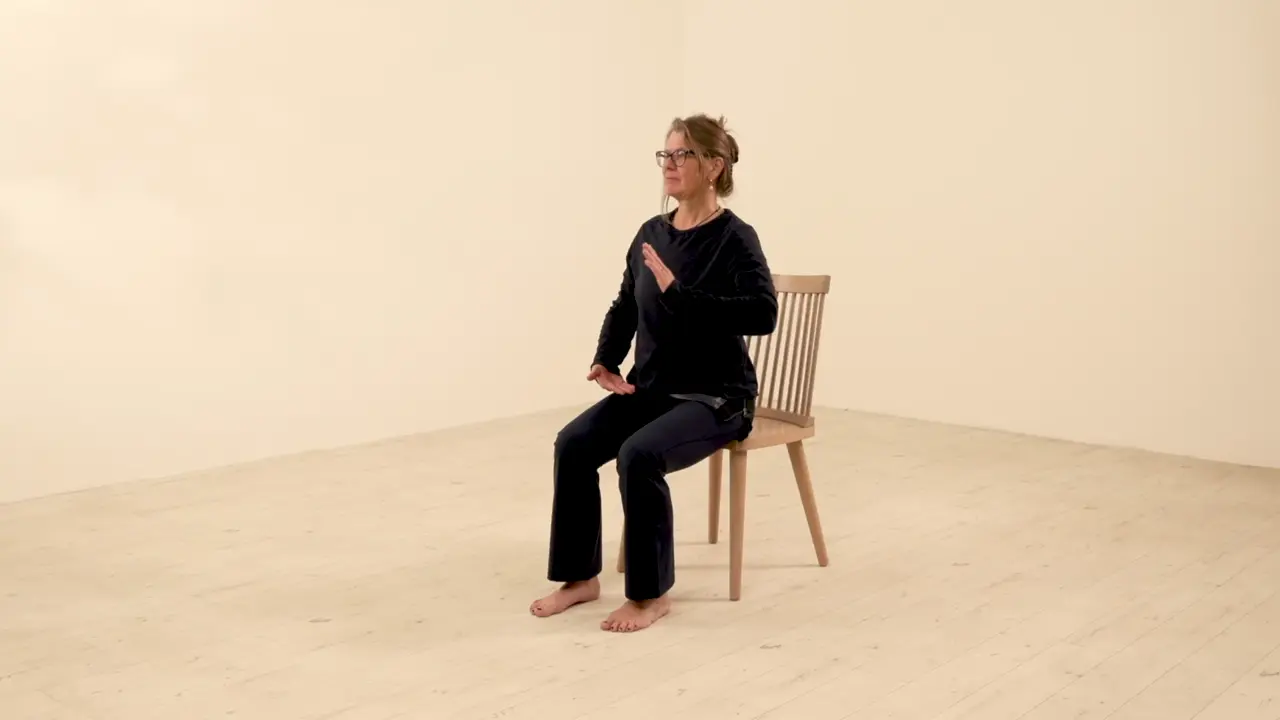
Spinal Twist and Back Glance
Spinal Twist and Back Glance combines a gentle torso rotation with a backward gaze to release tension in the spine and shoulders. It enhances mobility, balance, and postural awareness.
Condition & symptom support
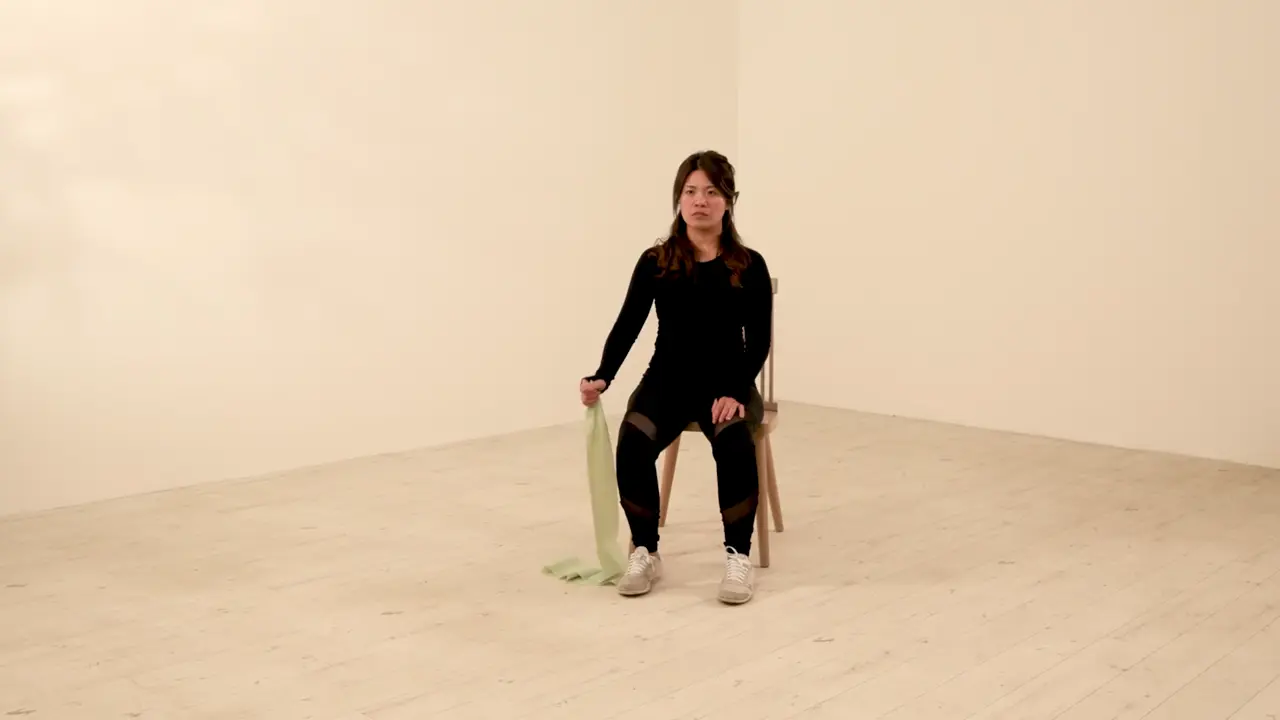
Seated Single Arm Banded Overhead Press
The Seated Single Arm Banded Overhead Press is a unilateral strength exercise that targets the shoulders and arms. Sit tall with one end of the resistance band under your foot and hold the other end in one hand at shoulder height. Press the band overhead until your arm is straight, then lower with control. This exercise builds shoulder stability and balanced strength.

Podcasts
Making work work
Work can take up so much of our waking hours but how often do we look at our relationship with work. Are you a workaholic or just going through the motions? Does it inspire or drain you? What about the people we work with: colleagues, managers and those unrequited crushes or unwanted attentions? When it comes to work, things can get complicated. Clare and Aileen delve into the tangled world of work to help you think about your relationship with work and give tips on how to navigate those complex relationships in the workplace.
by Thomas Andrew Porteus, MBCS
Related patient information and medicines
Patient information leaflet
Essential tremor
Essential tremor is the term for having uncontrolled shaking movements in parts of your body - most commonly your arms and hands. What is essential tremor. There is good treatment available in the form of medication and occasionally surgery. Essential tremor is also called familial essential tremor. It is different from physiological tremor.
Patient information leaflet
Liver failure
Acute liver failure, which can badly affect how our brain works and may cause you to feel drowsy and confused, and to have problems with memory and concentration... Acute liver failure, which may even cause you to go into a coma. Severe difficulty with brain functions caused by liver failure is called hepatic encephalopathy. How is liver failure.

Patient information leaflet
Body dysmorphic disorder
Body dysmorphic disorder (or body dysmorphia) is a common mental health problem. People with BDD spend an excessive amount of time thinking about a minor or imagined defect in their physical appearance, and are distressed about it. The usual treatments are cognitive behavioural therapy (CBT), a selective serotonin reuptake inhibitor (SSRI).

Patient information leaflet
Can I take Lactulose and Ropinirole together?
Ou... Simply search for your medicines to see potential interactions and what to do about them. Disclaimer This information is for general educational purposes only and should not be relied upon as a substitute for professional medical advice. Always consult your GP, pharmacist, or another qualified healthcare professional before making decisions.

Patient information leaflet
Can I take Lactulose and Pregabalin together?
Simply search for your medicines to see potential interactions and w... Disclaimer This information is for general educational purposes only and should not be relied upon as a substitute for professional medical advice. Always consult your GP, pharmacist, or another qualified healthcare professional before making decisions about your medications..

Patient information leaflet
Epidermoid and pilar cysts
Epidermoid and pilar cysts are commonly referred to as 'sebaceous cysts' (pronounced 'seb-ay-shuss'). They are overgrowths of skin cells (called keratin) held together in a little capsule, or sac. They are harmless smooth lumps just under the surface of the skin. They are not cancerous and do not require removal unless they are bothering you by.
Further reading and references
- Familial encephalopathy with neuroserpin inclusion bodies; MedlinePlus, National Library of Medicine.
- Bradshaw CB, Davis RL, Shrimpton AE, Holohan PD, Rea CB, Fieglin D, Kent P, Collins GH. Cognitive deficits associated with a recently reported familial neurodegenerative disease: familial encephalopathy with neuroserpin inclusion bodies. Arch Neurol. 2001 Sep;58(9):1429-34. doi: 10.1001/archneur.58.9.1429.
- Coutelier M, Andries S, Ghariani S, Dan B, Duyckaerts C, van Rijckevorsel K, Raftopoulos C, Deconinck N, Sonderegger P, Scaravilli F, Vikkula M, Godfraind C. Neuroserpin mutation causes electrical status epilepticus of slow-wave sleep. Neurology. 2008 Jul 1;71(1):64-6. doi: 10.1212/01.wnl.0000316306.08751.28. No abstract available.
- D'Acunto E, Fra A, Visentin C, Manno M, Ricagno S, Galliciotti G, Miranda E. Neuroserpin: structure, function, physiology and pathology. Cell Mol Life Sci. 2021 Oct;78(19-20):6409-6430. doi: 10.1007/s00018-021-03907-6. Epub 2021 Aug 17.
- Davis RL, Holohan PD, Shrimpton AE, Tatum AH, Daucher J, Collins GH, Todd R, Bradshaw C, Kent P, Feiglin D, Rosenbaum A, Yerby MS, Shaw CM, Lacbawan F, Lawrence DA. Familial encephalopathy with neuroserpin inclusion bodies. Am J Pathol. 1999 Dec;155(6):1901-13. doi: 10.1016/S0002-9440(10)65510-1.
- Davis RL, Shrimpton AE, Carrell RW, Lomas DA, Gerhard L, Baumann B, Lawrence DA, Yepes M, Kim TS, Ghetti B, Piccardo P, Takao M, Lacbawan F, Muenke M, Sifers RN, Bradshaw CB, Kent PF, Collins GH, Larocca D, Holohan PD. Association between conformational mutations in neuroserpin and onset and severity of dementia. Lancet. 2002 Jun 29;359(9325):2242-7. doi: 10.1016/S0140-6736(02)09293-0.
- Davis RL, Shrimpton AE, Holohan PD, Bradshaw C, Feiglin D, Collins GH, Sonderegger P, Kinter J, Becker LM, Lacbawan F, Krasnewich D, Muenke M, Lawrence DA, Yerby MS, Shaw CM, Gooptu B, Elliott PR, Finch JT, Carrell RW, Lomas DA. Familial dementia caused by polymerization of mutant neuroserpin. Nature. 1999 Sep 23;401(6751):376-9. doi: 10.1038/43894.
- Galliciotti G, Sonderegger P. Neuroserpin. Front Biosci. 2006 Jan 1;11:33-45. doi: 10.2741/1778.
- Godinez A, Rajput R, Chitranshi N, Gupta V, Basavarajappa D, Sharma S, You Y, Pushpitha K, Dhiman K, Mirzaei M, Graham S, Gupta V. Neuroserpin, a crucial regulator for axogenesis, synaptic modelling and cell-cell interactions in the pathophysiology of neurological disease. Cell Mol Life Sci. 2022 Mar 4;79(3):172. doi: 10.1007/s00018-022-04185-6.
- Gourfinkel-An I, Duyckaerts C, Camuzat A, Meyrignac C, Sonderegger P, Baulac M, Brice A. Clinical and neuropathologic study of a French family with a mutation in the neuroserpin gene. Neurology. 2007 Jul 3;69(1):79-83. doi: 10.1212/01.wnl.0000265052.99144.b5.
- Hagen MC, Murrell JR, Delisle MB, Andermann E, Andermann F, Guiot MC, Ghetti B. Encephalopathy with neuroserpin inclusion bodies presenting as progressive myoclonus epilepsy and associated with a novel mutation in the Proteinase Inhibitor 12 gene. Brain Pathol. 2011 Sep;21(5):575-82. doi: 10.1111/j.1750-3639.2011.00481.x. Epub 2011 Mar 24.
- Miranda E, MacLeod I, Davies MJ, Perez J, Romisch K, Crowther DC, Lomas DA. The intracellular accumulation of polymeric neuroserpin explains the severity of the dementia FENIB. Hum Mol Genet. 2008 Jun 1;17(11):1527-39. doi: 10.1093/hmg/ddn041. Epub 2008 Feb 11.
- Yang X, Fang Z, Yan L, He X, Luo H, Han Z, Gui J, Cheng M, Jiang L. Role of SERPINI1 pathogenic variants in familial encephalopathy with neuroserpin inclusion bodies: A case report and literature review. Seizure. 2022 Dec;103:137-147. doi: 10.1016/j.seizure.2022.11.008. Epub 2022 Nov 13.
- Yepes M, Lawrence DA. Neuroserpin: a selective inhibitor of tissue-type plasminogen activator in the central nervous system. Thromb Haemost. 2004 Mar;91(3):457-64. doi: 10.1160/TH03-12-0766.
Share your thoughts or experiences with others in our patient communities.
Simple access to trusted treatments and health services online.
Common conditions
Get help with common conditions through the NHS, without a GP appointment.





Sign up to the Patient newsletter
Your weekly dose of clear, trustworthy health advice - written to help you feel informed, confident and in control.
By subscribing you accept our Privacy Policy. You can unsubscribe at any time. We never sell your data.