Primary macronodular adrenal hyperplasia
Last updated 26 Jul 2023
Meets Patient’s editorial guidelines
- DownloadDownload
- Share
- Language
- Discussion
- Ask Patient
- Audio Version
- Add to preferred sources on Google
Primary macronodular adrenal hyperplasia (PMAH) is a disorder characterised by multiple lumps (nodules) in the adrenal glands, which are small hormone-producing glands located on top of each kidney. These nodules, which usually are found in both adrenal glands (bilateral) and vary in size, cause adrenal gland enlargement (hyperplasia) and result in the production of higher-than-normal levels of the hormone cortisol. Cortisol is an important hormone that suppresses inflammation and protects the body from physical stress such as infection or trauma through several mechanisms including raising levels of blood glucose, also called blood sugar.
Video picks for Genetic conditionsVideo library
Description
Primary macronodular adrenal hyperplasia (PMAH) is a disorder characterised by multiple lumps (nodules) in the adrenal glands, which are small hormone-producing glands located on top of each kidney. These nodules, which usually are found in both adrenal glands (bilateral) and vary in size, cause adrenal gland enlargement (hyperplasia) and result in the production of higher-than-normal levels of the hormone cortisol. Cortisol is an important hormone that suppresses inflammation and protects the body from physical stress such as infection or trauma through several mechanisms including raising levels of blood glucose, also called blood sugar.
PMAH typically becomes evident in a person's forties or fifties. It is considered a form of Cushing syndrome, which is characterised by increased levels of cortisol resulting from one of many possible causes. These increased cortisol levels lead to weight gain in the face and upper body, fragile skin, bone loss, fatigue, and other health problems. However, some people with PMAH do not experience these signs and symptoms and are said to have subclinical Cushing syndrome.
Inheritance patterns
The source lists the following possible inheritance patterns: Not inherited; Autosomal dominant. More than one pattern can apply in different cases.
Related genes
Other names
ACTH-independent macronodular adrenal hyperplasia
ACTH-independent macronodular adrenocortical hyperplasia
Adrenal Cushing syndrome due to AIMAH
Adrenocorticotropic hormone-independent macronodular adrenal hyperplasia
AIMAH
Corticotropin-independent macronodular adrenal hyperplasia
PMAH
Primary bilateral macronodular adrenal hyperplasia
Patient picks for Genetic conditions

Hormones
Cushing's syndrome
Cushing's syndrome is caused by too high a level of glucocorticoid in the body. This can be caused by taking steroid medication long-term (the common cause) or by the body making too much cortisol (the main glucocorticoid made by the body). Symptoms usually develop gradually and so the diagnosis (other than that caused by steroid medication) may not be clear for some time.
by Dr Rachel Hudson, MRCGP

Hormones
Congenital adrenal hyperplasia
Congenital adrenal hyperplasia is an inherited (genetic) condition causing swelling of the adrenal glands. The condition is associated with a decrease in the blood level of a hormone called cortisol and an increase in the level of male sex hormones (androgens) in both sexes. Some people get a mild condition that produces no symptoms. Others (mainly baby boys) develop a severe form that can be life-threatening. Medical treatment to correct hormone levels is available. Surgery to improve the appearance of unusual genitalia (in girls) is sometimes considered.
by Dr Rosalyn Adleman, MRCGP

Hormones
Addison's disease
Addison's disease is a condition in which your adrenal glands are not working as well as they should. In Addison's disease the adrenal glands do not produce as much of the steroid hormones (such as cortisol) as they normally do. These hormones are vital for your body and if you do not have enough of them, you can become very unwell. If the level of these hormones becomes very low, it can be life-threatening. Treatment is with replacement hormone tablets which you need to take every day.
by Dr Doug McKechnie, MRCGP
Tests and investigations
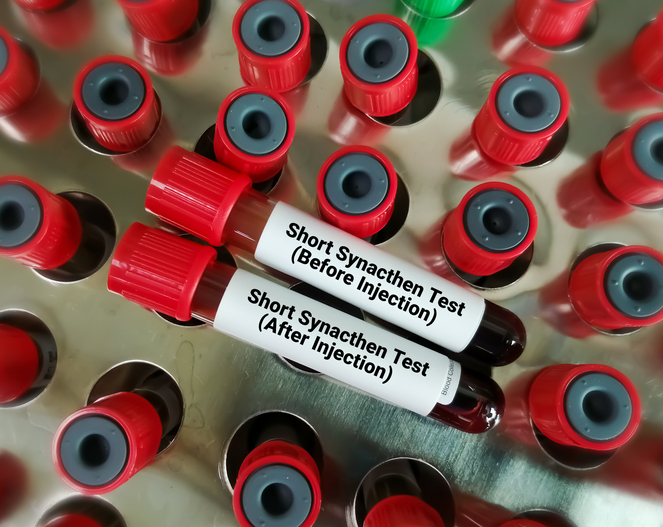
Synacthen test
A synacthen test checks the function of the adrenal glands. It can help to see whether the adrenal glands are producing enough steroid hormone (cortisol). Note: the information below is a general guide only. The arrangements, and the way tests are performed, often vary between different hospitals. Always follow the instructions given by your doctor or local hospital.
by Dr Philippa Vincent, MRCGP

Hormones
Adrenal fatigue
Adrenal fatigue is a theory that the adrenal glands can become 'overworked' from chronic stress, leading to symptoms such as fatigue and low energy. However, there is no scientific evidence to support this claim. Adrenal fatigue is not recognised as a medical condition by professional medical societies, and the consensus amongst mainstream doctors is that it does not exist as a disease.
by Dr Doug McKechnie, MRCGP

Children's health
1 in 5 children starting primary school are not fully protected against serious illnesses
Around 1 in 5 children going back to school are not protected against several serious illnesses. Read here about why UK Health Security Agency (UKHSA) and NHS England urge you to check your child’s vaccination record and catch up on any missed jabs, and what illnesses the vaccinations protect against.
by Lawrence Higgins
Related patient information and medicines
Patient information leaflet
Cushing's syndrome
Cushing's syndrome is caused by too high a level of glucocorticoid in the body. This can be caused by taking steroid medication long-term (the common cause) or by the body making too much cortisol (... Adrenal problems There are various rare disorders of the adrenal glands which can cause high levels of cortisol. These include: Adrenal hyperplasia.
Patient information leaflet
Congenital adrenal hyperplasia
Congenital adrenal hyperplasia is an inherited (genetic) condition causing swelling of the adrenal glands. The condition is associated with a decrease in the blood level of a hormone called cortisol and an increase in the level of male sex hormones (androgens) in both sexes. What is congenital adrenal hyperplasia. Congenital adrenal hyperplasia.
Patient information leaflet
Addison's disease
Addison's disease is a condition in which your adrenal glands are not working as well as they should. In Addison's disease the adrenal glands do not produce as much of the steroid hormones (such as cortisol) as they normally do. These hormones are vi... What is Addison's disease. Addison's disease, also known as primary adrenal insufficiency, is a.

Patient information leaflet
Missed periods
The thyroid gland produces hormones which may affect periods. If you are producing either too much hormone ( hyperthyroidism Overactive thyroid gland ) or too little ( hypothyroidism Underactive thyroid gland ), your periods may be affected. Congenital adrenal hyperplasia Congenital adrenal hyperplasia. This is a rare inherited condition where.

Patient information leaflet
Immunisation for flu
... For the 2025-26 season, flu vaccines for eligible children and pregnant women will be available from 1st September 2026. Flu vaccines for other groups of eligible adults (see below) will be available from 1st October 2026. The Department of Health issues advice as to who should be immunised. This is reviewed each year. The aim is to protect.

Patient information leaflet
Pituitary gland disorders
This leaflet gives a brief overview of the pituitary gland and the hormones it makes. The pituitary gland is found at the base of the brain and is 'pea-sized'. The pituitary gland is an overall controller of a number of other glands in the body, overseeing the function of these organs through hormones. Some of the pituitary gland disorders.
Further reading and references
- Primary macronodular adrenal hyperplasia; MedlinePlus, National Library of Medicine.
- Alencar GA, Lerario AM, Nishi MY, Mariani BM, Almeida MQ, Tremblay J, Hamet P, Bourdeau I, Zerbini MC, Pereira MA, Gomes GC, Rocha Mde S, Chambo JL, Lacroix A, Mendonca BB, Fragoso MC. ARMC5 mutations are a frequent cause of primary macronodular adrenal Hyperplasia. J Clin Endocrinol Metab. 2014 Aug;99(8):E1501-9. doi: 10.1210/jc.2013-4237. Epub 2014 Apr 7.
- Assie G, Libe R, Espiard S, Rizk-Rabin M, Guimier A, Luscap W, Barreau O, Lefevre L, Sibony M, Guignat L, Rodriguez S, Perlemoine K, Rene-Corail F, Letourneur F, Trabulsi B, Poussier A, Chabbert-Buffet N, Borson-Chazot F, Groussin L, Bertagna X, Stratakis CA, Ragazzon B, Bertherat J. ARMC5 mutations in macronodular adrenal hyperplasia with Cushing's syndrome. N Engl J Med. 2013 Nov 28;369(22):2105-14. doi: 10.1056/NEJMoa1304603.
- De Venanzi A, Alencar GA, Bourdeau I, Fragoso MC, Lacroix A. Primary bilateral macronodular adrenal hyperplasia. Curr Opin Endocrinol Diabetes Obes. 2014 Jun;21(3):177-84. doi: 10.1097/MED.0000000000000061.
- Elbelt U, Trovato A, Kloth M, Gentz E, Finke R, Spranger J, Galas D, Weber S, Wolf C, Konig K, Arlt W, Buttner R, May P, Allolio B, Schneider JG. Molecular and clinical evidence for an ARMC5 tumor syndrome: concurrent inactivating germline and somatic mutations are associated with both primary macronodular adrenal hyperplasia and meningioma. J Clin Endocrinol Metab. 2015 Jan;100(1):E119-28. doi: 10.1210/jc.2014-2648.
- Faucz FR, Zilbermint M, Lodish MB, Szarek E, Trivellin G, Sinaii N, Berthon A, Libe R, Assie G, Espiard S, Drougat L, Ragazzon B, Bertherat J, Stratakis CA. Macronodular adrenal hyperplasia due to mutations in an armadillo repeat containing 5 (ARMC5) gene: a clinical and genetic investigation. J Clin Endocrinol Metab. 2014 Jun;99(6):E1113-9. doi: 10.1210/jc.2013-4280. Epub 2014 Mar 6.
- Fragoso MC, Domenice S, Latronico AC, Martin RM, Pereira MA, Zerbini MC, Lucon AM, Mendonca BB. Cushing's syndrome secondary to adrenocorticotropin-independent macronodular adrenocortical hyperplasia due to activating mutations of GNAS1 gene. J Clin Endocrinol Metab. 2003 May;88(5):2147-51. doi: 10.1210/jc.2002-021362.
- Gagliardi L, Schreiber AW, Hahn CN, Feng J, Cranston T, Boon H, Hotu C, Oftedal BE, Cutfield R, Adelson DL, Braund WJ, Gordon RD, Rees DA, Grossman AB, Torpy DJ, Scott HS. ARMC5 mutations are common in familial bilateral macronodular adrenal hyperplasia. J Clin Endocrinol Metab. 2014 Sep;99(9):E1784-92. doi: 10.1210/jc.2014-1265. Epub 2014 Jun 6.
Share your thoughts or experiences with others in our patient communities.
Simple access to trusted treatments and health services online.
Common conditions
Get help with common conditions through the NHS, without a GP appointment.





Sign up to the Patient newsletter
Your weekly dose of clear, trustworthy health advice - written to help you feel informed, confident and in control.
By subscribing you accept our Privacy Policy. You can unsubscribe at any time. We never sell your data.