Familial thoracic aortic aneurysm and dissection
Last updated 22 Aug 2023
Meets Patient’s editorial guidelines
- DownloadDownload
- Share
- Language
- Discussion
- Ask Patient
- Audio Version
- Add to preferred sources on Google
Familial thoracic aortic aneurysm and dissection (familial TAAD) involves problems with the aorta, which is the large blood vessel that distributes blood from the heart to the rest of the body. Familial TAAD affects the upper part of the aorta, near the heart. This part of the aorta is called the thoracic aorta because it is located in the chest (thorax). Other vessels that carry blood from the heart to the rest of the body (arteries) can also be affected.
Video picks for Genetic conditionsVideo library
Description
Familial thoracic aortic aneurysm and dissection (familial TAAD) involves problems with the aorta, which is the large blood vessel that distributes blood from the heart to the rest of the body. Familial TAAD affects the upper part of the aorta, near the heart. This part of the aorta is called the thoracic aorta because it is located in the chest (thorax). Other vessels that carry blood from the heart to the rest of the body (arteries) can also be affected.
In familial TAAD, the aorta can become weakened and stretched (aortic dilatation), which can lead to a bulge in the blood vessel wall (an aneurysm). Aortic dilatation may also lead to a sudden tearing of the layers in the aorta wall (aortic dissection), allowing blood to flow abnormally between the layers. These aortic abnormalities are potentially life-threatening because they can decrease blood flow to other parts of the body such as the brain or other vital organs, or cause the aorta to break open (rupture).
The occurrence and timing of these aortic abnormalities vary, even within the same affected family. They can begin in childhood or not occur until late in life. Aortic dilatation is generally the first feature of familial TAAD to develop, although in some affected individuals dissection occurs with little or no aortic dilatation.
Aortic aneurysms usually have no symptoms. However, depending on the size, growth rate, and location of these abnormalities, they can cause pain in the jaw, neck, chest, or back; swelling in the arms, neck, or head; difficult or painful swallowing; hoarseness; shortness of breath; wheezing; a chronic cough; or coughing up blood. Aortic dissections usually cause severe, sudden chest or back pain, and may also result in unusually pale skin (pallor), a very faint pulse, numbness or tingling (paresthesias) in one or more limbs, or paralysis.
Familial TAAD may not be associated with other signs and symptoms. However, some individuals in affected families show mild features of related conditions called Marfan syndrome or Loeys-Dietz syndrome. These features include tall stature, stretch marks on the skin, an unusually large range of joint movement (joint hypermobility), and either a sunken or protruding chest. Occasionally, people with familial TAAD develop aneurysms in the brain or in the section of the aorta located in the abdomen (abdominal aorta). Some people with familial TAAD have heart abnormalities that are present from birth (congenital). Affected individuals may also have a soft out-pouching in the lower abdomen (inguinal hernia), an abnormal curvature of the spine (scoliosis), or a purplish skin discoloration (livedo reticularis) caused by abnormalities in the tiny blood vessels of the skin (dermal capillaries). However, these conditions are also common in the general population. Depending on the genetic cause of familial TAAD in particular families, they may have an increased risk of developing blockages in smaller arteries, which can lead to heart attack and stroke.
Inheritance patterns
The source lists the following possible inheritance patterns: Autosomal dominant. More than one pattern can apply in different cases.
Related genes
Other names
Annuloaortic ectasia
Congenital aneurysm of ascending aorta
FAA
Familial aortic aneurysm
Familial aortic dissection
Familial TAAD
Familial thoracic aortic aneurysm
FTAAD
TAA
TAAD
Thoracic aortic aneurysm
Patient picks for Genetic conditions
Heart health and blood vessels
Aortic dissection
An aortic dissection is a rare, serious condition. The inner layer of the aorta (the biggest blood vessel in the body, coming directly from the heart) tears. Blood then surges through the tear. This causes the inner and middle layers of the aorta to separate (dissect). Aortic dissection is a medical emergency and needs urgent treatment. The treatment for aortic dissection includes an operation to repair the wall of the aorta. Medicines to reduce blood pressure are also used. Aortic dissection is often fatal but early diagnosis and treatment of aortic dissection can greatly improve survival.
by Dr Colin Tidy, MRCGP
Heart health and blood vessels
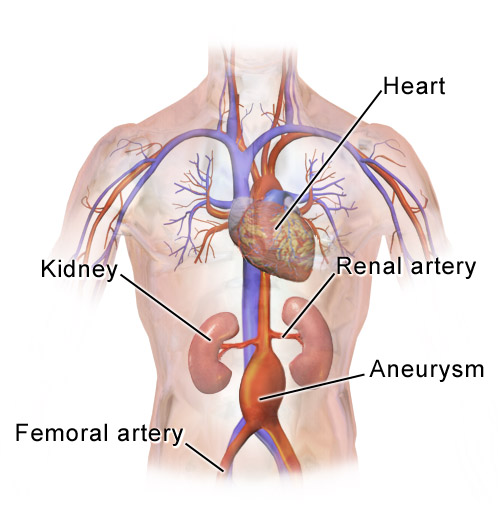
Abdominal aortic aneurysm
The aorta is the main blood vessel in the abdomen, running down from your heart. It is normally about the diameter of a garden hose. In older people, particularly those who smoke, part of it can enlarge and balloon up. This is called an abdominal aortic aneurysm (often abbreviated to AAA, pronounced 'triple-A'). This doesn't cause any symptoms and the person is usually unaware they have it, until it leaks or bursts. The medical term for this is rupture. If the aneurysm ruptures, it can be fatal. In the UK there is a screening programme for men over the age of 65, to see if they have a triple-A. An operation to repair the aneurysm may be advised if it is larger than 5.5 cm, as above this size the risk of rupture increases significantly.
by Dr Doug McKechnie, MRCGP
Heart health and blood vessels
Aortic stenosis
The aortic valve is a heart valve that lies between the left ventricle and the aorta. In aortic stenosis, when the aortic valve opens to let blood pump through, it does not open as widely as it would normally. The opening between the left ventricle and the aorta is therefore narrowed (stenosed). The amount of blood that can pass from the left ventricle to the aorta is therefore reduced. The more narrowed the valve, the smaller the amount of blood that can get through, and the more significant the symptoms. In some cases, aortic stenosis occurs at the same time as aortic regurgitation.
by Dr Philippa Vincent, MRCGP
Heart health and blood vessels
Aortic regurgitation
Aortic regurgitation is sometimes called aortic incompetence or a leaky aortic valve. In aortic regurgitation the valve does not close properly. The aortic valve is a heart valve that lies between the left ventricle and the aorta. Therefore, blood leaks back (regurgitates) into the left ventricle from the aorta. In some cases, aortic regurgitation occurs at the same time as aortic stenosis. Read more about aortic stenosis.
by Dr Colin Tidy, MRCGP
Tests and investigations
CT scan
Note: the information below is a general guide only. The arrangements, and the way tests are performed, may vary between different hospitals. Always follow the instructions given by your doctor or local hospital.
by Dr Rachel Hudson, MRCGP

Bones, joints and muscles
Broken or bruised ribs
Broken or bruised ribs occur when there is a force to the chest such as from a fall, road accident or assault. The force from severe coughing, straining, or heavy sports can also cause rib injury. The symptoms may include pain when coughing, laughing or sneezing, and swelling around the ribs. A bruised rib usually heals itself in 2-3 weeks; pain killers may help with the symptoms. Complications can occur if internal organs are damaged by the sharp end of a broken rib. If you are feeling breathless or unable to catch your breath - call for an emergency ambulance immediately (999 in the UK).
by Dr Philippa Vincent, MRCGP
Related patient information and medicines
Patient information leaflet
Aortic dissection
An aortic dissection is a rare, serious condition. The inner layer of the aorta (the biggest blood vessel in the body, coming directly from the heart) tears. High blood pressure High blood pressure over a long period of time may weaken the wall of the... People who already have an enlarged aorta ( aortic aneurysm Abdominal aortic aneurysm ) are.
Patient information leaflet
Marfan syndrome
Marfan syndrome (named after Dr Antoine Marfan, the French doctor who first described it in 1896) is a genetic disorder which people are born with and which lasts lifelong. Anatomy of the heart and blood vessels Heart and blood vessel problems are the most serious problems that people with Marfan syndrome tend to have. Please seek help immediately.

Patient information leaflet
NHS screening programme
Screening involves tests on people without symptoms to check if they have a disease or condition before it causes symptoms. The reason for screening is the expectation that a problem can be discovered in the ear... Different types of screening tests are offered, depending on the condition they are screening for. For example, Aortic aneurysm. The.

Patient information leaflet
Right upper quadrant pain
In acute pancreatitis Acute pancreatitis there is usually also a ... Pain coming from the aorta The aorta is the main blood vessel that carries blood from the heart through the abdomen to the rest of the body. Pain coming from the aorta can be caused by: Aortic aneurysm Abdominal aortic aneurysm. The aorta becomes swollen and weakened and may.
Patient information leaflet
Turner syndrome
Turner syndrome is a genetic condition that only affects girls. The most characteristic features of the syndrome are b... The most common are as follows: Heart and blood vessel complications. Heart valves may become faulty, abnormalities on the heart tracing (electrocardiogram, or ECG), or abnormalities of the main blood vessels such as the main.
Patient information leaflet
Abdominal aortic aneurysm
In older people, particularly those who smoke, part of it can enlarge and balloon up. This is called an abdominal aortic aneurysm (often abbreviated to AAA, pronounced 'triple-A'). This doesn't cause any symptoms and the person is usually unaware they have it, until it leaks or bursts. If the aneurysm ruptures, it can be fatal. An operation to.
Further reading and references
- Familial thoracic aortic aneurysm and dissection; MedlinePlus, National Library of Medicine.
- Brautbar A, LeMaire SA, Franco LM, Coselli JS, Milewicz DM, Belmont JW. FBN1 mutations in patients with descending thoracic aortic dissections. Am J Med Genet A. 2010 Feb;152A(2):413-6. doi: 10.1002/ajmg.a.32856.
- El-Hamamsy I, Yacoub MH. Cellular and molecular mechanisms of thoracic aortic aneurysms. Nat Rev Cardiol. 2009 Dec;6(12):771-86. doi: 10.1038/nrcardio.2009.191. Epub 2009 Nov 3.
- Elefteriades JA, Pomianowski P. Practical genetics of thoracic aortic aneurysm. Prog Cardiovasc Dis. 2013 Jul-Aug;56(1):57-67. doi: 10.1016/j.pcad.2013.06.002.
- Erbel R, Aboyans V, Boileau C, Bossone E, Bartolomeo RD, Eggebrecht H, Evangelista A, Falk V, Frank H, Gaemperli O, Grabenwoger M, Haverich A, Iung B, Manolis AJ, Meijboom F, Nienaber CA, Roffi M, Rousseau H, Sechtem U, Sirnes PA, Allmen RS, Vrints CJ; ESC Committee for Practice Guidelines. 2014 ESC Guidelines on the diagnosis and treatment of aortic diseases: Document covering acute and chronic aortic diseases of the thoracic and abdominal aorta of the adult. The Task Force for the Diagnosis and Treatment of Aortic Diseases of the European Society of Cardiology (ESC). Eur Heart J. 2014 Nov 1;35(41):2873-926. doi: 10.1093/eurheartj/ehu281. Epub 2014 Aug 29. No abstract available.
- Grond-Ginsbach C, Pjontek R, Aksay SS, Hyhlik-Durr A, Bockler D, Gross-Weissmann ML. Spontaneous arterial dissection: phenotype and molecular pathogenesis. Cell Mol Life Sci. 2010 Jun;67(11):1799-815. doi: 10.1007/s00018-010-0276-z. Epub 2010 Feb 14.
- Guo DC, Regalado E, Casteel DE, Santos-Cortez RL, Gong L, Kim JJ, Dyack S, Horne SG, Chang G, Jondeau G, Boileau C, Coselli JS, Li Z, Leal SM, Shendure J, Rieder MJ, Bamshad MJ, Nickerson DA; GenTAC Registry Consortium; National Heart, Lung, and Blood Institute Grand Opportunity Exome Sequencing Project; Kim C, Milewicz DM. Recurrent gain-of-function mutation in PRKG1 causes thoracic aortic aneurysms and acute aortic dissections. Am J Hum Genet. 2013 Aug 8;93(2):398-404. doi: 10.1016/j.ajhg.2013.06.019. Epub 2013 Aug 1.
- Jondeau G, Boileau C. Genetics of thoracic aortic aneurysms. Curr Atheroscler Rep. 2012 Jun;14(3):219-26. doi: 10.1007/s11883-012-0241-4.
- Milewicz DM, Carlson AA, Regalado ES. Genetic testing in aortic aneurysm disease: PRO. Cardiol Clin. 2010 May;28(2):191-7. doi: 10.1016/j.ccl.2010.01.017.
- Milewicz DM, Cecchi AC. Heritable Thoracic Aortic Disease Overview. 2003 Feb 13 [updated 2023 May 4]. In: Adam MP, Bick S, Mirzaa GM, Wallace SE, Amemiya A, editors. GeneReviews(R) [Internet]. Seattle (WA): University of Washington, Seattle; 1993-2026. Available from http://www.ncbi.nlm.nih.gov/books/NBK1120/
- Morisaki H, Akutsu K, Ogino H, Kondo N, Yamanaka I, Tsutsumi Y, Yoshimuta T, Okajima T, Matsuda H, Minatoya K, Sasaki H, Tanaka H, Ishibashi-Ueda H, Morisaki T. Mutation of ACTA2 gene as an important cause of familial and nonfamilial nonsyndromatic thoracic aortic aneurysm and/or dissection (TAAD). Hum Mutat. 2009 Oct;30(10):1406-11. doi: 10.1002/humu.21081.
- Pyeritz RE. Heritable thoracic aortic disorders. Curr Opin Cardiol. 2014 Jan;29(1):97-102. doi: 10.1097/HCO.0000000000000023.
Share your thoughts or experiences with others in our patient communities.
Simple access to trusted treatments and health services online.
Common conditions
Get help with common conditions through the NHS, without a GP appointment.





Sign up to the Patient newsletter
Your weekly dose of clear, trustworthy health advice - written to help you feel informed, confident and in control.
By subscribing you accept our Privacy Policy. You can unsubscribe at any time. We never sell your data.