androgen receptor
Last updated 1 Apr 2024
Meets Patient’s editorial guidelines
- DownloadDownload
- Share
- Language
- Discussion
- Audio Version
- Add to preferred sources on Google
The AR gene provides instructions for making a protein called an androgen receptor. Androgens are hormones (such as testosterone) that are important for normal male sexual development before birth and during puberty. Androgen receptors allow the body to respond appropriately to these hormones.
Normal function
The AR gene provides instructions for making a protein called an androgen receptor. Androgens are hormones (such as testosterone) that are important for normal male sexual development before birth and during puberty. Androgen receptors allow the body to respond appropriately to these hormones.
The receptors are present in many of the body's tissues, where they attach (bind) to androgens. The resulting androgen-receptor complex then binds to DNA and regulates the activity of certain genes that play a role in male sexual development. By turning the genes on or off as necessary, the androgen receptor complex helps direct the development of male sex characteristics. Androgens and androgen receptors also have other important functions in both males and females, such as regulating hair growth and sex drive.
In one region of the AR gene, a DNA segment known as CAG is repeated multiple times. This CAG segment is called a triplet or trinucleotide repeat. In most people, the number of CAG repeats in the AR gene ranges from fewer than 10 to about 36.
Conditions referring to this gene or chromosome
Other names
AIS
ANDR_HUMAN
DHTR
NR3C4
TFM
Related patient information and medicines

Patient information leaflet
Prostate cancer
Enzalutamide blocks androgen receptors, meaning that it b... Apalutamide plus androgen deprivation therapy (ADT) NICE has recommended that an anti-androgen treatment called apalutamide can be offered in combination with anti-androgen medicines if: You have hormone-sensitive prostate cancer that has metastasised and a form of chemotherapy called.

Patient information leaflet
Addison's disease
In Addison's disease the adrenal glands do not produce as much of the steroid hormones (such as cortisol) as they normally do. Androgens include hormones such as testosterone and oestrogen. Androgens... Androgens have important functions in both men and women. Replacing androgens The adrenal glands also make androgen hormones. Androgens are also.

Patient information leaflet
Adrenarche
This leaflet was originally provided by Miriam Leach (written when a 4th year MB ChB student at Manchester University), used here with permission. Adrenarche (ad-ren-ar-ke) is known to be an ordinary bodily process that happens to boys and girls as they begin to make the transition to being a teenager. Adrenarche is a period of time when more of a.

Patient information leaflet
Breast cancer
If breast cancer is diagnosed at an early stage, less treatment may be needed and it is more likely to be effective. In general, the more advanced the cancer (the more it has grown and spread), the less chance that treatment will be curative. However, treatments are improving all the time and they can often slow the progress of the cancer. Fatty.

Patient information leaflet
Congenital adrenal hyperplasia
Congenital adrenal hyperplasia is an inherited (genetic) condition causing swelling of the adrenal glands. The condition is associated with a decrease in the blood level of a hormone called cortisol and an increase in the level of male sex hormones (androgens) in both sexes. Some people get a mild condition that produces no symptoms. Congenital.
Patient information leaflet
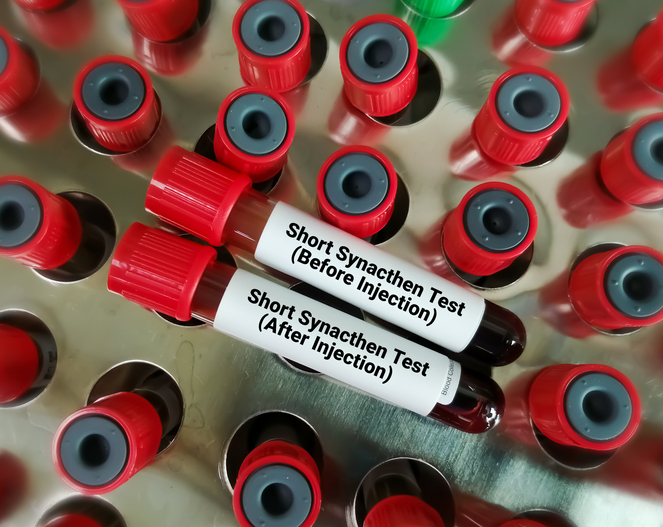
Synacthen test
A synacthen test checks the function of the adrenal glands. It can help to see whether the adrenal... Note : the information below is a general guide only. The arrangements, and the way tests are performed, often vary between different hospitals. Cells in the outer part of the adrenal glands (the adrenal cortex) make the chemicals (hormones).
Further reading and references
- androgen receptor; MedlinePlus, National Library of Medicine.
- Adachi H, Katsuno M, Minamiyama M, Waza M, Sang C, Nakagomi Y, Kobayashi Y, Tanaka F, Doyu M, Inukai A, Yoshida M, Hashizume Y, Sobue G. Widespread nuclear and cytoplasmic accumulation of mutant androgen receptor in SBMA patients. Brain. 2005 Mar;128(Pt 3):659-70. doi: 10.1093/brain/awh381. Epub 2005 Jan 19.
- Beitel LK, Scanlon T, Gottlieb B, Trifiro MA. Progress in Spinobulbar muscular atrophy research: insights into neuronal dysfunction caused by the polyglutamine-expanded androgen receptor. Neurotox Res. 2005;7(3):219-30. doi: 10.1007/BF03036451.
- Bennett NC, Gardiner RA, Hooper JD, Johnson DW, Gobe GC. Molecular cell biology of androgen receptor signalling. Int J Biochem Cell Biol. 2010 Jun;42(6):813-27. doi: 10.1016/j.biocel.2009.11.013. Epub 2009 Nov 30.
- Gottlieb B, Beitel LK, Nadarajah A, Paliouras M, Trifiro M. The androgen receptor gene mutations database: 2012 update. Hum Mutat. 2012 May;33(5):887-94. doi: 10.1002/humu.22046. Epub 2012 Mar 13.
- Gottlieb B, Beitel LK, Wu J, Elhaji YA, Trifiro M. Nuclear receptors and disease: androgen receptor. Essays Biochem. 2004;40:121-36. doi: 10.1042/bse0400121.
- Hillmer AM, Hanneken S, Ritzmann S, Becker T, Freudenberg J, Brockschmidt FF, Flaquer A, Freudenberg-Hua Y, Jamra RA, Metzen C, Heyn U, Schweiger N, Betz RC, Blaumeiser B, Hampe J, Schreiber S, Schulze TG, Hennies HC, Schumacher J, Propping P, Ruzicka T, Cichon S, Wienker TF, Kruse R, Nothen MM. Genetic variation in the human androgen receptor gene is the major determinant of common early-onset androgenetic alopecia. Am J Hum Genet. 2005 Jul;77(1):140-8. doi: 10.1086/431425. Epub 2005 May 18.
- Katsuno M, Adachi H, Tanaka F, Sobue G. Spinal and bulbar muscular atrophy: ligand-dependent pathogenesis and therapeutic perspectives. J Mol Med (Berl). 2004 May;82(5):298-307. doi: 10.1007/s00109-004-0530-7. Epub 2004 Feb 27.
- Levy-Nissenbaum E, Bar-Natan M, Frydman M, Pras E. Confirmation of the association between male pattern baldness and the androgen receptor gene. Eur J Dermatol. 2005 Sep-Oct;15(5):339-40.
- Poletti A, Negri-Cesi P, Martini L. Reflections on the diseases linked to mutations of the androgen receptor. Endocrine. 2005 Dec;28(3):243-62. doi: 10.1385/ENDO:28:3:243.
- Zajac JD, Fui MN. Kennedy's disease: clinical significance of tandem repeats in the androgen receptor. Adv Exp Med Biol. 2012;769:153-68.
Join the conversation
Share your thoughts or experiences with others in our patient communities.

Ask, share, connect.
Browse discussions, ask questions, and share experiences across hundreds of health topics.
Sign up to the Patient newsletter
Your weekly dose of clear, trustworthy health advice - written to help you feel informed, confident and in control.
By subscribing you accept our Privacy Policy. You can unsubscribe at any time. We never sell your data.