Familial atrial fibrillation
Last updated 18 Aug 2020
Meets Patient’s editorial guidelines
- DownloadDownload
- Share
- Language
- Discussion
- Ask Patient
- Audio Version
- Add to preferred sources on Google
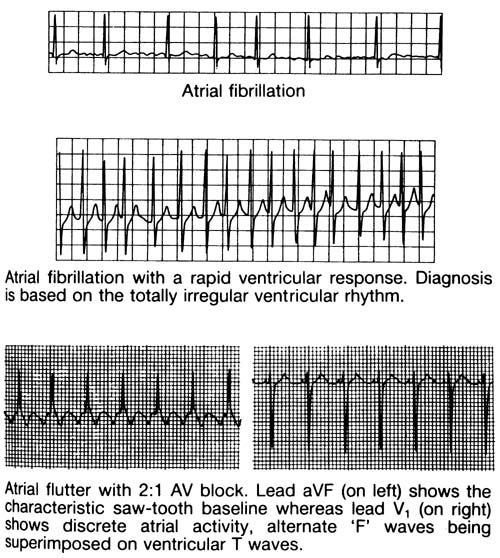
Familial atrial fibrillation is an inherited abnormality of the heart's normal rhythm. Atrial fibrillation is characterised by episodes of uncoordinated electrical activity (fibrillation) in the heart's upper chambers (the atria), which cause a fast and irregular heartbeat. If untreated, this abnormal heart rhythm (arrhythmia) can lead to dizziness, chest pain, a sensation of fluttering or pounding in the chest (palpitations), shortness of breath, or fainting (syncope). Atrial fibrillation also increases the risk of stroke and sudden death. Complications of atrial fibrillation can occur at any age, although some people with this heart condition never experience any health problems associated with the disorder.
Video picks for Genetic conditionsVideo library
Description
Familial atrial fibrillation is an inherited abnormality of the heart's normal rhythm. Atrial fibrillation is characterised by episodes of uncoordinated electrical activity (fibrillation) in the heart's upper chambers (the atria), which cause a fast and irregular heartbeat. If untreated, this abnormal heart rhythm (arrhythmia) can lead to dizziness, chest pain, a sensation of fluttering or pounding in the chest (palpitations), shortness of breath, or fainting (syncope). Atrial fibrillation also increases the risk of stroke and sudden death. Complications of atrial fibrillation can occur at any age, although some people with this heart condition never experience any health problems associated with the disorder.
Inheritance patterns
The source lists the following possible inheritance patterns: Autosomal dominant. More than one pattern can apply in different cases.
Related genes
Other names
Atrial fibrillation, familial
Auricular fibrillation
Patient picks for Genetic conditions

Heart health and blood vessels
Atrial fibrillation explained
Atrial fibrillation is when your heartbeat is usually irregular and too fast. Here we look at what can cause it, the symptoms, and the treatment you may receive if you have it.
by Lawrence Higgins
Heart health and blood vessels
Atrial fibrillation
Atrial fibrillation (AF) is an abnormal fast irregular heartbeat. An abnormal heartbeat rhythm is called an arrhythmia. A normal heart rate is between 60 and 100 beats a minute (bpm) when you're resting. In AF the heart rate can sometimes be very fast (often between 140 and 180 bpm) as well as being irregular.
by Dr Doug McKechnie, MRCGP

Heart health and blood vessels
Atrial fibrillation stroke prevention options
Without any medicine to reduce the risk, about 50 in every 1,000 people who have atrial fibrillation (AF) will have a stroke. The individual risk for each person will also depend on other factors including your age, whether you have already had a stroke and whether you have heart failure, diabetes or high blood pressure.
by Dr Colin Tidy, MRCGP
Treatment and medication
Atrial fibrillation and stroke prevention
The medicines used to prevent a atrial fibrillation-related stroke are called anticoagulants. These help to stop blood clots forming in your blood vessels.
by Dr Colin Tidy, MRCGP
Heart health and blood vessels
Atrial septal defect
Atrial septal defect (ASD) is a hole (defect) in the wall (septum) between the heart's two upper, or collecting, chambers (atria). One chamber is known as an atrium. The septum separates the heart's left and right side. A septal defect is sometime called a 'hole' in the heart. It is the third most common heart problem that babies are born with. Many defects in the atrial septum close themselves and cause no problems. Otherwise, they can be closed by keyhole procedure or surgery. Most babies born with a defect in the septum have normal survival.
by Dr Colin Tidy, MRCGP
Heart health and blood vessels
Familial hypercholesterolaemia
Familial hypercholesterolaemia is inherited high cholesterol. It is a condition where you have a very high cholesterol level in your blood.
by Dr Colin Tidy, MRCGP
Related patient information and medicines
Patient information leaflet
Dilated cardiomyopathy
Some forms of dilated cardiomyopathy run in families. About one in four people with idiopathic dilated cardiomyopathy have a familial (hereditary) form. This means that several members of their family also have dilated cardiomyopathy. An anticoagulant Anticoagulants (blood thinner) may be advised if someone has atrial fibrillation Atrial.
Patient information leaflet
Heart valve disease
The leaflet called Anatomy of the heart includes details about the function of the heart and how the heart beats. The main possible complications that may develop include the following: Atrial fibrillation develops in about 4 in 10 cases. In this condition, the heart beats in a fast a... The irregular heart rhythm can cause the sensation of.
Patient information leaflet
Aortic stenosis
Sometimes, the symptoms of aortic stenosis lead to an echocardiogram being organised to assess the s... NICE recommends that all patients with a heart murmur, where aortic stenosis is suspected, should be considered for an echocardiogram, particularly if they are over 75 years old, if there is a family history of aortic stenosis or if there are.
Patient information leaflet
Abnormal heart rhythms
Sometimes you may notice them as a slight thud in the chest if you are lying... Caffeine in tea or coffee, and alcohol may cause you to have more ectopic beats than usual. Supraventricular tachycardia Supraventricular tachycardia. Atrial fibrillation (AF) Atrial fibrillation. Atrial flutter is similar to atrial fibrillation (AF). The atria.

Patient information leaflet
Wolff-Parkinson-White syndrome
Wolff-Parkinson-White syndrome is not common but can cause a fast heart rate or other heart rhythm abnormalities from time to time. Treatment can be given for the fast heart rate and also to prevent any further episodes. What is Wolff-Parkinson-White syndrome. In Wolff-Parkinson-White (WPW) syndrome there is an extra connection (an accessory.
Patient information leaflet
Anticoagulants
People who are at high risk of getting a blood clot, and might be recommended anticoagulants, include people with: A fast irregular heartbeat - atrial fibrillation or AF Atrial fibrillation. ... that DOACs should be the preferred option for AF, instead of warfarinOther people with atrial fibrillation (particularly older people with other medical.
Further reading and references
- Familial atrial fibrillation; MedlinePlus, National Library of Medicine.
- Chen YH, Xu SJ, Bendahhou S, Wang XL, Wang Y, Xu WY, Jin HW, Sun H, Su XY, Zhuang QN, Yang YQ, Li YB, Liu Y, Xu HJ, Li XF, Ma N, Mou CP, Chen Z, Barhanin J, Huang W. KCNQ1 gain-of-function mutation in familial atrial fibrillation. Science. 2003 Jan 10;299(5604):251-4. doi: 10.1126/science.1077771.
- Fatkin D, Santiago CF, Huttner IG, Lubitz SA, Ellinor PT. Genetics of Atrial Fibrillation: State of the Art in 2017. Heart Lung Circ. 2017 Sep;26(9):894-901. doi: 10.1016/j.hlc.2017.04.008. Epub 2017 May 11.
- Gutierrez A, Chung MK. Genomics of Atrial Fibrillation. Curr Cardiol Rep. 2016 Jun;18(6):55. doi: 10.1007/s11886-016-0735-8.
- Hucker WJ, Saini H, Lubitz SA, Ellinor PT. Atrial Fibrillation Genetics: Is There a Practical Clinical Value Now or in the Future? Can J Cardiol. 2016 Nov;32(11):1300-1305. doi: 10.1016/j.cjca.2016.02.032. Epub 2016 Feb 12.
- Xiao J, Liang D, Chen YH. The genetics of atrial fibrillation: from the bench to the bedside. Annu Rev Genomics Hum Genet. 2011;12:73-96. doi: 10.1146/annurev-genom-082410-101515.
Share your thoughts or experiences with others in our patient communities.
Simple access to trusted treatments and health services online.
Common conditions
Get help with common conditions through the NHS, without a GP appointment.





Sign up to the Patient newsletter
Your weekly dose of clear, trustworthy health advice - written to help you feel informed, confident and in control.
By subscribing you accept our Privacy Policy. You can unsubscribe at any time. We never sell your data.