Port-wine stain
Birthmark
Peer reviewed by Dr Toni Hazell, FRCGPLast updated by Dr Hayley Willacy, FRCGP Last updated 31 Oct 2022
Meets Patient’s editorial guidelines
- DownloadDownload
- Share
- Language
- Discussion
- Audio Version
- Add to preferred sources on Google
A port-wine stain is a differently coloured patch of skin that a baby is born with. It is usually over their face, neck or scalp, and looks pink or pale purple. It is often called a port-wine birthmark now.
At a glance
A port-wine stain is a type of birthmark, usually a pink or pale purple patch of skin.
They are present at birth and are caused by tiny, permanently dilated blood vessels.
Port-wine stains typically appear on the face, neck, scalp or upper chest.
They are not painful or itchy but can darken and thicken with age if untreated.
Laser treatment, ideally started in young children, can make the stain much paler.
In rare cases, a port-wine stain on the face can be linked to eye or brain problems.
A specialist doctor may check babies with a facial port-wine stain for other issues.
What is a port-wine stain?
A baby's skin is normally pretty much the same colour all over. But with a port-wine stain the baby has a patch of skin which looks different to their usual skin colour. It is usually a pink or pale purple patch on one side of their scalp, neck or face.
That's why they're called 'port-wine': because port (the alcoholic drink) is usually dark red.
Are port-wine birthmarks hereditary?
Generally speaking, port-wine stains are just random events and there isn't anyone else in the family who has one.
How common are port-wine stains?
Birthmarks are common, and about 1 in 300 newborns have a port-wine stain. That is fairly common. In rare cases it can develop in early childhood. But you might not see too many people with them, because some patches might be small and barely noticeable. Some people might have had them treated at a young age and the red colour has faded away, or they may be using camouflage products to cover them up.
What causes a port-wine stain?
A port-wine stain is also called a naevus flammeus or, more commonly, a firemark.
It is almost always a type of birthmark. It is caused by abnormal development of tiny blood vessels.
Usually port-wine stains are present at birth. They are formed because the tiny blood vessels (capillaries) in the skin are too big (dilated).
Normally we have microscopic nerves that keep the blood vessels small (constricted) most of the time. This keeps skin cool and pale usually.
In port-wine stains the nerves that control the blood vessels don't work properly, so they are permanently dilated. The result is that the skin looks red when it shouldn't.
Usually the redness is in a patch on the face, neck, scalp or upper chest.
What are the symptoms of a port-wine stain?
Generally the only symptom of a port-wine stain is the appearance.
They are not painful or itchy.
A port-wine stain is treated to reduce the chance of its appearance distressing the child. .
What do port-wine birthmarks look like?
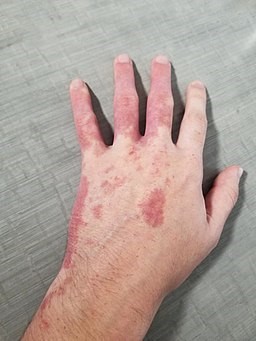
Port-wine stains are pigmented birthmarks, they can vary in size from a few millimetres across to a big patch covering almost all of one half of someone's face, however they can appear anywhere on the body. Their colour can vary from pale red to deep purple.
The picture below shows an adult's hand. Stain colour is often lighter in babies, as port-wine stains tend to darken with age:
Port-wine stain hand
Do port-wine stains fade?
They are not harmful, but if just left alone port-wine stains tend to darken over the years. The overlying skin is smooth and flat at first. By middle age the overlying skin can become thickened and lumpy (a cobblestone-like appearance). A lot of people find it distressing to live with skin like this on their face and therefore request treatment.
How would a doctor diagnose a port-wine stain?
There is no particular test for a port-wine stain.
The diagnosis is made on the appearance of a newborn's skin.
A biopsy is not normally necessary.
A port-wine stain should not be confused with a 'salmon patch' or 'stork mark' (sometimes called a 'stork bite') that almost half of babies have, on the back of their neck in the midline. This fades over about a year and is entirely harmless.
Are any further tests done?
Because very rarely something could be wrong with the baby's brain or eyes, if a baby has a port-wine stain they are usually checked by a specialist doctor. They will probably have a brain scan and a detailed eye check.
Do they mean something else is wrong with the baby?
About 1 in 100 babies born with a port-wine stain on the face have problems of the eye or brain. If 1 in 300 babies have a port-wine stain and 1 in 100 of these have something else wrong then you can see how rare these problems are: they only affect 1 in 30,000 babies.
Eye problems: may develop if the port-wine stain is on the eyelid area. If a child has a port-wine stain next to an eye then an eye specialist will normally check the child regularly until they are adult.
Brain abnormalities: are an uncommon association with port-wine stains of the face. This is due to extensive blood vessel abnormalities in the brain (the Sturge-Weber syndrome). Epilepsy and other problems may then develop.
Spine abnormalities and varicose veins: can be other associated problems.
The majority of children with port-wine stains do not have these complications.
How doctors remove a port-wine stain birthmark
Laser treatment
Pulsed dye laser is the treatment of choice for port-wine stains. It is a treatment that was developed in the 1980s, so plenty is known about it.
The treatment fires tiny lasers at the blood vessels in the skin, making them seal off.
Initially just a small area will be treated, as a test. This can judge how well the child handles the treatment and whether they find it too painful. Children say it feels like being flicked by a rubber band.
The skin can be numbed with local anaesthetic cream beforehand. But if the child finds it too painful or there is a large area to be treated then they can have the treatment under a general anaesthetic. Most hospitals will only give a general anaesthetic over the age of 2 years for the laser treatment.
Typically about six laser sessions are given over a period of a year.
Laser therapies work best when used at a young age and when the port-wine stain is pale pink rather than deep purple.
About three quarters of children have a good response to laser treatment, with the port-wine stain getting much paler.
In the long term the skin area can go back to a darker colour, about ten years after laser treatment.
NHS funding for laser treatment is not always guaranteed.
Camouflage cream
For skin patches that have not responded well to laser, or if the person would like a bit more cover-up for a special occasion, camouflage creams can used. These come in a wide variety of colours and can be matched to the person's skin colour.
Waterproof creams have been designed. Usually the cream is removed each night with a cleanser.
When is the best time to treat a port-wine birthmark ?
Most port-wine stains are quite pale and flat in a newborn. If left alone they gradually get thicker, bumpy and darker. This is why early treatment, in a young child, is better than in an adult.
Patient picks for Other skin conditions

Skin, nail and hair health
Pressure sores
A pressure sore is also known as a 'bed sore' or a 'pressure ulcer'. It is a sore or broken (ulcerated) area of skin caused by irritation and continuous pressure on part of your body. Pressure sores are more common over places where your bones are close to your skin (bony prominences) such as your heels, the lower part of your back and your bottom. There are various things that can increase your risk of developing a pressure sore. In particular, risk increases if your mobility is reduced for some reason and you are spending long periods lying in bed or sitting in a chair. There are various measures you can take to prevent most pressure sores developing. These include changing your position as much as possible and also using pressure-relieving devices.
by Dr Hayley Willacy, FRCGP
Skin, nail and hair health
Sun and sunburn
This leaflet discusses the risks and benefits of sunlight to your skin. It gives tips on how to enjoy sunshine safely so it you can do you good and reduce the risk of causing harm. It is very important to protect children from the sun. The delicate skin of a child is more sensitive to sun damage than the skin of an adult.
by Dr Caroline Wiggins, MRCGP
Frequently asked questions
Can a port-wine stain appear after birth?
While most port-wine stains are present at birth, in rare cases, they can develop during early childhood.
If my baby has a port-wine stain, how can I differentiate it from a 'stork mark'?
A port-wine stain should not be confused with a 'salmon patch' or 'stork mark', which nearly half of babies have, typically on the back of their neck in the midline. Stork marks fade over about a year and are harmless, whereas port-wine stains are caused by permanently dilated blood vessels and tend to darken if left untreated.
What might happen to the skin with a port-wine stain as a person ages, even if it's not harmful?
If a port-wine stain is left untreated, the overlying skin, which is initially smooth and flat, can become thickened and lumpy, developing a 'cobblestone-like' appearance by middle age. The colour of the stain also tends to darken over the years.
Is it possible for the treated area to change colour again after successful laser treatment?
Yes, even after successful laser treatment where the port-wine stain becomes much paler, the treated skin area can revert to a darker colour about ten years later.
Are camouflage creams suitable for everyday use, or are they just for special occasions?
Camouflage creams can be used to cover skin patches that haven't responded well to laser treatment, or when a person wants more cover-up for special occasions. They are available in various colours to match skin tones and are typically removed each night with a cleanser.
Further reading and references
- Sturge-Weber Syndrome, SWS; Online Mendelian Inheritance in Man (OMIM)
- Sabeti S, Ball KL, Burkhart C, et al; Consensus Statement for the Management and Treatment of Port-Wine Birthmarks in Sturge-Weber Syndrome. JAMA Dermatol. 2021 Jan 1;157(1):98-104. doi: 10.1001/jamadermatol.2020.4226.
- Wanitphakdeedecha R, Ng JNC, Yan C, et al; Quality of Life and Psychological Effects of Port-Wine Stain: A Review of Literature. Clin Cosmet Investig Dermatol. 2021 Jun 22;14:681-690. doi: 10.2147/CCID.S315804. eCollection 2021.
- Jeon H, Bernstein LJ, Belkin DA, et al; Pulsed Dye Laser Treatment of Port-Wine Stains in Infancy Without the Need for General Anesthesia. JAMA Dermatol. 2019 Apr 1;155(4):435-441. doi: 10.1001/jamadermatol.2018.5249.
About the authorView full bio
Updated by

Dr Hayley Willacy, FRCGP
General Practitioner, Medical Author
MBChB (1992), DRCOG, DFFP, MRCOG (Part 1) MRCGP (2007), DFSRH (2013), MSc - medical education (2020)
Dr Hayley Willacy was an NHS GP working in northwest England, who retired from clinical practice in 2022 after 30 years.
About the reviewerView full bio

Dr Toni Hazell, FRCGP
MBBS, BSc, FRCGP, DFSRH, Dip GU med, DRCOG, DCH (London, UK, 2000)
Dr. Toni Hazell qualified from St. Mary’s Hospital Medical School and did her VTS at Northwick Park Hospital.
Join the conversation
Share your thoughts or experiences with others in our patient communities.

Ask, share, connect.
Browse discussions, ask questions, and share experiences across hundreds of health topics.

Feeling unwell?
Assess your symptoms online for free
Sign up to the Patient newsletter
Your weekly dose of clear, trustworthy health advice - written to help you feel informed, confident and in control.
By subscribing you accept our Privacy Policy. You can unsubscribe at any time. We never sell your data.