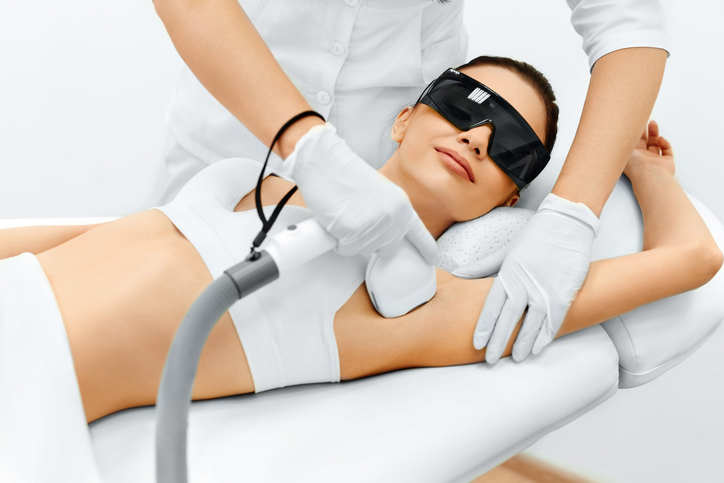
Laser hair removal
Peer reviewed by The British Association of Plastic Surgeons (BAAPS)Authored by The British Association of Plastic Surgeons (BAAPS)Originally published 23 Mar 2016
Meets Patient’s editorial guidelines
- DownloadDownload
- Share
- Language
- Discussion
- Audio Version
- Add to preferred sources on Google
Content notice
This page hasn’t been reviewed recently, so some information or external links may have changed.
This leaflet is provided by the British Association of Aesthetic Plastic Surgeons, the professional body responsible for the advancement of education and safety in aesthetic plastic surgery.
At a glance
Laser hair removal is a method of removing unwanted body hair.
It is often used by people with excessive hairiness called hirsutism.
Laser light targets pigment in the hair root to stop hair growth.
Treatment works best on dark hair and is less effective on grey or blonde hair.
The treated area may be red and warm for a few hours after treatment.
Repeat treatments are usually needed several times a year.
A small test patch is recommended first to check for side effects.
Traditional methods for removing unwanted body hair include shaving, waxing, the application of depilatory cream and electrolysis. Depilation by laser is a relatively new technique. It helps not only those with normal hair growth, but also those with excessive hairiness of the body or face, a condition called hirsutism which causes considerable psychological distress.
Hirsutism affects approximately 10% of women between the ages of 18 and 35. In most cases there is no obvious cause but some patients may have a hormonal disturbance. Hirsutism may also be a feature of the menopause. Unwanted hair is a significant problem for transsexuals and transvestites, and many males with hair on their back dislike it intensely. Children with hairy moles of the face or lumbar spine area are often teased.
Hair biology
Hair biology
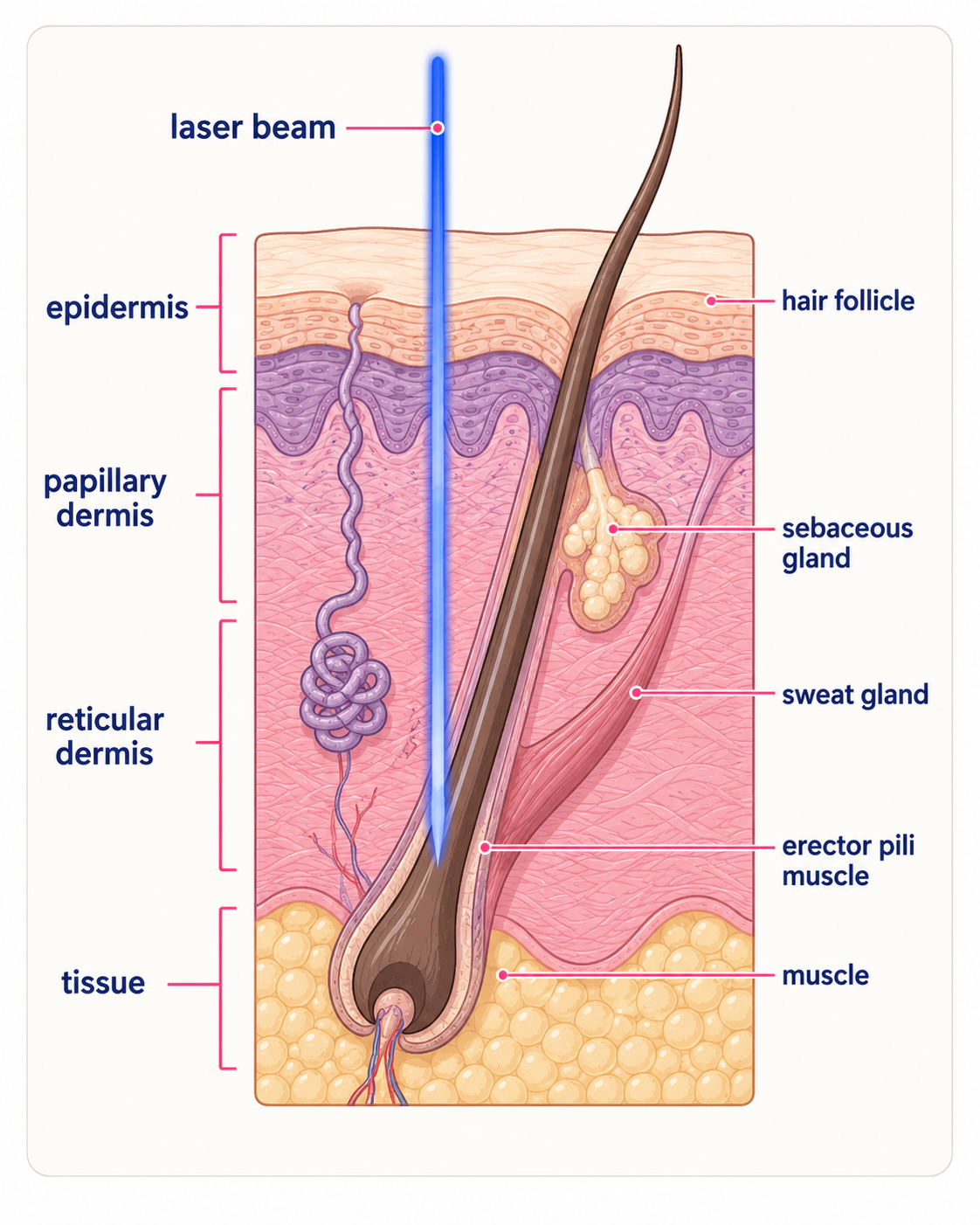
The hair grows in cycles, alternating between a growing phase (anagen) and a quiescent phase (telogen); catagen is the period of transition between the two.
Cells half way up the hair follicle are thought to be responsible for hair growth. The depilation laser delivers a particular wavelength of laser light which targets the pigment in the hair. This light penetrates up to a millimetre beneath the skin where it is absorbed by the pigment in the part of the hair root which is important for growth.
Hairs come in a variety of thicknesses and colours according to the pigment they contain. Black and laser light penetrates through the skin and is preferentially absorbed by the hair.
The stem cells responsible for hair growth are thought to be located at the attachment of the erector pili muscle to the follicle. The brown hairs contain most pigment and are easiest to treat. Grey or blonde hair has little pigment and is unlikely to respond to treatment.
Treatment
Treatment may be a little uncomfortable - it feels a little like an elastic band snapping against the skin - but some patients prefer to use local anaesthetic cream to numb the area first. Aloe vera gel may also be used during or after treatment for its cooling effect. Some lasers have a cooling system which reduces the discomfort of the treatment.
After treatment, the treated area may look red and feel warm and tender. This feeling goes after a couple of hours, but in a few patients, particularly those with dark skin, blistering and crusting of the skin sometimes occur after laser treatment. Some hairs disappear at the treatment session; others, which initially look curled up or "frazzled" may take a few days to fall out.
Types of laser
A variety of laser systems are now available. Ruby lasers, Alexandrite lasers, Nd-YAG lasers and white light machines can all be used to remove hair with varying degrees of success. The size of the area covered by each pulse of laser energy varies with the machine used.
Results
Initial reports of laser hair removal were extremely promising, and some research went so far as to claim that it may be permanent, but this is generally not the case. A few patients do not respond to the laser treatment at all but many will have good results. Regrowth is not only less dense but also less coarse. In the ideal patient, with dark hair and pale skin, the hair usually disappears for two to three months and then slowly regrows. Repeat treatment is usually required several times a year.
Safety
When laser treatment is carried out it is essential that all those within the treatment room, you and the staff, should wear protective goggles or glasses. Entry to the room is strictly controlled whilst treatment is being given.
Complications and problems
Laser light can damage the skin's pigment and sometimes the treatment area may become unusually pale or dark several months after treatment. For this reason, it is always wise to carry out a small trial of treatment in an unobtrusive area before proceeding to extensive treatment. The test patch is examined six to eight weeks later for unwanted side effects and to carefully assess success before proceeding to further treatment. Special care is needed when treating patients with black or brown skin. The Nd-YAG laser may be most suitable for dark skins as it causes less skin damage. After treatment you should stay out of the sun as exposure of recently laser treated skin to strong sunshine may increase the risk of pigmentation problems.
The future
At present many patients derive great benefit from laser hair removal, achieving hair-free intervals of up to three months. Further research is likely to improve results in the future. Permanency, the gold standard of hair removal, seems to be some way off however.
Content used with permission from the British Association of Aesthetic Plastic Surgeons website: Laser hair removal. Copyright for this leaflet is with the BAAPS.
Disclaimer
This leaflet is designed to supply useful information but is not to be regarded as advice specific to any particular case. It does not replace the need for a thorough consultation and all prospective patients should seek the advice of a suitably qualified medical practitioner. The BAAPS accepts no liability for any decision taken by the reader in respect of the treatment they decide to undertake.
Patient picks for Cosmetic surgery

Surgery and procedures
Breast reduction
This leaflet is provided by the British Association of Aesthetic Plastic Surgeons, the professional body responsible for the advancement of education and safety in aesthetic plastic surgery.
by The British Association of Plastic Surgeons (BAAPS)
Surgery and procedures
Nose reduction surgery (rhinoplasty)
This leaflet is provided by the British Association of Aesthetic Plastic Surgeons, the professional body responsible for the advancement of education and safety in aesthetic plastic surgery.
by The British Association of Plastic Surgeons (BAAPS)
Frequently asked questions
Does laser hair removal work on all hair colours?
Laser hair removal is most effective on brown and black hair because the laser targets the pigment within the hair. Grey or blonde hair has very little pigment, making it unlikely to respond effectively to the treatment.
How many sessions of laser hair removal are typically needed to see results?
Regrowth typically occurs after two to three months, and repeat treatment is usually required several times a year to maintain the hair-free interval and manage regrowth. Over time, the regrowth is less dense and less coarse.
What is the sensation of laser hair removal like during treatment?
Treatment may cause a little discomfort, often described as feeling like an elastic band snapping against the skin. Some patients choose to use a local anaesthetic cream to numb the area beforehand, and some lasers include a cooling system to help reduce this discomfort. Aloe vera gel can also be used during or after treatment for a cooling effect.
Are there any specific aftercare instructions following laser hair removal?
After receiving laser treatment, it's important to avoid exposure to strong sunlight, as this can increase the risk of pigmentation problems on the recently treated skin. The treated area may also look red, feel warm, and be tender for a couple of hours after the session.
Can laser hair removal cause permanent changes to skin colour?
Yes, laser light can sometimes damage the skin's pigment, potentially causing the treated area to become unusually pale or dark several months after treatment. To minimise this risk, a small test patch is usually performed in an inconspicuous area. After 6-8 weeks, this test patch is checked for unwanted side effects and effectiveness before proceeding with more extensive treatment.
About the authorView full bio
Authored by

The British Association of Plastic Surgeons (BAAPS)
The British Association of Aesthetic Plastic Surgeons (BAAPS) is the professional body for Plastic Surgeons in the UK.
About the reviewerView full bio
The British Association of Plastic Surgeons (BAAPS)
The British Association of Aesthetic Plastic Surgeons (BAAPS) is the professional body for Plastic Surgeons in the UK.
Article history
Article also available in English, German, Spanish, French, Italian, Portuguese, Hindi, Hebrew, Arabic, and Swedish.
23 Mar 2016 | Originally published
Authored by:
The British Association of Plastic Surgeons (BAAPS)Peer reviewed by
The British Association of Plastic Surgeons (BAAPS)
Join the conversation
Share your thoughts or experiences with others in our patient communities.

Ask, share, connect.
Browse discussions, ask questions, and share experiences across hundreds of health topics.

Feeling unwell?
Assess your symptoms online for free
Sign up to the Patient newsletter
Your weekly dose of clear, trustworthy health advice - written to help you feel informed, confident and in control.
By subscribing you accept our Privacy Policy. You can unsubscribe at any time. We never sell your data.