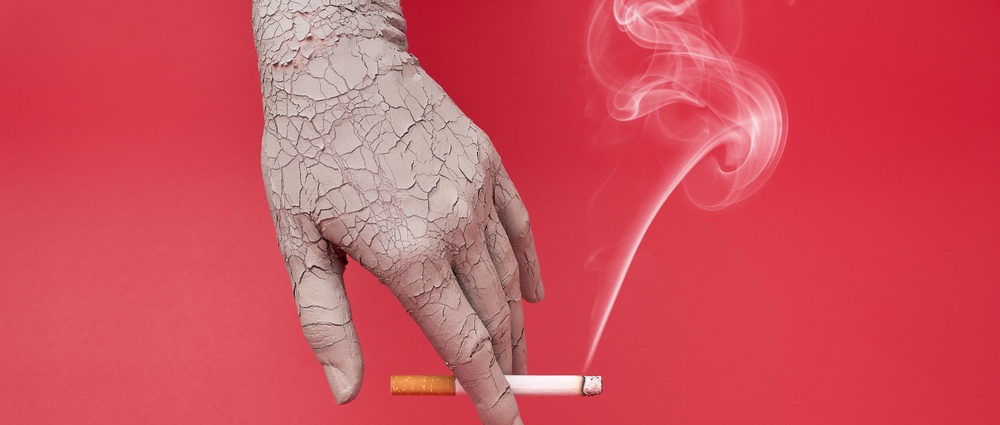
Smoking effects on skin: from ageing to illness
Peer reviewed by Dr Colin Tidy, MRCGPLast updated by Lynn StephenLast updated 6 Mar 2026
Meets Patient’s editorial guidelines
- DownloadDownload
- Share
- Language
- Discussion
- Audio Version
- Add to preferred sources on Google
Smoking is bad for you but its effects on your skin's health may not be the first thing you think of. We explore how this deadly habit can damage the largest organ of your body - the skin.
Dr Anjali Mahto, consultant dermatologist and British Skin Foundation member, explains that smoking damages nearly every organ in your body
"Unlike damage to your heart or lungs, the effects on skin are often outwardly visible," she says. "Not only is smoking related to the development of certain skin disorders, it is a major culprit in premature ageing of the skin."
Premature ageing
Smoking deprives your skin of oxygen and nutrients. While some smokers appear pale, others develop an uneven colour. The habit also stains the smoker's fingers and teeth, and makes them more susceptible to age spots or patches of darker skin, especially if they spend a lot of time in the sun.
There are more than 4,000 chemicals in tobacco smoke, several of which can trigger the destruction of collagen and elastin, which gives your skin its strength and elasticity. Smoking damages the building blocks of skin causing it to sag, not only on your face but also your arms and breasts.
Smokers also develop earlier and deeper wrinkles in addition to a smoker's pucker, caused by using certain muscles around their mouth that non-smokers do not.
Mahto says that the link between smoking and wrinkles has been known for many years. Smoking is an independent risk factor for developing wrinkles. Women seem to be more susceptible to this than their male counterparts.
This commonly shows itself as fine lines around the eyes - sometimes called crow's feet - and mouth at an earlier age than non-smokers.
Mahto adds: "Aside from early wrinkling, other facial features have been described in smokers. These include thinning of the skin, facial redness, and prominence of the underlying bony contours of the face."
Skin cancer
Spending too much time in the sun increases your odds of getting skin cancer, but smoking also increases this chance. Smokers are much more likely to develop squamous cell carcinoma (SSC) - the second most common type of skin cancer - caused by the uncontrolled growth of abnormal squamous cells in the outermost layer of the skin.
Mayto says: "Even people who only smoke a few cigarettes a day remain vulnerable to this. It is thought that tobacco found in smoke suppresses your immune system, allowing cancer cells to evade recognition.
"Whilst SCC is easier to treat if found early, it does have the potential to spread to other parts of the body and can potentially be life-threatening."
Our expert warns that smokers have a higher chance of developing wart-related cancers - including cancer of the vulva, anus, and penis, as well as genital warts caused by the human papillomavirus (HPV). This could be related to the immunosuppressive effects of nicotine.
Poor wound healing
Many studies have shown that smoking can interrupt the wound healing process, causing higher rates of wound infection, decreased wound strength, skin graft failure, tissue death, and blood clot formation.
Nicotine is thought to cause blood vessels to narrow and decrease blood flow, reducing the amount of oxygen and other nutrients reaching wound tissues. It can also cause tiny blood clots to form, which can block small blood vessels.
Tobacco also prevents the formation of collagen. Reduced collagen production causes changes in the normal inflammatory processes that occur during wound healing. Furthermore, smoking delays the formation of new blood vessels within a wound.
Other skin disorders
Psoriasis
Smoking can aggravate other skin conditions such as psoriasis, a relatively common disorder of the skin that causes red, scaly patches of skin.
Mahto explains that smokers have a higher chance of developing this condition compared to non-smokers. They are also more likely to have severe and more extensive disease that is less likely to respond successfully to treatment.
She says: "Nicotine is thought to directly affect your immune system, potentially triggering psoriasis in those people who may already have an underlying tendency towards developing this condition. It binds to skin cells known as keratinocytes, promoting their cell division and turnover."
Discoid lupus erythematosus
Smoking can also aggravate discoid lupus erythematosus. This is an autoimmune skin condition where scaly, red patches often appear in sun-exposed sites.
Mahto says: "The areas can often clear but leave behind scarring. This occurs at least ten times more commonly in smokers compared to non-smokers.
"Treatment of this condition with antimalarial and other drugs has also been shown to be less effective in smokers."
Hidradenitis suppurativa
Also common among smokers is hidradenitis suppurativa, a long-term condition that results in painful boil-like swellings and abscesses under the skin - particularly in the groin and armpits - that can often discharge and leave scarring.
Mahto explains: "The areas can often clear but leave behind scarring. This occurs at least ten times more commonly in smokers compared to non-smokers.
"Treatment of this condition with antimalarial and other medicine has also been shown to be less effective in smokers."
One more reason to quit
Smoking is bad for your skin, but quitting can cause its appearance to improve. Blood flow recovers, meaning your skin receives the oxygen and nutrients it requires, leading to a healthier looking complexion. The stains found on fingers and nails may also disappear and teeth may look whiter.
Of course, quitting smoking also improves your general health. Within a year, the likelihood of developing heart disease is half that of a smoker. And within ten years, an ex-smoker is no more likely to die of lung cancer than someone who has never smoked.
Patient picks for Smoking and vaping
Healthy living
How to stop smoking
The start of a new year is often a time when people make resolutions and strive to adopt healthier habits. One goal you might have is to give up smoking. But, once you commit to quitting, how can you ensure you stick with it throughout the year?
by Emily Jane Bashforth
Healthy living
Benefits of stopping smoking
Stopping smoking can make a big difference to your health and lifestyle. It is never too late to stop smoking to greatly benefit your health. For example, if you stop smoking in middle age, before having cancer or some other serious disease, you avoid most of the increased risk of death due to smoking. Help is available if you find it difficult to stop smoking.
by Dr Toni Hazell, FRCGP
About the authorView full bio
Updated by

Lynn Stephen
Content developer
MA (Hons)
Lynn joined Patient in 2023 and her role includes checking all the professional leaflets, patient information leaflets and medicine leaflets, to ensure consistency of spelling, grammar, reference material and brand style, working with the medical authors and clinical director to coordinate the authoring and peer reviewing of the leaflets.
Authored by

Kerry Taylor-Smith
Freelance journalist
BSc (Hons) Natural Sciences
Kerry has been a freelance writer, editor and proofreader since 2016; she specialises in science and health-related topics.
About the reviewerView full bio

Dr Colin Tidy, MRCGP
General Practitioner, Medical Author
MBBS, MRCGP, MRCP (Paediatrics), DCH
Dr Colin Tidy is an NHS Doctor, based in Oxfordshire.
Article history
Article also available in English, German, Spanish, French, Italian, Portuguese, Hindi, Hebrew, Arabic, and Swedish.
Next review due: 6 Mar 2029
6 Mar 2026 | Latest version
14 Nov 2018 | Originally published
Authored by:
Kerry Taylor-Smith
Join the conversation
Share your thoughts or experiences with others in our patient communities.

Ask, share, connect.
Browse discussions, ask questions, and share experiences across hundreds of health topics.

Feeling unwell?
Assess your symptoms online for free
Sign up to the Patient newsletter
Your weekly dose of clear, trustworthy health advice - written to help you feel informed, confident and in control.
By subscribing you accept our Privacy Policy. You can unsubscribe at any time. We never sell your data.