Fine-needle aspiration
Peer reviewed by Dr Hannah Gronow, MBACPLast updated by Dr Roger Henderson, MBBSLast updated 22 Nov 2018
Meets Patient’s editorial guidelines
- DownloadDownload
- Share
- Language
- Discussion
- Ask Patient
- Audio Version
- Add to preferred sources on Google
Content notice
This page hasn’t been reviewed recently, so some information or external links may have changed.
In fine-needle aspiration a thin, hollow needle is used to take a sample of cells from an organ or lump under the skin. The cells are then analysed under a microscope.
Note: the information below is a general guide only. The arrangements and the way tests are performed, may vary between different hospitals. Always follow the instructions given by your doctor or local hospital.
At a glance
Fine-needle aspiration uses a thin needle to take cell samples from a lump or organ.
This test can help to identify the type of cells in a lump, including detecting cancer.
It is commonly used for breast lumps or the thyroid gland in your neck.
A doctor inserts a thin needle into the lump, sometimes guided by a scan.
You may feel a little sore or get a bruise, but serious complications are uncommon.
Video picks for General tests and investigationsVideo library
What is fine-needle aspiration?
Fine-needle aspiration involves using a thin, hollow needle to remove samples of cells from tissue or fluid in an organ or a lump. It is not quite the same as a biopsy, which takes a very small chunk of tissue away. Once the samples of cells have been removed, they are sent to the laboratory for further testing.
Fine-needle aspiration is usually done to identify the type of cells inside a lump or to see how well treatment of an existing lump is working.
It is commonly used to investigate lumps found in the breast or a gland found in your neck (the thyroid). However, it can also be used in other parts of the body. It is a very useful way of detecting cancer.
How does fine-needle aspiration work?
A very thin, hollow needle is gently inserted through the skin into the lump or organ below. Often there is a syringe attached to the needle. The doctor can use the syringe to help 'suck' some of the cells into the needle by gently pulling on the plunger.
Usually, the test can be done without the need to make a cut in the skin. This helps to minimise any discomfort for the person having the test, as well as the risk of infection or other complications.
If the lump being tested is very small it might be necessary to use a scanning machine to help guide the needle to the right place. This may be done by an ultrasound scan, a computerised tomography (CT) scan or an X-ray of the breast (a mammogram).
What happens?
The doctor will clean the skin where the needle is to be inserted. In some cases you will also be given a local anaesthetic to numb the area. This may not be necessary if the lump is very close to the surface of your skin.
The doctor will hold the lump steady with one hand and insert a thin needle (which may be attached to a syringe) into the lump.
Fine-needle aspiration
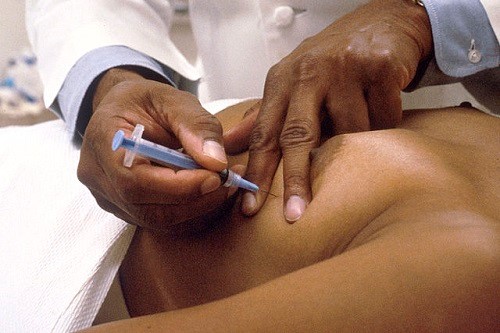
They may move the needle in and out of the area to make sure of getting enough tissue or fluid. If there is a syringe attached they will gently pull back on the plunger to help remove the tissue or fluid. The process takes a few seconds to a few minutes. The needle will then gently be removed and your doctor may apply some pressure to help stop any bleeding.
If the doctor cannot easily feel the lump, you may have an imaging test, such as a CT scan, ultrasound scan, or mammogram to see where to put the needle. In this case, a doctor known as a radiologist may do the aspiration. The radiologist may do the investigation but they will not know the result immediately.
If the lump is a fluid-filled sac (a cyst), the fluid is removed and the lump usually goes away.
After the test is over, the cells taken from the needle are sent to the laboratory. It may take a few days to get the results of the test back, depending on what part of your body has been tested.
What should I do to prepare for a fine-needle aspiration?
This depends on what part of your body is being tested. Your local hospital should give you information on what is required. Usually very little preparation is necessary.
Note: if you take a blood-thinning medicine (an anticoagulant) such as warfarin, you may be asked to stop taking this for a few days before the procedure.
What can happen after a fine-needle aspiration?
Most fine-needle aspirations are carried out without any problems.
Commonly, you may feel a little sore for a couple of days after the test. You may develop a bruise at the site where the needle was inserted. Complications are uncommon but can include:
Bleeding or bruising. This should stop and heal quickly.
Infection at the point where the needle went in.
Other complications specific to the site of needle insertion.
Patient picks for General tests and investigations
Surgery and procedures
Endobronchial ultrasound-guided transbronchial needle aspiration
Endobronchial ultrasound-guided transbronchial needle aspiration (EBUS TBNA) is a procedure which uses a special kind of telescope to see inside the airways. It also uses ultrasound to allow doctors to take samples of tissue just outside the lungs. EBUS TBNA is occasionally referred to as an EBUS procedure as well. Note: the information below is a general guide only. The arrangements and the way tests are performed may vary between different hospitals. Always follow the instructions given by your doctor or local hospital.
by Dr Colin Tidy, MRCGP
Cancer
Bone marrow biopsy and aspiration
A bone marrow biopsy is a procedure where a sample of tissue is taken from the inside of a bone.
by Dr Laurence Knott
Chest and lungs
Aspiration pneumonia
Aspiration pneumonia is a lower respiratory tract (chest) infection caused by bacteria which have leaked into the lungs from fluid from the stomach or mouth. This can be as a result of vomiting or an inability to swallow properly. It causes symptoms of a lower respiratory tract infection (cough, fever, shortness of breath) and is usually treated with antibiotics.
by Dr Philippa Vincent, MRCGP

Mental health
Overcoming your fear of needles
It goes without saying that nobody likes injections. Faced with a routine visit to the pharmacist - be that for a travel vaccination or a flu jab - most people treat the experience as a necessary evil. For some people, however, disliking injections runs a lot deeper than that. It is estimated that up to 10% of the population have a genuine needle phobia, meaning they have a persistent and excessive fear of needles. This can manifest as deep anxiety before and during the consultation, or even avoiding vaccinations altogether.
by Abi Millar

Brain and nerves
Pins and needles
Numbness is a condition where you can't feel anything in part of your body, some describe it as a 'limb falling asleep'. Pins and needles are a tingling or numbness feeling or prickling sensation that is often felt in hands or feet. Usually this is due to pressure on nerves/nerve cells or the blood vessels that supply nerves. This often happens after you've been in an awkward position, like sitting cross-legged, or it may be the sign of a trapped nerve. Occasionally, it may be the sign of a more serious underlying problem such as diabetes. The most common causes are mentioned below.
by Dr Hayley Willacy, FRCGP

Signs and symptoms
What could be causing your pins and needles?
Everyone might experience them occasionally, but the causes behind pins and needles aren't always down to lying awkwardly on an arm or leg. Here we look at what causes pins and needles and when to worry about them.
by Lawrence Higgins
Frequently asked questions
What is the difference between a fine-needle aspiration and a biopsy?
A fine-needle aspiration uses a thin, hollow needle to collect samples of cells, while a biopsy takes a small piece of tissue. Both are sent for laboratory testing, but the aspiration collects individual cells rather than a solid piece of tissue.
Will I feel pain during a fine-needle aspiration?
The doctor may clean the area and, in some cases, give you a local anaesthetic to numb it, especially if the lump is not very close to the skin's surface. This helps minimise discomfort. After the procedure, you might feel a little sore for a couple of days.
How long does a fine-needle aspiration procedure take?
The actual process of inserting the needle and collecting cells typically takes only a few seconds to a few minutes.
How long will it take to get the results back after a fine-needle aspiration?
It may take a few days to receive the results of the test, and the exact time can depend on which part of your body has been tested.
Further reading and references
- Karadeniz Cakmak G, Emre AU, Tascilar O, et al; Diagnostic adequacy of surgeon-performed ultrasound-guided fine needle aspiration biopsy of thyroid nodules. J Surg Oncol. 2012 Jul 5. doi: 10.1002/jso.23212.
- Yu YH, Wei W, Liu JL; Diagnostic value of fine-needle aspiration biopsy for breast mass: a systematic review and meta-analysis. BMC Cancer. 2012 Jan 25;12:41.
- VanderLaan PA; Fine-needle aspiration and core needle biopsy: An update on 2 common minimally invasive tissue sampling modalities. Cancer Cytopathol. 2016 Dec;124(12):862-870. doi: 10.1002/cncy.21742. Epub 2016 May 16.
About the authorView full bio
Updated by

Dr Roger Henderson, MBBS
General Practitioner, Medical Author
MBBS, LMSSA
Dr Roger Henderson qualified as a GP in 1985 and has authored for EMIS since early 2013.
About the reviewerView full bio

Dr Hannah Gronow, MBACP
General Practitioner
MB, ChB, MBACP
Hannah qualified as a GP in 1997. She joined EMIS (Patient) as a peer reviewer in August 2006.
Share your thoughts or experiences with others in our patient communities.
Simple access to trusted treatments and health services online.
Common conditions
Get help with common conditions through the NHS, without a GP appointment.





Sign up to the Patient newsletter
Your weekly dose of clear, trustworthy health advice - written to help you feel informed, confident and in control.
By subscribing you accept our Privacy Policy. You can unsubscribe at any time. We never sell your data.