Lichen simplex
Peer reviewed by Dr Hayley Willacy, FRCGP Last updated by Dr Colin Tidy, MRCGPLast updated 18 Jan 2023
Meets Patient’s editorial guidelines
- DownloadDownload
- Share
- Language
- Discussion
- Ask Patient
- Audio Version
- Add to preferred sources on Google
Medical Professionals
Professional Reference articles are designed for health professionals to use. They are written by UK doctors and based on research evidence, UK and European Guidelines. You may find one of our health articles more useful.
Appearance
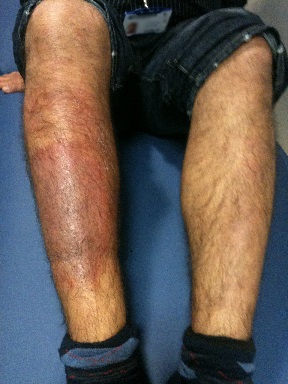
Lichen simplex, sometimes called lichen simplex chronicus or neurodermatitis, presents as a localised demarcated plaque, usually with scaling, excoriations and lichenification (increased skin markings and thickened skin) on the surface. The lesion is particularly itchy. Common sites are the calf, elbow, shin, behind the neck, and genitalia (vulva or scrotum).1 2 Plaques are usually greater than 5 cm in diameter.3
Lichen simplex on a young man's shin
Lichen simplex on dorsum of young man's foot
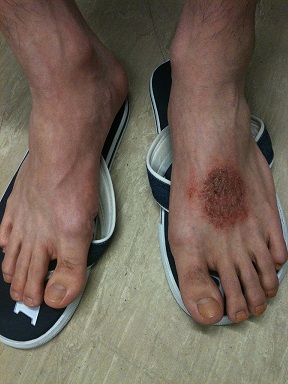
Images above provided for Patient.info by Dr Oliver Starr
What causes lichen simplex? (Aetiology)4
Lichen sclerosis is generally caused by persistent scratching causing the skin to become lichenified (thick and leathery), such as associated with:
Different itchy skin conditions - eg, eczema, irritant or allergic dermatitis and psoriasis.
Itchy infections - eg, fungal skin infection.
Dry skin.
Insect bites. Scars.
Varicose veins and varicose eczema.
Nerve dysfunction, such as due to a back injury, shingles or stroke.
Lichen simplex is more common in people who feel anxious or stressed. Sometimes, no cause can be identified.
Lichen simplex epidemiology
The condition has been estimated to occur in 12% of the population.5 The highest prevalence is mid-to-late adulthood, with a peak at 30-50 years. There is no race predilection, although people with dark skin tend to develop more marked pigmentary changes.6 The condition is aggravated by periods of inactivity (presumably because there are no distractions to the itching) and stress.7 One study found that people with lichen simplex chronicus had different personality profiles from those who did not.8
Differential diagnosis9
Usually the unilateral nature of the lesion, on the shin or dorsum of the foot, coupled with the history of an enlarging, very itchy skin thickening are enough to make the diagnosis clinically.
However, there are some dermatological conditions that need to be excluded, including the dermatological manifestations of systemic diseases of the gastrointestinal, neurological and renal systems, as well as haematological conditions.
Dermatological conditions which need to be considered include:
Acanthosis nigricans (not as thickened as lichen simplex and usually on the back of the neck).
Acne keloidalis nuchae - (keloid papules and plaques on the occipital scalp occurring almost exclusively in Afro-American men).
Alopecia mucinosa - papules and plaques, seen mainly in the young (<40 years), leading to hair loss.
Amyloidosis (of the primary localised cutaneous type).
Discoid (nummular) dermatitis, also known as discoid eczema. (Usually more lesions, scattered up a limb).
Pretibial myxoedema (usually bilateral).
Plaque psoriasis (more widespread than lichen simplex and bilateral).
Seborrhoeic dermatitis (usually bilateral).
Stasis dermatitis.
Investigations
Narrowing the list of potential causes may be helped by doing an IgE level and patch testing to exclude atopy and allergy, mycotic studies and biopsy for histopathology.
Lichen simplex primary care treatment and management9
There remains a paucity of high-quality studies supporting treatments for lichen simplex. The most robust evidence is for using topical corticosteroids and limited data suggest benefit with other treatments such as topical immunomodulators, topical antipruritic agents, oral antihistamines, antiepileptics and antidepressants. Novel treatments include transcutaneous electrical nerve stimulation (TENS), focused ultrasound, and phototherapy.10
Once the lesion is covered over and the patient cannot scratch it, it usually resolves. Resolution once a firm occlusive dressing is applied (and hopefully not removed by the patient, to scratch) is therefore diagnostic of lichen simplex.
Itching may be relieved by using potent (occasionally very potent) steroids such as clobetasol or fluocinolone. Once the lesion has lost its lichenification and thickening, it becomes less itchy and the strong steroids only need to be used if itching recurs.
Tar or ichthyol preparations have been shown to be beneficial for their anti-pruritic effect.
Oral antihistamines may be required. A sedative antihistamine such as chlorphenamine may be first-line if sleep disturbance is a problem.
Oral antibiotics may be required for swab-positive infections.
Intralesional steroids such as triamcinolone may be considered in resistant cases.
Other treatment options currently being investigated include topical doxepin and capsaicin, topical aspirin/dichloromethane, topical and oral immune modulators such as tacrolimus.11 12 Topical tacrolimus may be particularly helpful for cases resistant to other treatment and promote long-lasting benefit.13
Gabapentin has also been used to good effect in cases resistant to topical treatments.14
Prognosis
The prognosis will depend on the nature of any underlying skin condition, as well as the intensity and duration of any itching. The condition often improves well with treatment but occasional cases may become persistent, especially on the genitalia.
Patient picks for Dermatology

Professional
Genital herpes simplex
How common... (Epidemiology) Herpes simplex - genital; NICE CKS, May 2024 (UK access only) 65302 : CKS Herpes simplex - genital Genital herpes simplex is one of the most common sexually transmitted infections. Up to 23% of adults in the UK have antibodies to HSV-2. Contact dermatitis Contact and occupational dermatitis or atopic dermatitis Atopic.
by Dr Philippa Vincent, MRCGP

Professional
Lichen sclerosus
Synonyms: lichen sclerosus et atrophicus, balanitis xerotica obliterans, lichen albus, white spot disease, Csillag's disease, kraurosis vulvae What is lichen sclerosus. Lichen sclerosus (LS) is a chronic inflammatory dermatosis which usually affects the skin of the anogenital region in women, and the glans penis and foreskin in men. ...us,Br J.
by Dr Colin Tidy, MRCGP

Professional
Lichen planus
What is lichen planus. Lichen planus (LP) is a pruritic, papular eruption characterised by its violaceous colour and polygonal shape, sometimes with a fine scale. It is most often found on the flexor surfaces of the upper extremities, genitalia and on the mucous membranes. ScientificWorldJournal. 2014 Jan 30;2014:742826. doi: 10.1155/2014/742826..
by Dr Colin Tidy, MRCGP
Professional
Pityriasis lichenoides
What is pityriasis lichenoides. Pityriasis lichenoides is an umbrella term for a spectrum of rare benign skin disorders thought to be T-cell mediated in response to an environmental antigen that is most likely viral. There are three types, listed here in descending order of frequency: Pityriasis lichenoides chronica ... Int J Dermatol. 2010.
by Dr Toni Hazell, FRCGP

Professional
Herpes simplex eye infections
Overview Herpes simplex - ocular; NICE CKS, October 2021 (UK access only) 62481 : CKS Herpes simplex - ocular There are two types of herpes simplex virus (HSV) which are capable of causing an acute viral infection characterised by clusters of vesicles. HSV-1 Oral herpes simplex mainly causes infection above the waist (characteristically the face,.
by Dr Colin Tidy, MRCGP

Professional
Oral herpes simplex
Synonyms: oral herpes labialis, cold sore What is oral herpes simplex. Of the herpes viruses, herpes simplex virus type 1 (HSV-1) is usually the cause of oral infection. Oral herpes simplex epidemiology Herpes simplex - oral; NICE CKS, October 2021 (UK access only) 62953 : CKS Herpes simplex - oral Around 40% of young adults who are seropositive.
by Dr Toni Hazell, FRCGP
Exclusive updates for healthcare professionals
Stay informed with the latest clinical updates, professional insights, and evidence-based guidance. The Patient Pro newsletter curates essential content for healthcare professionals—delivered straight to your inbox.
By subscribing you accept our Privacy Policy. You can unsubscribe at any time. We never sell your data.
Further reading and references
- Yang L, Li X, Huang W, et al; The Efficacy and Safety of Acupuncture in the Treatment of Neurodermatitis: A Systematic Review and Meta-Analysis. Evid Based Complement Alternat Med. 2022 Sep 1;2022:8182958. doi: 10.1155/2022/8182958. eCollection 2022.
- Thorstensen KA, Birenbaum DL; Recognition and management of vulvar dermatologic conditions: lichen sclerosus, lichen planus, and lichen simplex chronicus. J Midwifery Womens Health. 2012 May-Jun;57(3):260-75. doi: 10.1111/j.1542-2011.2012.00175.x.
- European guideline for the management of vulval conditions; International Union against Sexually Transmitted Infections, 2016
- Lichen simplex chronicus on the back; Medline Plus
- Ju T, Vander Does A, Mohsin N, et al; Lichen Simplex Chronicus Itch: An Update. Acta Derm Venereol. 2022 Oct 19;102:adv00796. doi: 10.2340/actadv.v102.4367.
- An JG et al; Quality Of Life of Patients with Neurodermatitis. Int J Med Sci 2013; 10(5):593-598.
- Cahill S, Chronic pruritic vulva lesion, Journal of Family Practice, Vol. 62, No. 02: 97-99, 2013.
- Lotti T, Buggiani G, Prignano F; Prurigo nodularis and lichen simplex chronicus. Dermatol Ther. 2008 Jan-Feb;21(1):42-6. doi: 10.1111/j.1529-8019.2008.00168.x.
- Martin-Brufau R, Corbalan-Berna J, Ramirez-Andreo A, et al; Personality differences between patients with lichen simplex chronicus and normal population: A study of pruritus. Eur J Dermatol. 2010 May-Jun;20(3):359-63. doi: 10.1684/ejd.2010.0961. Epub 2010 Apr 13.
- Lichen Simplex; DermNet.
- Juarez MC, Kwatra SG; A systematic review of evidence based treatments for lichen simplex chronicus. J Dermatolog Treat. 2021 Nov;32(7):684-692. doi: 10.1080/09546634.2019.1708856. Epub 2020 Mar 6.
- Elmariah SB, Lerner EA; Topical therapies for pruritus. Semin Cutan Med Surg. 2011 Jun;30(2):118-26. doi: 10.1016/j.sder.2011.04.008.
- Cohen KR, Frank J, Salbu RL, et al; Pruritus in the elderly: clinical approaches to the improvement of quality of life. P T. 2012 Apr;37(4):227-39.
- Aschoff R, Wozel G; Topical tacrolimus for the treatment of lichen simplex chronicus. J Dermatolog Treat. 2007;18(2):115-7.
- Gencoglan G, Inanir I, Gunduz K; Therapeutic hotline: Treatment of prurigo nodularis and lichen simplex chronicus with gabapentin. Dermatol Ther. 2010 Mar-Apr;23(2):194-8.
About the authorView full bio
Updated by

Dr Colin Tidy, MRCGP
General Practitioner, Medical Author
MBBS, MRCGP, MRCP (Paediatrics), DCH
Dr Colin Tidy is an NHS Doctor, based in Oxfordshire.
About the reviewerView full bio

Dr Hayley Willacy, FRCGP
General Practitioner, Medical Author
MBChB (1992), DRCOG, DFFP, MRCOG (Part 1) MRCGP (2007), DFSRH (2013), MSc - medical education (2020)
Dr Hayley Willacy was an NHS GP working in northwest England, who retired from clinical practice in 2022 after 30 years.
Simple access to trusted treatments and health services online.
Common conditions
Get help with common conditions through the NHS, without a GP appointment.





More in dermatology
- Anogenital warts
- Bullous dermatoses
- Cicatricial pemphigoid
- Contact and occupational dermatitis
- Dermatophytosis
- Granuloma annulare
- Hyperhidrosis
- Hyposensitisation
- Ichthyosis hystrix
- Itching
- Mastocytosis and mast cell disorders
- Milia
- Palmar erythema
- Pompholyx
- Rubella
- Scabies
- Sexually transmitted infections
- Skin manifestations of systemic disease
- Toxocariasis
- Venous leg ulcers