The best resistance band workouts to build muscle
Peer reviewed by Dr Colin Tidy, MRCGPLast updated by Lynn StephenLast updated 28 Jul 2026
Meets Patient’s editorial guidelines
- DownloadDownload
- Share
- Language
- Discussion
- Audio Version
- Add to preferred sources on Google
Resistance bands are a great way to improve the quality of your strength training routine. They can be incorporated into numerous exercises, adding extra force so that your muscles have to work harder to perform each task.
Do resistance bands work?
Although small, lightweight, and budget-friendly, many people still shy away from incorporating resistance bands into their fitness regimes. Part of the issue may be that their versatility - all the many ways resistance bands can be used on different parts of the body - make people unsure of where to start.
Scepticism over how well resistance bands can build muscle is also another factor, but they can be just as effective as using traditional free weights or weights machines.
How do resistance bands work?
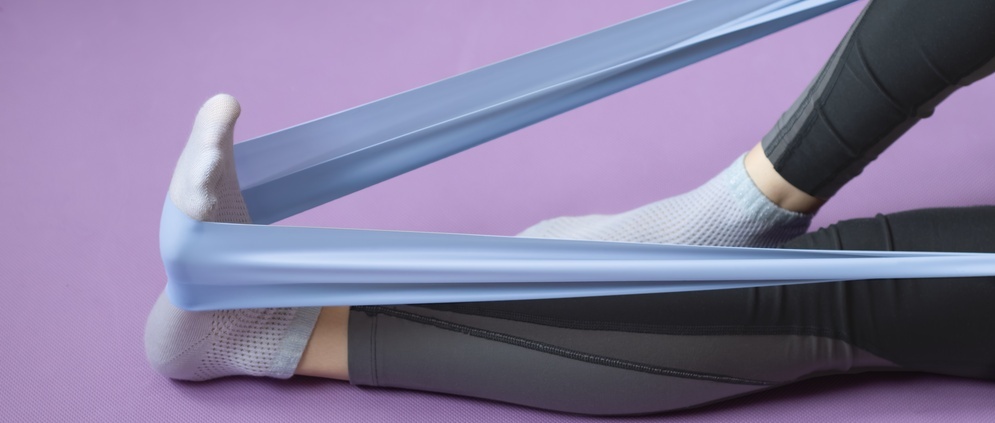
As the name suggests, these flat, stretchy elastic bands wrap around parts of your body - such as both your legs or arms - to add extra resistance while you hold or move these body parts away from each other.
Penny Weston, owner of the wellness centre MADE, explains that resistance bands are great for making your muscles work harder to stabilise and perform each exercise.
"They are also quick and simple to use. Storing them takes up no space which makes them easy to use at home, or on the move as you can just tuck them into your bag," she adds.
Exercises that incorporate resistance bands can be used for:
Strength building - as resistance bands place a force on your muscles when stretched tight.
Improving balance and mobility - they can help people of all ages improve balance and flexibility in their joints.
Improving your form - this comes from getting better at maintaining tension in the resistance band.
Weight lifting - wrapping resistance bands around the ends of a weight bar can increase bar velocity and power.
Injury rehabilitation - resistance bands can aid recovery for injuries that affect areas such as the knees, shoulders, and hips.
Do resistance bands build muscle?
Resistance band exercises are a great way to build muscle and strength. As Weston says, you can target almost every body part.
The effectiveness of building muscle with resistance bands has been demonstrated in many studies,1 including as part of a variable resistance training programme for athletes to increase power and strength.2
Performing a strength workout with resistance bands - with the band exerting extra force on targeted muscles, such as your leg muscles - can significantly improve the quality of each repetition (rep). This makes your workout routine more effective.
Laura Williams, fitness expert, says that speed and tension play a role in the effectiveness of your exercises too. A resistance band provides tension throughout the whole exercise - the slower you complete your rep, the more your muscles have to work.
"Bands come in different levels of resistance, enabling you to add or decrease intensity easily," she explains. "Varying from high intensity to low by using different strengths of band, for different exercises, will help you get the most out of an exercise."
The best muscle-building resistance band workouts
Williams explains that you can make a muscle-building resistance band workout effective by including a good variety of exercises.
"This could include both compound moves - those that target multiple muscle groups - and isolation exercises, which target single muscle groups," she says.
Weston recommends doing each strength workout with resistance bands for 45 seconds and then resting for 15 seconds.
"Try and complete four sets of each exercise too," she adds.
Bicep curls
Weston says: "This resistance band workout is a great way to build strength in those muscles that people often overdo with typical weights."
Sit on a chair or a step, tuck the band underneath your right knee, and hold it with your right hand.
Pull your hand up towards your shoulder against the resistance of the band. Keep your upper arm still as you pull on the band, and keep your elbow underneath your shoulder and close to your body.
Do around 10 repetitions on the right and then switch to the left side.
Russian twist
Weston says: "This is a brilliant exercise to work those obliques more effectively than with a medicine ball."
Sitting down, wrap the band around your feet. The band needs to stay taught the whole time.
Hold each side of the band with each hand and pull it up, lifting your legs off the ground - the higher you lift, the harder the exercise.
Your back must be at a 45-degree angle to the floor and your knees slightly bent.
Move your hands to one side and touch the floor and then twist to the other side.
Lateral raise
Weston says: "The lateral raise can be hard at first but is a good one to work the muscles in your upper back. It can enhance muscle growth but also increase your range of motion."
Stand in the middle of the band with your knees slightly bent, feet staggered with the right foot forward and flat on the floor.
Put your left foot back so that the resistance band sits underneath the arch of the right foot.
Hold the band with both hands and then raise your arms outwards until they are parallel to the floor.
Return slowly to your starting position. You can work this exercise up slowly.
Bicycle crunch
Weston says: "Using a resistance band takes this exercise to the next level and is brilliant for toning your midsection and slimming your waist."
Lie flat on your back with the resistance band wrapped around your feet.
Put your hands on the floor at your side and keep your lower back on the floor.
Pull your left knee in towards your chest at the same time as extending your right leg - while keeping it off the ground - as if you are cycling.
Reverse the position and keep pedalling.
Push-ups
Weston says: "This exercise will help develop your chest, triceps, and shoulder muscles all together. Using a resistance band will make your push-ups harder, and is much safer than trying to add traditional weights."
Start with the resistance band looped around your back and grip it in front with both hands.
Do your usual push-up but focus on driving your hands into the ground and then pressing your body upwards with as much energy as you can.
How often should you work out with resistance bands?
Weston cautions that resistance bands are not a quick fix to build muscle and you do need to do the exercises regularly.
There is no hard and fast rule - the frequency that you perform a muscle-building resistance band workout in your week can depend on your starting fitness level and fitness goals. This said, aim for at least 2-3 days a week in order to see long-term improvements.
Remember, it's perfectly natural to feel a little wobbly when you first start a muscle-building resistance band workout routine. It could take a little bit of time to get used to stretching the resistance band tight and to build up enough muscle to support this without shaking. However, with regular training, over time you will feel your strength grow and your form improve.
Patient picks for Exercise and physical activity
Healthy living
What are the benefits of strength exercises?
When we think of getting fit, most of us picture walking, running, and other cardiovascular-based exercise. Although these are great ways to be active, many of us tend to avoid strength exercises. Here, we explore the many health benefits they can bring.
by Lynn Stephen

Healthy living
What is Tai Chi Walking - and is it worth a try?
The martial art of Tai Chi has been around for centuries. Originally developed as a form of self-defensive combat, it’s still going strong today - though its greatest strength now lies in its ability to support overall health and wellbeing. For something so ancient, it’s impressive that Tai Chi is still finding new relevance in today’s wellness world. One of the latest ways it’s being embraced - particularly across online platforms - is through a more accessible adaptation of the practice known as Tai Chi Walking.
by Victoria Raw
Further reading and references
- Mascarin NC, de Lira CAB, Vancini RL, et al; Strength Training Using Elastic Bands: Improvement of Muscle Power and Throwing Performance in Young Female Handball Players. J Sport Rehabil. 2017 May;26(3):245-252. doi: 10.1123/jsr.2015-0153. Epub 2016 Aug 24.
- Joy JM, Lowery RP, Oliveira de Souza E, et al; Elastic Bands as a Component of Periodized Resistance Training. J Strength Cond Res. 2016 Aug;30(8):2100-6. doi: 10.1519/JSC.0b013e3182986bef.
About the authorView full bio
Updated by

Lynn Stephen
Content developer
MA (Hons)
Lynn joined Patient in 2023 and her role includes checking all the professional leaflets, patient information leaflets and medicine leaflets, to ensure consistency of spelling, grammar, reference material and brand style, working with the medical authors and clinical director to coordinate the authoring and peer reviewing of the leaflets.
Authored by

Amberley Davis
Senior writer
BA (Hons), CPD
Amberley is a senior writer with Patient and has written extensively on a range of health and wellbeing topics.
About the reviewerView full bio

Dr Colin Tidy, MRCGP
General Practitioner, Medical Author
MBBS, MRCGP, MRCP (Paediatrics), DCH
Dr Colin Tidy is an NHS Doctor, based in Oxfordshire.
Article history
Article also available in English, German, Spanish, French, Italian, Portuguese, Hindi, Hebrew, Arabic, and Swedish.
Next review due: 28 Jul 2029
28 Jul 2026 | Latest version
28 Apr 2022 | Originally published
Authored by:
Amberley Davis
Join the conversation
Share your thoughts or experiences with others in our patient communities.

Ask, share, connect.
Browse discussions, ask questions, and share experiences across hundreds of health topics.

Feeling unwell?
Assess your symptoms online for free
Sign up to the Patient newsletter
Your weekly dose of clear, trustworthy health advice - written to help you feel informed, confident and in control.
By subscribing you accept our Privacy Policy. You can unsubscribe at any time. We never sell your data.