Goitre
Thyroid swelling
Peer reviewed by Dr Surangi Mendis, MRCGPLast updated by Dr Rachel Hudson, MRCGPLast updated 31 Oct 2023
Meets Patient’s editorial guidelines
- DownloadDownload
- Share
- Language
- Discussion
- Audio Version
- Add to preferred sources on Google
In this series:Overactive thyroid glandThyroid eye diseaseThyroid function testsThyroid scans and uptake testsAntithyroid medicines
A goitre (pronounced goy-ter, sometimes spelt as 'goiter') is an enlarged thyroid gland. This gives you a lump at the front of your neck. Some people with a goitre have an underactive or overactive thyroid gland. This means that they make too much or too little thyroid hormone. There are various causes of goitre and treatment depends on the cause.
At a glance
A goitre is a swelling in the neck caused by an enlarged thyroid gland.
It can be a general swelling or one or more lumps in the thyroid gland.
Goitres can be caused by various factors, including autoimmune conditions, iodine deficiency, and some medicines.
Symptoms may include neck swelling, difficulty breathing or swallowing, but usually no pain.
Treatment depends on the cause, size, and whether it is causing symptoms.
What is a goitre?
Neck cross-section showing the thyroid gland
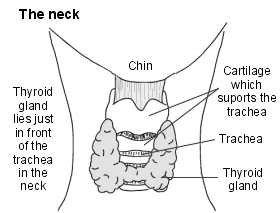
A goitre is an enlarged thyroid gland. A goitre can mean that all the thyroid gland is swollen or enlarged, or one or more swellings or lumps develop in a part or parts of the thyroid gland.
Where is the thyroid gland?
The thyroid gland is in the lower part of the front of the neck. It lies just in front of the windpipe (trachea). It has a right and left lobe which are connected together by a narrow band of thyroid tissue called the isthmus.
It is roughly the shape of a butterfly. You cannot usually see or feel a normal thyroid gland. If the thyroid gland enlarges, it causes a swelling in the neck which you can see - a goitre.
The thyroid gland makes thyroid hormones - called thyroxine (T4) and triiodothyronine (T3). These hormones are carried around the body in the bloodstream. T4 and T3 help to keep the body's functions (the metabolism) working at the correct pace. Many cells and tissues in the body need T4 and T3 to keep them working correctly.
Causes of goitre
There are different types of goitre, each with various causes.
Diffuse smooth goitre
This means that the entire thyroid gland is larger than normal. The thyroid gland feels smooth but is larger than normal.
There are a number of causes. For example:
Graves' disease - an autoimmune disease which causes the thyroid to swell and produce too much of the thyroid hormone thyroxine (T4). In autoimmune disorders your body produces proteins called antibodies which damage a different part of your body - in this case, your thyroid gland.
Inflammation of the thyroid gland (thyroiditis) - which can be due to various causes. For example, another autoimmune condition called Hashimoto's thyroiditis can damage the thyroid gland. Infections with germs such as bacteria and viruses can cause different types of thyroiditis. Radiotherapy treatment to the neck can also lead to inflammation of the thyroid gland.
Iodine deficiency. The thyroid gland needs iodine to make T4 and triiodothyronine (T3). If you lack iodine in your diet, the thyroid swells as it tries to make enough T4 and T3.
Some medicines such as lithium and amiodarone can cause the thyroid gland to swell as a side-effect.
Hereditary factors - some people inherit a tendency for a thyroid gland to swell. In particular, it may swell at times of life when you may make more T4 and T3 - for example, when you are pregnant, or during puberty.
Any other disorder which causes problems in the making of T4 or T3 may cause the thyroid gland to swell.
Nodular goitres
A thyroid nodule is a small lump which develops in the thyroid gland. There are two types:
A multinodular goitre. This means the thyroid gland has developed many lumps or nodules. The thyroid gland feels generally lumpy.
A single nodule. Causes include:
A cyst. This is a non-cancerous sac-like swelling filled with fluid.
An adenoma. This is a solid non-cancerous tumour.
A cancerous tumour (thyroid cancer is rare however).
Other rare causes.
Goitre symptoms
Swelling in the neck. The size of a goitre can range from very small and barely noticeable, to very large.
A lack of pain. However, an inflamed thyroid gland (thyroiditis) can be painful.
Difficulty with breathing or with swallowing. A large goitre may press on the windpipe (trachea) or the gullet (oesophagus).
If your thyroid gland makes too much or too little thyroxine (T4) or triiodothyronine (T3), this can cause a range of symptoms. See the separate leaflets called Overactive Thyroid Gland (Hyperthyroidism), Underactive Thyroid Gland (Hypothyroidism) and Thyroid Eye Disease for more details.
Diagnosing a goitre
Examination by a doctor
This is done to determine if a neck swelling arises from the thyroid, or from another structure in the neck.
Blood tests
When you have a goitre, a doctor will usually do some blood tests to check if you are making too much or too little thyroxine (T4) or triiodothyronine (T3). Blood tests may also help to find out the cause of some goitres. See the separate leaflet called Thyroid function tests.
Ultrasound scan
An ultrasound scan of the thyroid. This is the best test for thyroid swellings. An ultrasound scan is a safe and painless test which uses sound waves to create images of organs and structures inside your body. It can tell if a nodule is a cyst or a solid lump. See the separate leaflet called Thyroid Scans and Uptake Tests.
Biopsy
A small piece of tissue (a biopsy) may be taken from a nodule to look at under the microscope. The biopsy is done by inserting a thin needle into the nodule. It is a simple and safe procedure. The specialist doing the biopsy can see where they are inserting the needle by doing an ultrasound scan at the same time.
Other tests
Occasionally other specialist blood tests are needed to help establish the cause. Occasionally a computerised tomography (CT) scan or a magnetic resonance imaging (MRI) scan is needed.
Goitre treatment
Treatment depends on the cause, the size of the goitre, and whether it is causing symptoms. For example:
If you have a small goitre that is not due to a cancerous nodule, and your thyroid gland is making the correct amounts of thyroid hormones then you may not need any treatment.
You will need treatment if you make too much or too little of your thyroid hormones. For medicines used in the treatment of an overactive thyroid gland, see the separate leaflet called Antithyroid Medications.
An operation to remove some or all of the thyroid gland may be an option in some cases.
Radioactive iodine treatment may be an option for a goitre causing an overactive thyroid gland (hyperthyroidism).
This involves taking a drink, or swallowing a capsule, which contains radioactive iodine.
The radioactive iodine builds up in the thyroid gland.
As the radioactivity is concentrated in the thyroid gland, it destroys some thyroid tissue.
You may need to take thyroxine (T4) tablets after having radioactive iodine, if too much of the thyroid is destroyed.
If you have cancer of the thyroid, you will probably need an operation to remove the cancer and some of the thyroid gland.
Iodine replacement is given if the goitre is due to lack of iodine in the diet.
Patient picks for Thyroid condtions
Hormones
Iodine deficiency
Iodine is essential for the body to make thyroid hormone. Low levels of iodine may cause an underactive thyroid gland and symptoms of hypothyroidism (eg, tiredness, constipation and weight gain). Iodine deficiency in pregnant women may cause problems for the baby, including learning disability. There has been a worldwide campaign to prevent iodine deficiency by using salt containing added iodine. However, iodine deficiency is still a widespread problem in many countries. Mild iodine deficiency may still affect some people in the UK.
by Dr Rosalyn Adleman, MRCGP

Hormones
Thyroid and parathyroid problems
This leaflet gives a brief overview of the thyroid and parathyroid glands and the common medical problems which can occur with these.
by Dr Caroline Wiggins, MRCGP
Frequently asked questions
Does a goitre always mean my thyroid gland is not working properly?
Not necessarily. While a goitre can be linked to issues where the thyroid gland makes too much or too little thyroid hormones, it can also occur when the gland is making the correct amounts of hormones. Your doctor will conduct blood tests to check your hormone levels.
What is the difference between a diffuse smooth goitre and a nodular goitre?
A diffuse smooth goitre means the entire thyroid gland is enlarged and feels smooth. A nodular goitre, on the other hand, involves the development of one or more lumps, called nodules, within the thyroid gland, making it feel generally lumpy.
Can a goitre be painful?
Normally, a goitre does not cause pain. However, if the thyroid gland becomes inflamed (a condition called thyroiditis), it can be painful.
What is a biopsy and why might I need one for a thyroid nodule?
A biopsy involves taking a small piece of tissue from a nodule using a thin needle, which is then examined under a microscope. This procedure helps to determine if the nodule is non-cancerous or cancerous, as cancerous tumours are a rare cause of nodules.
How long does it take for radioactive iodine treatment to work for an overactive thyroid gland?
The radioactive iodine builds up in the thyroid gland and works by destroying some thyroid tissue. The article does not specify an exact timeframe for when you will notice the effects, but it is a process that reduces the gland's activity over time.
Further reading and references
- Thyroid disease: assessment and management; NICE guidance (November 2019 - last updated October 2023)
About the authorView full bio
Updated by

Dr Rachel Hudson, MRCGP
General Practitioner and Medical Author
MBChB, MRCGP (2008), BSc (Medical Science), DFSRH, DRCOG, DCH
Dr Rachel Hudson, is an NHS GP working in the North West of England.
About the reviewerView full bio

Dr Surangi Mendis, MRCGP
Consultant and Medical Author
MBBS, BSc (1st), MRCGP (2014), DFSRH, PGcert otology and audiology
Surangi Mendis is a consultant in Audiovestibular Medicine and Neuro-otology at The Royal National ENT and Eastman Dental Hospitals, UCLH.
Join the conversation
Share your thoughts or experiences with others in our patient communities.

Ask, share, connect.
Browse discussions, ask questions, and share experiences across hundreds of health topics.

Feeling unwell?
Assess your symptoms online for free
Sign up to the Patient newsletter
Your weekly dose of clear, trustworthy health advice - written to help you feel informed, confident and in control.
By subscribing you accept our Privacy Policy. You can unsubscribe at any time. We never sell your data.