Lumbar puncture
Spinal tap
Peer reviewed by Dr Colin Tidy, MRCGPLast updated by Dr Toni Hazell, FRCGPLast updated 10 Feb 2023
Meets Patient’s editorial guidelines
- DownloadDownload
- Share
- Language
- Discussion
- Audio Version
- Add to preferred sources on Google
A lumbar puncture is used to diagnose meningitis and some other brain and spinal cord disorders.
At a glance
A lumbar puncture is a procedure to collect and test cerebrospinal fluid.
This fluid surrounds your brain and spinal cord.
It helps diagnose conditions like meningitis or other brain and spinal cord problems.
You usually lie on your side with knees to your chest while the doctor inserts a needle.
Local anaesthetic numbs the area, but you might feel pressure or a sharp sensation.
Headaches can occur afterwards, and it's best to lie down for a few hours.
Note: the information below is a general guide only. The arrangements, and the way tests are performed, may vary between different hospitals. Always follow the instructions given by your doctor, specialist, or local hospital.
What is a lumbar puncture?
A lumbar puncture (sometimes called a spinal tap) is a procedure where a sample of cerebrospinal fluid (CSF) is taken for testing. CSF is the fluid that surrounds the brain (cerebrum) and spinal cord. This test is most commonly used to diagnose meningitis (an infection of the meninges - the structure that surrounds the brain and spinal cord). It is also used to help diagnose some other conditions of the brain, spinal cord and central nervous system, including a subarachnoid haemorrhage which is a type of bleed inside the brain.
When is a lumbar puncture needed?
If you, or your child, is admitted to hospital with symptoms that could be caused by meningitis then a lumbar puncture may be done urgently, either in the emergency department or very soon after your admission to a ward. Alternatively, you might be admitted for a planned lumbar puncture, as part of the diagnostic process for a long-term (chronic) neurological condition.
How is a lumbar puncture done?
Usually you lie on a couch on your side with your knees pulled up against your chest. Sometimes it is done with you sitting up and leaning forwards on some pillows. The doctor or nurse will clean an area of your lower back with antiseptic.
They will then inject some local anaesthetic into a small area of skin which lies over a space between two lower spinal bones (vertebrae). This stings a little at first but then makes the skin numb.
The doctor then pushes a thin hollow needle through the skin and tissues between two vertebrae into the space around the spinal cord which is filled with CSF. Because the skin is numbed with local anaesthetic, most people do not feel pain. You may feel pressure as the needle is inserted. However, some people do have a sharp feeling in the back or leg when the needle is pushed through.
Procedure method
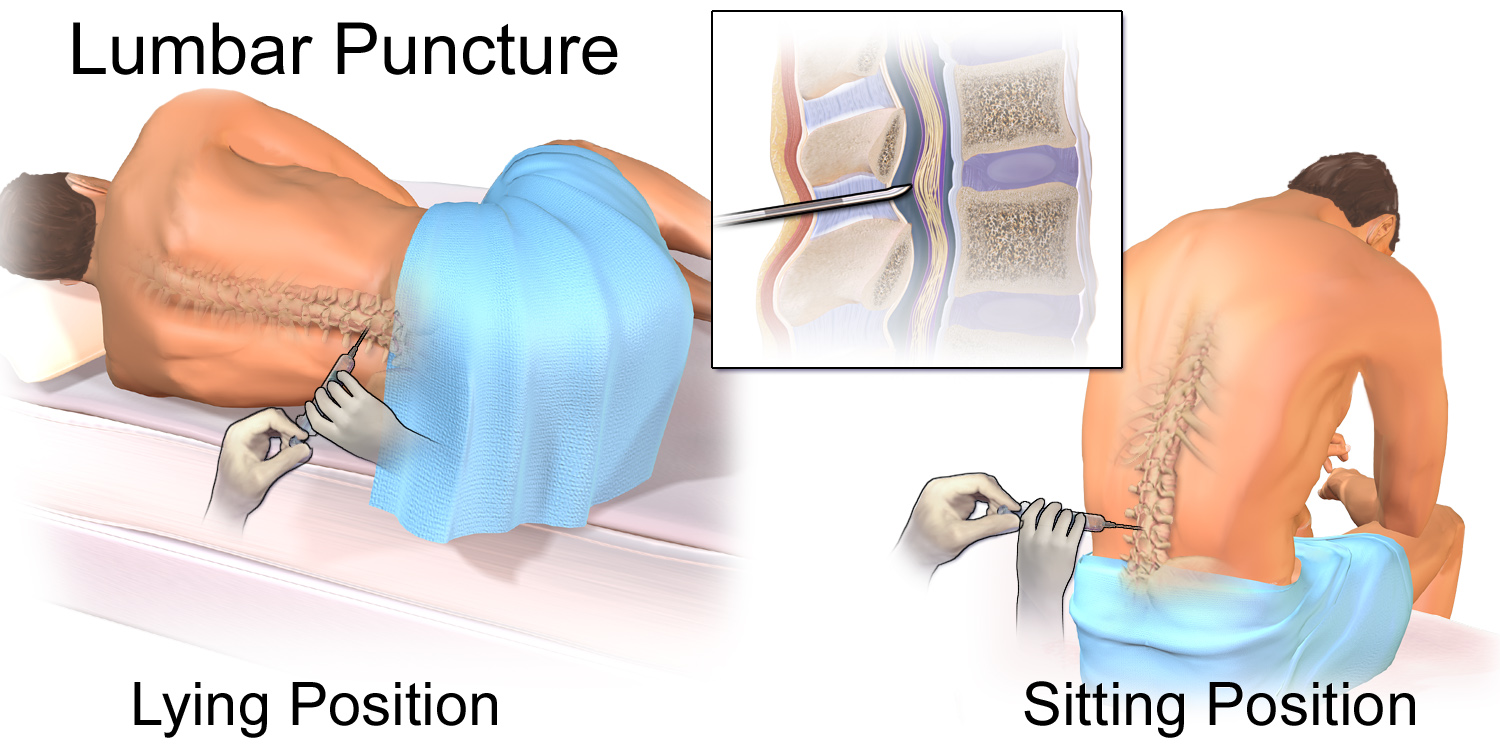
Some fluid leaks back through the needle and is collected in a sterile pot. If you have possible meningitis, this fluid sample is sent to the laboratory to be examined under the microscope to look for germs (bacteria), red blood cells and white blood cells, which are a sign of infection. It is also 'cultured' to see if any bacteria grow and what type they are.
The fluid can also be tested for protein, sugar and other chemicals if necessary. Sometimes the doctor will also measure the fluid pressure. This is done by attaching a special tube to the needle, which can measure the pressure of the fluid coming out.
The needle is usually in for about 1-2 minutes. As soon as the required amount of fluid is collected, the needle is taken out and a sticking plaster put over the site of needle entry.
How long does a lumbar puncture take?
In total the procedure will take about 30-45 minutes; this includes the time to get you ready in the correct position and set up all the equipment.
Are there any side-effects or risks from a lumbar puncture?
Some people develop a post lumbar puncture headache. This usually goes after a few hours. It is best to lie down for a few hours after the test, as this makes a headache less likely to develop. There is also risk of infection or bleeding at the needle puncture site and although rare, some damage to the spinal cord or brain may occur as a result on a lumbar puncture. It is very important that you tell the doctor if you are taking anticoagulants (blood-thinning drugs) so that they can take any necessary precautions to reduce the risk of bleeding.
Recovering from a lumbar puncture
It is sensible to stay lying flat for a period of time after a lumbar puncture - the doctor who does it will tell you how long. They will usually advise you not to operate heavy machinery or drive for at lest 24 hours and not to play sport or do any strenuous activities for at least a week.
Patient picks for General tests and investigations

Tests and investigations
Audiology
If you or a family member suspect that you have a hearing problem, then an audiologist will usually provide an assessment and also may be involved in providing any treatment needed. Certain conditions causing balance difficulties or dizziness can arise due to problems in the ear and audiologists can undertake specialist tests to investigate these problems as well.
by Dr Surangi Mendis, MRCGP

Tests and investigations
Patch testing for contact dermatitis
Patch testing may help to find the cause of allergic contact dermatitis, if you think you've developed a skin condition because of something you're in contact with.
by Dr Hayley Willacy, FRCGP
Frequently asked questions
What is involved in a spinal tap?
A lumbar puncture, also known as a spinal tap, involves taking a sample of cerebrospinal fluid (CSF) the fluid surrounding your brain and spinal cord. This is done by inserting a thin, hollow needle into the space between two lower spinal bones after the skin has been numbed with a local anaesthetic. The collected fluid is then sent for testing to help diagnose various conditions.
How painful is a lumbar puncture?
Most people do not feel pain during a lumbar puncture because a local anaesthetic is used to numb the skin where the needle is inserted. You might feel some pressure when the needle goes in. However, some individuals may experience a sharp feeling in their back or leg as the needle is pushed through.
How to prepare for a lumbar puncture?
The article suggests that you will either lie on your side with your knees pulled up to your chest or sit up and lean forward on pillows. The doctor or nurse will clean your lower back with antiseptic. It is very important to inform your doctor if you are taking any blood-thinning medications (anticoagulants) so they can take precautions to reduce the risk of bleeding.
How long will I be off work after a lumbar puncture?
After a lumbar puncture, it's advisable to avoid operating heavy machinery or driving for at least 24 hours. You should also refrain from playing sports or doing any strenuous activities for at least a week. Your doctor will provide specific guidance on how long you should rest and what activities to avoid based on your individual situation.
Further reading and references
- Bacterial meningitis and meningococcal septicaemia: Management of bacterial meningitis and meningococcal septicaemia in children and young people younger than 16 years in primary and secondary care; NICE Clinical Guideline (last updated February 2015)
- Meningococcal disease: guidance, data and analysis; UK Health Security Agency (last updated April 2022)
- Sepsis - recognition, diagnosis and early management; NICE Guideline (July 2016 - updated January 2024)
- Viallon A, Botelho-Nevers E, Zeni F; Clinical decision rules for acute bacterial meningitis: current insights. Open Access Emerg Med. 2016 Apr 19;8:7-16. doi: 10.2147/OAEM.S69975. eCollection 2016.
- Cognat E, Koehl B, Lilamand M, et al; Preventing Post-Lumbar Puncture Headache. Ann Emerg Med. 2021 Sep;78(3):443-450. doi: 10.1016/j.annemergmed.2021.02.019. Epub 2021 May 7.
About the authorView full bio
Updated by

Dr Toni Hazell, FRCGP
MBBS, BSc, FRCGP, DFSRH, Dip GU med, DRCOG, DCH (London, UK, 2000)
Dr. Toni Hazell qualified from St. Mary’s Hospital Medical School and did her VTS at Northwick Park Hospital.
About the reviewerView full bio

Dr Colin Tidy, MRCGP
General Practitioner, Medical Author
MBBS, MRCGP, MRCP (Paediatrics), DCH
Dr Colin Tidy is an NHS Doctor, based in Oxfordshire.
Join the conversation
Share your thoughts or experiences with others in our patient communities.

Ask, share, connect.
Browse discussions, ask questions, and share experiences across hundreds of health topics.

Feeling unwell?
Assess your symptoms online for free
Sign up to the Patient newsletter
Your weekly dose of clear, trustworthy health advice - written to help you feel informed, confident and in control.
By subscribing you accept our Privacy Policy. You can unsubscribe at any time. We never sell your data.