Fingertip units for topical steroids
Peer reviewed by Dr Colin Tidy, MRCGPLast updated by Dr Doug McKechnie, MRCGPLast updated 19 Jan 2023
Meets Patient’s editorial guidelines
- DownloadDownload
- Share
- Language
- Discussion
- Audio Version
- Add to preferred sources on Google
Topical steroids are used for various skin conditions. The amount of topical steroid that you should apply is commonly measured by fingertip units.
At a glance
Topical steroids are creams, ointments, or lotions containing steroid drugs for skin conditions.
They reduce inflammation in the skin.
A fingertip unit (FTU) is a standard measure for topical steroids.
One FTU is the amount of steroid from a tube along an adult's fingertip.
One FTU covers an area twice the size of an adult's handprint.
The article provides guidance for measuring FTUs for adults and children.

Unsure about mixing medicines?
Check for possible interactions between medicines, supplements and foods before taking them together.
What are topical steroids?
Topical steroids are creams, ointments and lotions which contain steroid drugs. Topical steroids work by reducing inflammation in the skin. They are used for various skin conditions, such as atopic eczema. Unlike many other creams and ointments, it is important to get the dose right when using topical steroids, to avoid giving too much, or too little. This is why a standard measure is often used - the fingertip unit (FTU).
See the separate leaflet called Topical Steroids for Eczema for more information.
Fingertip units
Picture of a fingertip unit of a topical steroid
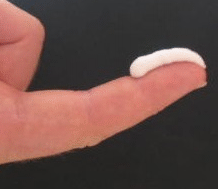
One FTU is the amount of topical steroid that is squeezed out from a standard tube along an adult's fingertip. (This assumes the tube has a standard 5 mm nozzle.) A fingertip is from the very end of the finger to the first crease in the finger. One FTU is enough to treat an area of skin twice the size of the flat of an adult's hand with the fingers together (ie a 'handprint').
Two FTUs are about the same as 1 g of topical steroid. Therefore, for example, say you treat an area of skin the size of eight adult hands. You will need four FTUs for each dose. (This is 2 g per dose. If the dose is once a day, then a 30 g tube should last for about 15 days of treatment.)
The following are further examples:
Area of skin to be treated (adults) | Size is roughly | FTUs each dose (adults) |
A hand and fingers (front and back) | About 2 adult hands | 1 FTU |
Front of chest and abdomen | About 14 adult hands | 7 FTUs |
Back and buttocks | About 14 adult hands | 7 FTUs |
Face and neck | About 5 adult hands | 2.5 FTUs |
An entire arm and hand | About 8 adult hands | 4 FTUs |
An entire leg and foot | About 16 adult hands | 8 FTUs |
Fingertip units and children
An FTU of cream or ointment is measured on an adult index finger before being rubbed on to a child. Again, one FTU is used to treat an area of skin on a child, equivalent to twice the size of the flat of an adult's hand with the fingers together. You can gauge the amount of topical steroid to use by using your (adult) hand to measure the amount of skin affected on the child. From this you can work out the amount of topical steroid to use.
The following gives a rough guide:
For a child aged 3-6 months
Entire face and neck - 1 FTU.
An entire arm and hand - 1 FTU.
An entire leg and foot - 1.5 FTUs.
The entire front of chest and tummy (abdomen) - 1 FTU.
The entire back including buttocks - 1.5 FTUs.
For a child aged 1-2 years
Entire face and neck - 1.5 FTUs.
An entire arm and hand - 1.5 FTUs.
An entire leg and foot - 2 FTUs.
The entire front of chest and abdomen - 2 FTUs.
The entire back including buttocks - 3 FTUs.
For a child aged 3-5 years
Entire face and neck - 1.5 FTUs.
An entire arm and hand - 2 FTUs.
An entire leg and foot - 3 FTUs.
The entire front of chest and abdomen - 3 FTUs.
The entire back including buttocks - 3.5 FTUs.
For a child aged 6-10 years
Entire face and neck - 2 FTUs.
An entire arm and hand - 2.5 FTUs.
An entire leg and foot - 4.5 FTUs.
The entire front of chest and abdomen - 3.5 FTUs.
The entire back including buttocks - 5 FTUs.
Patient picks for Skin medicines

Treatment and medication
Topical steroids for eczema
Topical steroids are medicated steroid creams that are put on the skin. They are used in addition to moisturisers (also called emollients) for treating eczema. Topical steroids reduce skin inflammation. A short course will usually clear a flare-up of eczema. Side-effects are unlikely to occur with short courses.
by Dr Toni Hazell, FRCGP

Treatment and medication
Acne treatments
Acne is common and troublesome. The aim of treatment is to clear spots as much as possible and to prevent scarring. Your doctor may recommend treatment applied to the skin (topical) or tablets, or a combination. Some things that work for others may not work well for you.
by Dr Hayley Willacy, FRCGP
Frequently asked questions
What does a fingertip unit (FTU) actually look like?
A fingertip unit (FTU) is the amount of topical steroid squeezed out from a standard tube (with a 5 mm nozzle) along an adult's fingertip. This is measured from the very end of the finger to the first crease.
How much skin area does one fingertip unit (FTU) cover?
One FTU is enough topical steroid to treat an area of skin that is twice the size of the flat of an adult's hand with their fingers held together, often referred to as a 'handprint'.
How many grams of topical steroid are in one fingertip unit (FTU)?
Approximately two fingertip units (FTUs) are equivalent to 1 gram of topical steroid.
How long will a 30g tube of topical steroid last if I apply it once a day?
If you are applying 2 grams of topical steroid per dose once a day, a 30-gram tube should last for about 15 days of treatment.
When applying topical steroids to a child, whose fingertip should be used to measure the dose?
When applying topical steroids to a child, the dose (FTU) should always be measured on an adult's index finger before being rubbed onto the child's skin. You can then use your own adult hand to estimate the size of the affected area on the child to determine how many FTUs are needed.
Further reading and references
- Long CC, Finlay AY; The finger-tip unit - a new practical measure. Clin Exp Dermatol. 1991 Nov;16(6):444-7.
- Bewley A; Expert consensus: time for a change in the way we advise our patients to use topical corticosteroids. Br J Dermatol. 2008 May;158(5):917-20. Epub 2008 Feb 22.
- British National Formulary (BNF); NICE Evidence Services (UK access only)
- Corticosteroids - topical (skin), nose, and eyes; NICE CKS, June 2022 (UK access only)
- Eczema - atopic; NICE CKS, April 2022 (UK access only)
About the authorView full bio
Updated by

Dr Doug McKechnie, MRCGP
Medical Writer
MA, MBBS, MSc, DRCOG, MRCP(UK), MRCGP(2021), FHEA
Dr Doug McKechnie is an NHS GP working in London. He works full-time clinically and is also the Deputy Lead for the Clinical and Professional Practice module at University College London Medical School.
About the reviewerView full bio

Dr Colin Tidy, MRCGP
General Practitioner, Medical Author
MBBS, MRCGP, MRCP (Paediatrics), DCH
Dr Colin Tidy is an NHS Doctor, based in Oxfordshire.
Join the conversation
Share your thoughts or experiences with others in our patient communities.

Ask, share, connect.
Browse discussions, ask questions, and share experiences across hundreds of health topics.

Feeling unwell?
Assess your symptoms online for free
Sign up to the Patient newsletter
Your weekly dose of clear, trustworthy health advice - written to help you feel informed, confident and in control.
By subscribing you accept our Privacy Policy. You can unsubscribe at any time. We never sell your data.